Lying Bent Knee Tibialis Press
The Lying Bent Knee Tibialis Press is a body-weight isolation drill for the tibialis anterior, the muscle running along the front of your shin that lifts your toes toward your knee. You lie on your back with your knees bent and feet flat on the floor, then repeatedly pull your toes and the balls of your feet up while your heels stay planted. Because the knee is bent and the hip is neutral, there is no balance demand and no load on the lower back, which makes this one of the simplest and most controlled ways to train dorsiflexion.
This movement is especially useful for runners, hikers, and lifters who spend a lot of time in shoes with a slightly elevated heel, a combination that leaves the front of the shin underworked compared with the calf. Strengthening the tibialis anterior can help with shin discomfort that shows up when training volume climbs, and it supports better foot control during squats, lunges, and any activity that requires your ankle to bend cleanly over your foot.
The bent-knee setup matters more than it looks. With the knee flexed and the foot resting on the floor, the gastrocnemius, which crosses the knee joint, is slack and cannot interfere, and the hip stays relaxed so you cannot cheat by swinging the leg. That leaves the tibialis anterior doing nearly all of the work through a short but clean arc. It also means the movement is gentle enough to use as a warm-up, a rehabilitation-style drill, or a high-rep finisher.
Execution is deliberately slow. From your back, press your heels lightly into the floor and slide your toes and midfoot up toward your shins as far as they will comfortably travel, hold the top briefly, then lower your feet back down with control so your soles touch the floor softly. The range is small, often only a few inches of movement at the toes, but you should feel a distinct working sensation along the outside and front of your shin, and possibly a stretch across the calf at the bottom.
A common mistake is rushing the reps or letting the heel pop off the floor, both of which turn a targeted drill into sloppy ankle bouncing. Keep the heel glued down, move at a pace of roughly two seconds up, one-second pause, two seconds down, and let the shin muscles, not momentum, do the work. Because the resistance is only your own foot, higher repetitions in the fifteen to twenty-five range per set usually work better than trying to force a heavy feel.
Use this exercise as a supplement two to three times per week, either as part of a lower-body warm-up, after running, or between sets of calf work. It requires nothing but floor space and a few minutes, and pairing it with standing calf raises covers both sides of the ankle in a balanced way.
Fitwill
Log Workouts, Track Progress & Build Strength.
Achieve more with Fitwill: explore over 9600 exercises with images and videos, access built-in and custom workouts, perfect for both gym and home sessions, and see real results.
Start your journey. Download today!




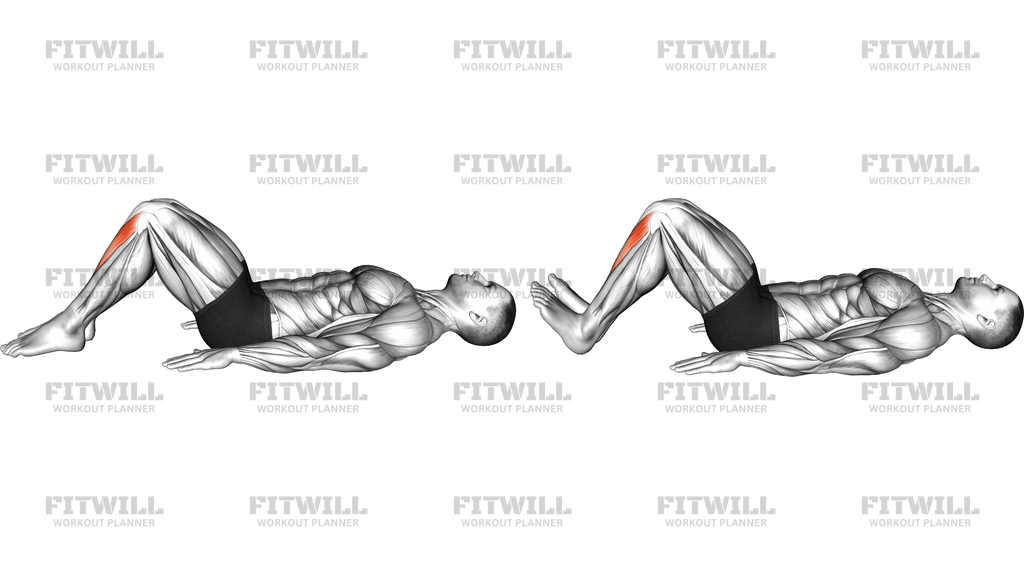
Instructions
- Lie on your back on an exercise mat or the floor with your arms relaxed at your sides and your head resting neutral.
- Bend both knees to roughly 90 degrees and place your feet flat on the floor about hip-width apart, so your heels are directly below or slightly behind your knees.
- Press your lower back gently toward the floor and keep your neck and shoulders relaxed before you start moving.
- Keeping your heels firmly planted, pull your toes and the balls of your feet up toward your shins as high as they will go without lifting your heels.
- Pause for one second at the top, feeling the contraction along the front of your shin.
- Lower your feet back down in a slow, controlled motion until your soles rest flat on the floor again.
- Exhale as you pull your toes up and inhale as you lower them back to the floor.
- Complete your target repetitions with the heels staying in contact with the floor the entire time.
- Reset your foot position between sets if your feet have drifted forward or your knees have fallen inward.
Tips & Tricks
- If you feel the front of your shin cramping, that is the target muscle working at a range it is not used to. Reduce the height of the toe lift or do fewer reps per set and build back up.
- Watch for the heel lifting as you pull your toes up. Plant the heel first, then start the lift; if the heel still rises, you are pulling too hard or too fast.
- Do not let your knees collapse toward each other. Keep them stacked over the ankles so both tibialis muscles share the work evenly.
- The range on this drill is small by nature. Chasing a bigger arc by rolling onto the balls of the feet defeats the purpose; a short, clean pull beats a big, sloppy one.
- Slow the lowering phase down rather than letting your feet slap back to the floor. The eccentric portion is where most of the useful work happens for the shin muscles.
- If both legs together feel awkward or one side dominates, work one leg at a time with the other foot resting flat beside it.
- Avoid pointing your toes at the bottom of each rep. Your foot should return to neutral, sole flat, before the next lift begins.
- Because the resistance is light, this exercise responds better to higher reps and slower tempo than to extra speed. Fifteen to twenty-five controlled reps per set is a practical range.
- If your toes cramp instead of your shin, relax your toes and let the movement come from the ankle rather than curling the foot.
Frequently Asked Questions
What muscles does the Lying Bent Knee Tibialis Press work?
The primary muscle is the tibialis anterior on the front of your shin, which lifts the toes toward the knee. The smaller deep muscles around the ankle assist with controlling the foot during the lift and lower.
Why are the knees bent instead of legs straight in this exercise?
Bending the knees slackens the gastrocnemius, which crosses the knee joint, so the calf cannot pull against the movement. This keeps the work isolated on the front of the shin and removes any hip or balance involvement.
Is the Lying Bent Knee Tibialis Press good for beginners?
Yes. It is done lying down with no load and a short range, so it is easy to learn and easy on the joints. Beginners should focus on slow reps and keeping the heels planted rather than doing more repetitions.
How many repetitions should I do?
Because the resistance is only the weight of your own foot, higher volumes work best. Aim for fifteen to twenty-five controlled reps per set, and add sets rather than speeding the movement up.
Should my heels stay on the floor the whole time?
Yes. The heel is the fixed point of the exercise. If your heel lifts, the shin muscles are no longer doing the work in isolation and the movement turns into an uncontrolled foot motion.
Can I do this exercise every day?
Many people can, since the load is very light and the muscle recovers quickly. If you are using it to support running or jumping volume, two to four sessions per week is a sensible starting point and you can adjust based on how your shins feel.
What is the difference between this and standing toe raises?
Standing toe raises add a balance and stability demand and involve the whole leg, while the Lying Bent Knee Tibialis Press removes balance entirely and isolates the shin muscles. The lying version is better for high-rep focused work; the standing version adds ankle stability under upright conditions.
I feel a cramp on the front of my shin during the set. Is that a problem?
It usually means the tibialis anterior is working at a range and volume it is not accustomed to. Stop the set, gently move the ankle through its range, and resume with fewer reps or a smaller lift. If discomfort persists outside the muscle-working sensation, reduce the frequency and reassess.
Can I make the Lying Bent Knee Tibialis Press harder?
Yes. Slow the tempo, add a longer pause at the top, increase the reps, or work one leg at a time so you cannot share the load. Once those become easy, you can progress to loaded or standing tibialis variations.