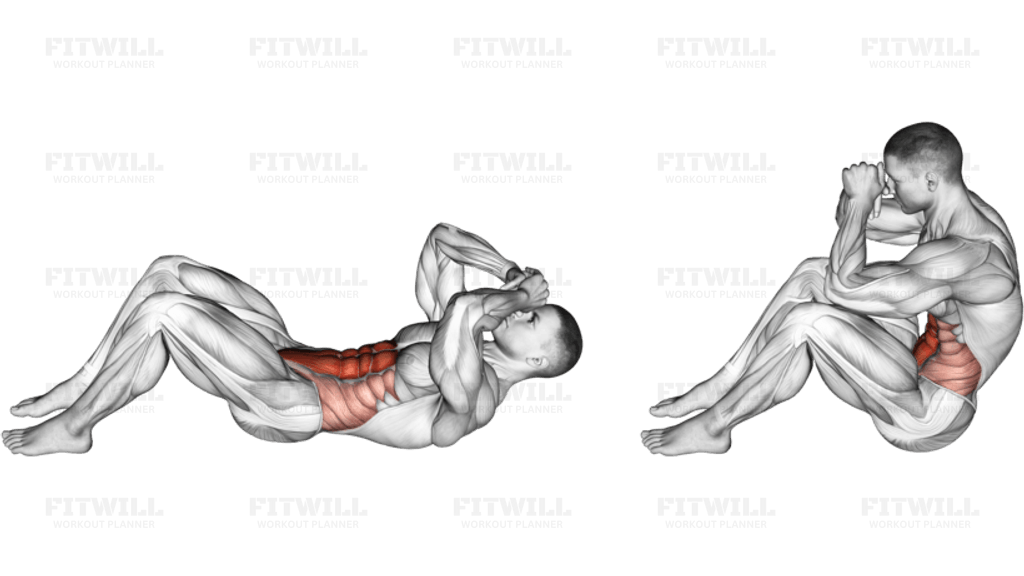
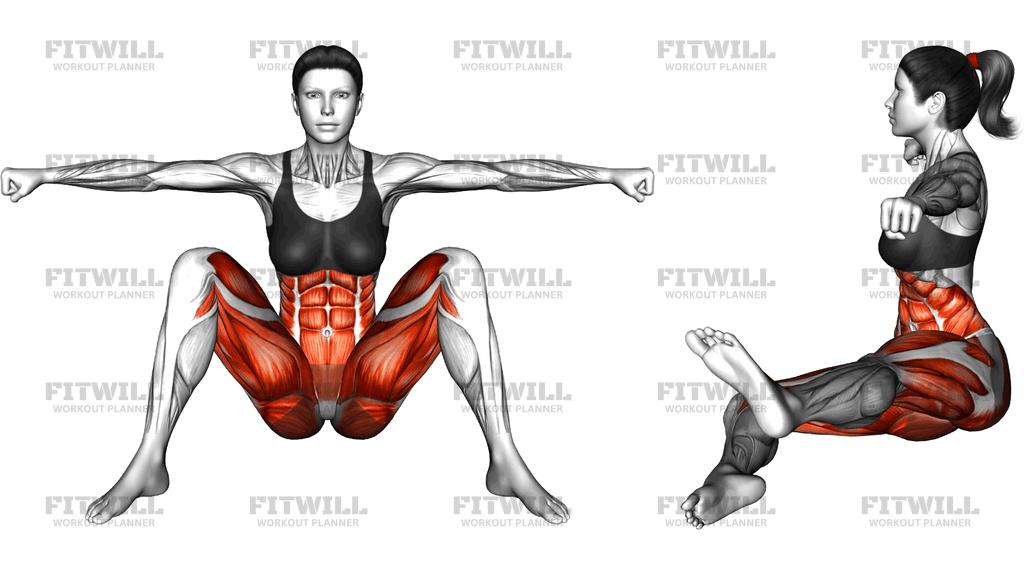
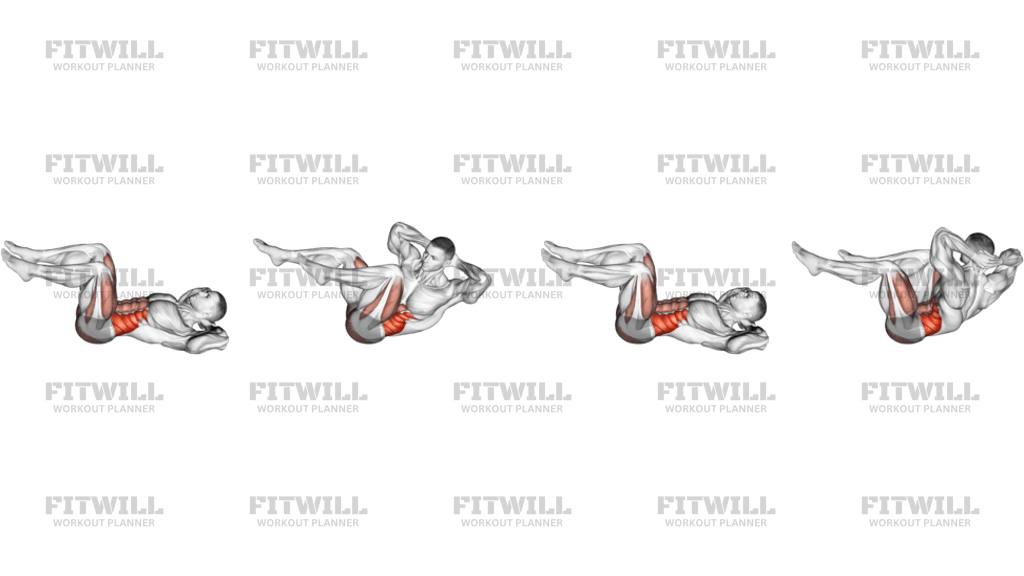
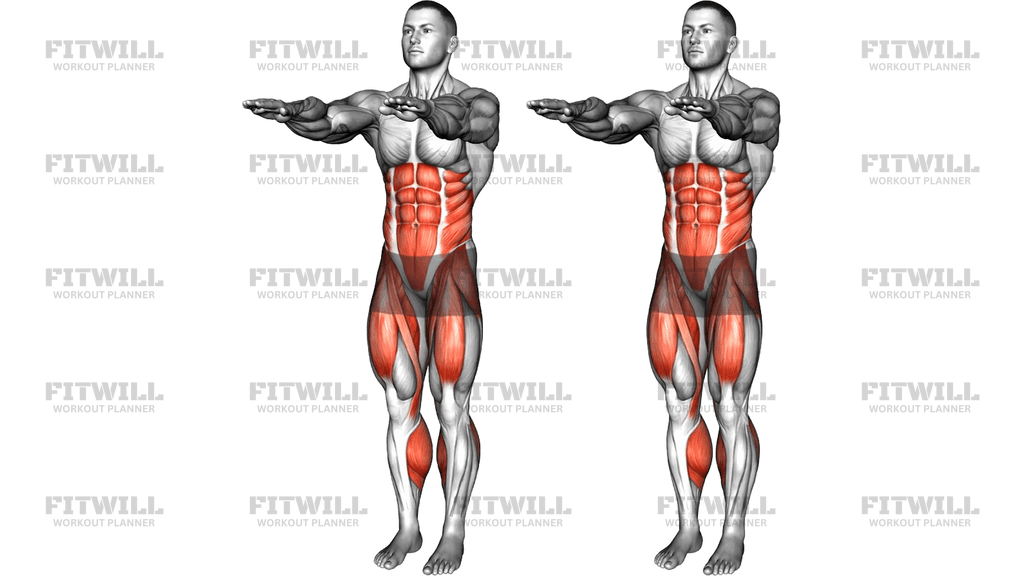
Twisting Crunch Shin Touch
Twisting Crunch Shin Touch is a bodyweight core exercise performed lying on your back with one leg pointed straight at the ceiling and the other leg extended long, hovering just above the floor. From there you crunch up and rotate your torso so your hands reach toward the shin of the raised leg, then repeat on the opposite side. It combines the spinal flexion of a standard crunch with rotation and a straight-leg hold, which is why it lights up the front of the abs and the side of the waist at the same time.
Because the torso twists toward one side while the opposite leg stays off the ground, the obliques work hard to drive and control the rotation, while the deep core and hip flexors hold your pelvis and lower back in position. The straight, suspended leg also challenges the quadriceps to stay locked out and the stabilizers around the hip to keep the leg from drifting. You get two distinct jobs in one rep: one leg anchors the position, and the other side of the trunk does the reaching.
This movement suits anyone who has already built basic crunch strength and wants a more demanding bodyweight option. It is a common choice in calisthenics-style core circuits, home workouts, and athletic conditioning, since rotating up against a raised target teaches the trunk to flex and rotate together, which carries over to throwing, striking, and change-of-direction actions.
Setup matters more than most people expect. Your lower back should stay pressed into the floor or mat at all times, and the hovering leg should sit only as low as you can hold without the lumbar spine lifting or arching. If the leg drops too far, the crunch turns into a lower-back exercise very quickly. Keep the raised leg close to vertical so you are reaching up a shin, not curling into a ball.
Execution is about rhythm and control rather than speed. Exhale as you curl the shoulder blade off the floor and rotate the hands toward the shin of the raised leg, pause briefly at the top, then lower under control before switching sides. The shoulders never fully rest back down between alternations, which keeps tension on the abdominals throughout the set.
A typical approach is 2 to 4 sets of 8 to 12 touches per side, placed near the middle or end of a workout when the core is warm. If holding both legs up proves too hard, bend the hovering knee slightly or keep it higher off the floor; if it becomes easy, slow the tempo and lengthen the pause at the top of each crunch.
[ Workout Log & Planner ]
Put your next workout in Fitwill
Keep your plan and training log ready when you are.


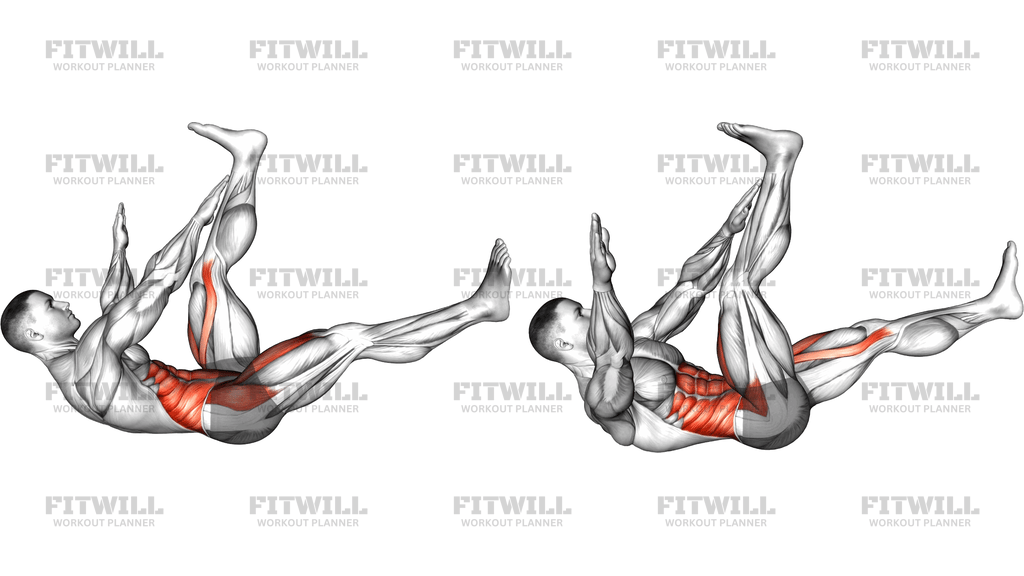
Instructions
- Lie on your back on a mat with your legs together and arms resting by your sides.
- Raise one leg straight up toward the ceiling so it is close to vertical, and extend the other leg long so it hovers a few inches above the floor.
- Extend both arms up toward the raised leg, hands reaching along either side of that shin, and press your lower back firmly into the mat.
- Brace your abdominals and keep the hovering leg still and steady before you start moving.
- Exhale and crunch up, curling your head and shoulder blade off the floor while your hands reach up the shin of the vertical leg.
- Pause for a moment at the top with your eyes on your hands and your ribs pulled toward the raised side of your waist.
- Lower your torso back down slowly without letting your shoulders fully rest on the floor.
- Switch sides: the long leg rises to vertical while the previously raised leg lowers into the hover, and crunch toward the new raised leg.
- Keep breathing steadily — exhale on each crunch up, inhale on the way down — and continue alternating for the target number of touches per side.
- To finish, lower both legs together with control, rest, and reset your back position before starting the next set.
Tips & Tricks
- The most common failure point is the hovering leg sagging and the lower back arching off the mat — keep that leg higher and your lumbar spine glued down rather than chasing a lower hold.
- Reach along the shin rather than past the foot; grabbing toward the toes makes you curl into a ball and removes the rotation the obliques need.
- Do not yank your head forward with your hands. Fingertips should reach toward the shin while the neck stays long, with enough space to hold an apple under your chin.
- If your quads shake or the straight leg drifts sideways, squeeze the thigh fully and point the toes to the ceiling to lock the leg in place.
- Alternate sides in one flowing switch rather than setting both legs down — but if you lose back contact, reset completely instead of fighting through it.
- Slow the lowering phase to about twice the speed of the crunch. Most people only benefit from the lifting part and free-fall back down.
- Keep the crunch small and honest: lifting until the shoulder blade clears the floor is enough. Pulling the whole trunk up usually means the hip flexors take over.
- Avoid holding your breath through the set. The exhale on each crunch naturally helps the abdominals shorten and will keep reps smoother.
Frequently Asked Questions
What muscles does the Twisting Crunch Shin Touch work?
The rectus abdominis drives the crunch, while the obliques handle the rotation toward the raised leg. The hip flexors and quadriceps work isometrically to keep one leg vertical and the other hovering off the floor.
Why does one leg stay straight above me during the Twisting Crunch Shin Touch?
The vertical leg gives your hands a target to reach toward and sets up the twist, while the long hovering leg forces your deep core to hold your pelvis and lower back steady. That double demand is what separates it from a plain crunch.
Is the Twisting Crunch Shin Touch suitable for beginners?
It is best treated as an intermediate step after standard crunches and lying leg raises feel comfortable. Beginners can keep the hovering leg higher off the floor or bend its knee slightly to make the hold easier.
My lower back hurts when the long leg hovers — what should I change?
Stop lowering the leg so far. Keep it higher above the floor, bend the knee a little, or shorten the set so you can keep your lower back pressed into the mat for every rep.
Should I touch the shin or the foot of the raised leg?
Reach along the shin. Chasing the foot pulls you into a tight ball, flattens out the twist, and shifts work away from the obliques.
How many reps of the Twisting Crunch Shin Touch should I do?
Two to four sets of 8 to 12 touches per side works well for most people. When that becomes easy, slow the lowering phase and lengthen the pause at the top instead of adding huge rep numbers.
Can I substitute the Twisting Crunch Shin Touch with another exercise?
A cross-body crunch or bicycle crunch covers similar flexion-plus-rotation work, though with less straight-leg demand. Lying leg raises paired with oblique work can split the two jobs if the combined version is too hard.
Why do my quadriceps burn during this exercise?
The raised leg stays straight and still for the whole set, so the quadriceps contract continuously to hold the knee locked out. That is expected; lower the leg slightly and bend the knee if the burn becomes distracting.
Do I need any equipment for the Twisting Crunch Shin Touch?
No equipment is required beyond floor space, though an exercise mat makes the lying position more comfortable and gives you a clear reference for keeping the lower back in contact.
How do I breathe during the Twisting Crunch Shin Touch?
Exhale as you crunch up and reach toward the shin, and inhale as you lower back to the hover position. Steady breathing keeps the abdominals working efficiently and prevents you from grinding through the set while holding your breath.