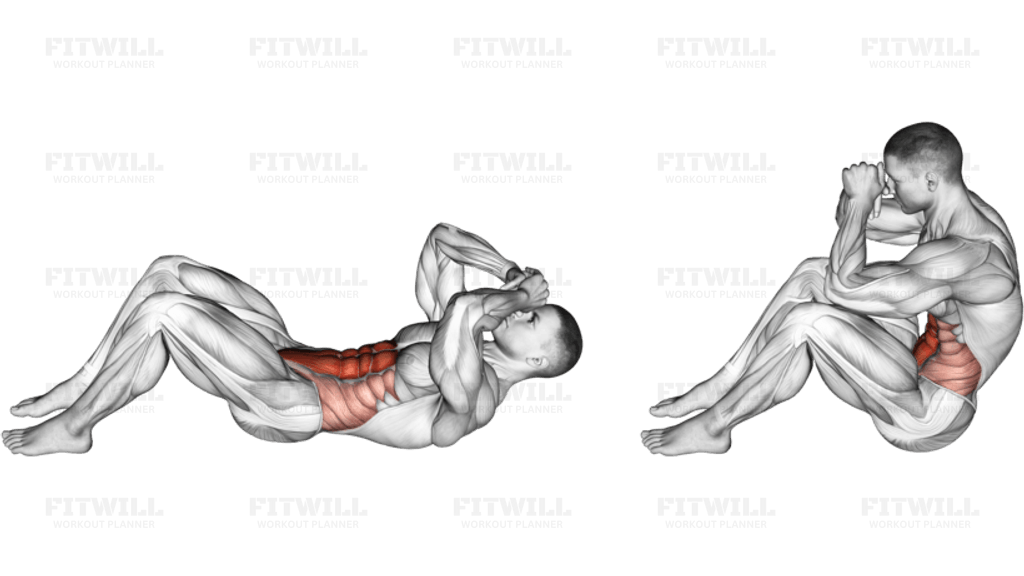
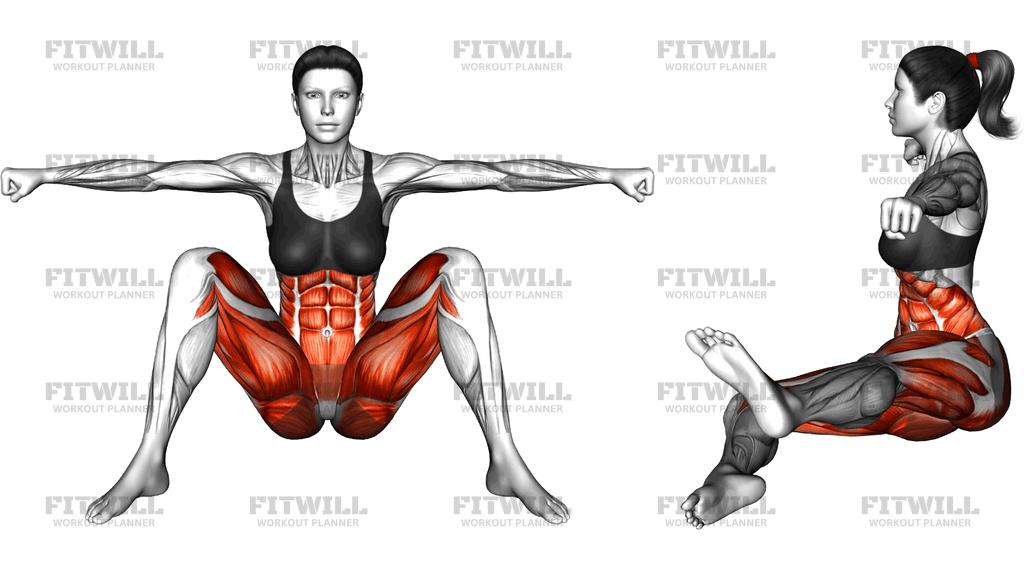
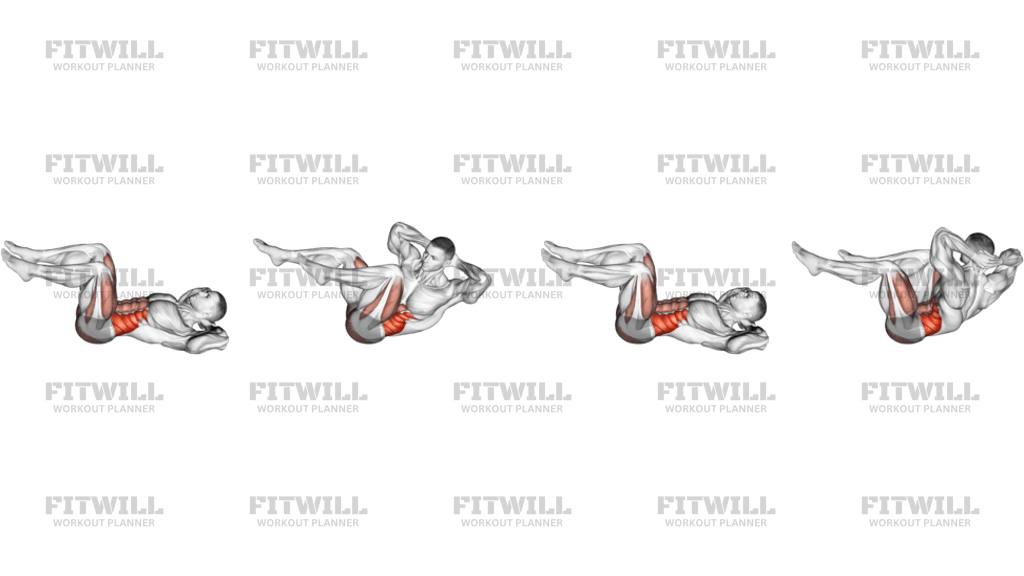
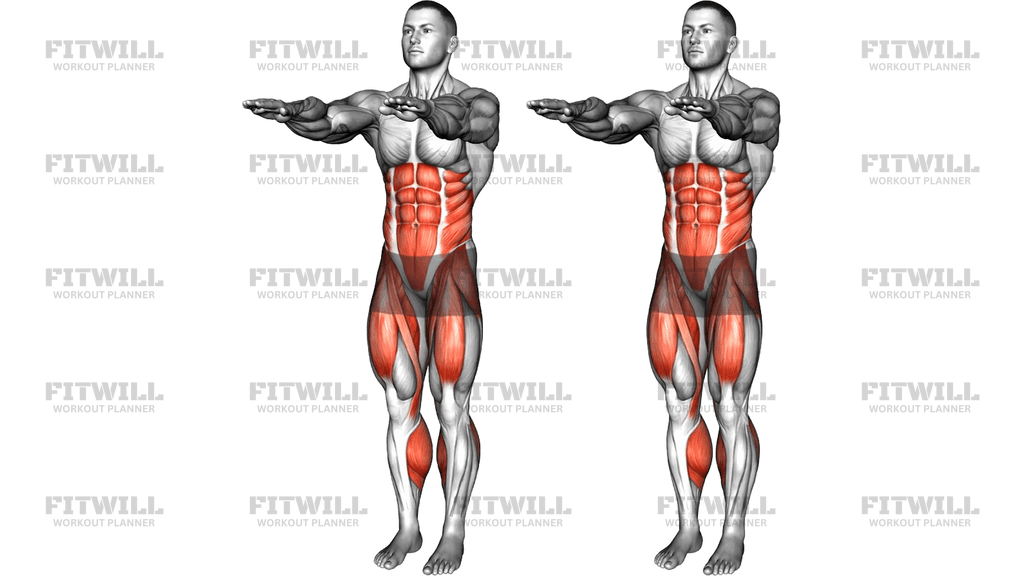
V Sit Alternating Under Knee Clap
The V Sit Alternating Under Knee Clap is an isometric core hold with a dynamic twist: you balance in a V sit on your sit bones with legs lifted and torso leaned back, then tap your hands together under one knee, then the other, without letting your feet or trunk drop. It looks simple from the outside, but holding the V shape while your arms leave the midline challenges your balance and forces your abdominal wall to work continuously to keep your torso upright.
This movement is best suited for people who already own a basic V sit or tucked seated balance. It is a common progression in calisthenics, gymnastics conditioning, martial arts, and general core training because it adds a coordination and timing element to a static hold. If you can hold a solid V sit for twenty to thirty seconds, this variation gives you a way to make that same position harder without adding external weight.
The main muscles working are the abdominals, especially the lower portion of the rectus abdominis, which holds your torso and pelvis in the leaned-back position. The hip flexors work hard to keep your legs off the floor, the quadriceps keep the knees extended, and the obliques and deep core stabilize against the small rotational pull created each time one hand reaches under a knee. The shoulders and arms contribute as they lift and cross toward the legs.
Setup matters more than speed here. Your balance point sits on the back edge of your sit bones, so small changes in torso angle or leg height dramatically change how hard the position is. A torso leaned around forty-five degrees with straight legs forms the classic V; beginners can bend the knees and keep the shins parallel to the floor to shorten the lever and make the hold manageable.
To execute it well, settle into the V first and find stillness before the hands move. Then clap under one knee, bring the hands apart, clap under the other knee, and continue alternating at a rhythm that does not disturb your trunk. Each clap should come from the arms moving, not from the torso rocking or the legs dropping toward the floor. Breathe steadily throughout rather than holding your breath.
Use this exercise as a finisher on core days, as a skill hold in a calisthenics session, or as a warm-up activation before heavy squats or deadlifts. If your lower back rounds onto the floor or your feet sink, regress to a bent-knee version or a tuck hold until you can keep the V position clean for the whole set.
Fitwill
Log Workouts, Track Progress & Build Strength.
Achieve more with Fitwill: explore over 9600 exercises with images and videos, access built-in and custom workouts, perfect for both gym and home sessions, and see real results.
Start your journey. Download today!




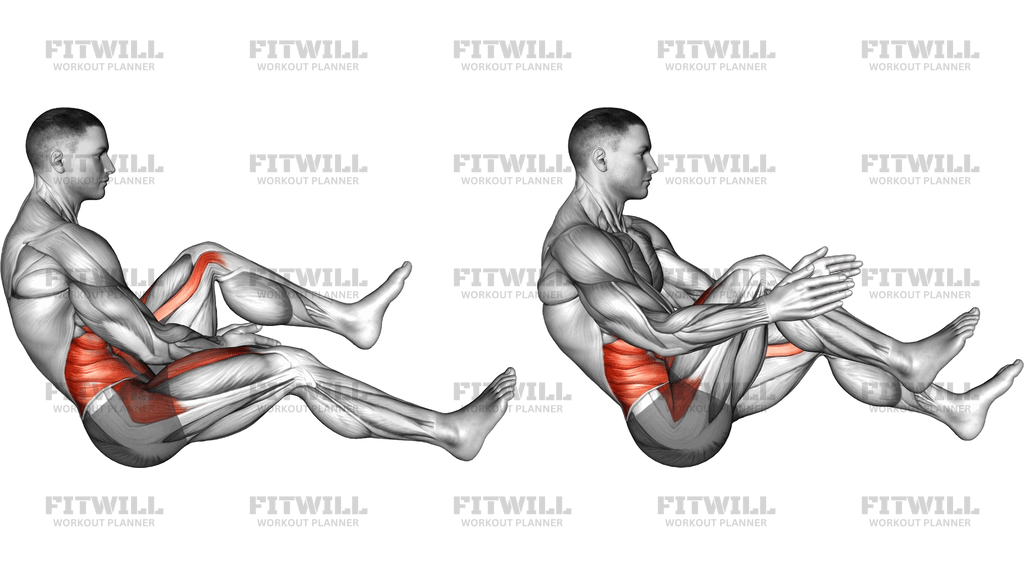
Instructions
- Sit on an exercise mat with your knees bent and feet flat on the floor, and place your hands on the backs of your thighs.
- Lean your torso back to about forty-five degrees and lift your feet off the floor, straightening your legs if you can so your body forms a V, balancing on your sit bones.
- Brace your abdominal wall firmly and lift your chest so your spine stays long rather than rounded forward.
- Extend both arms forward alongside your legs, palms facing each other or the floor.
- Reach your right hand under your right knee and clap your hands together beneath it, keeping your torso angle and leg height unchanged.
- Separate your hands and return both arms to the starting position in front of your legs.
- Repeat the clap under your left knee, alternating sides for the desired number of reps or time.
- Exhale steadily as each hand goes under the knee and inhale as the hands return; do not hold your breath.
- When the set is over, bend your knees and lower your feet to the floor under control rather than collapsing backward.
- Reset your balance on your sit bones between sets before starting the next round.
Tips & Tricks
- If your feet sink toward the floor every time your hands move, bend your knees and hold a tucked V instead; the shorter lever lets you keep the position honest.
- Watch for the torso dropping a few inches each time a hand reaches under the knee. Fix it by thinking about lifting your chest into the clap rather than reaching the shoulder forward.
- Keep your eyes on a fixed point ahead of you. Looking down at your knees makes the balance noticeably harder to hold.
- Do not rush the claps. A slow, even rhythm keeps the abdominals under tension, while fast clapping usually turns the exercise into a rocking motion driven by momentum.
- If your tailbone feels pressure or pain, shift slightly forward so you are balanced on the flesh of your sit bones rather than directly on bone, or use a thin mat.
- Keep the knees fully locked out in the straight-leg version. Soft knees quietly shorten the lever and reduce the demand on the quadriceps and hip flexors.
- If your shoulders fatigue before your abs, keep the claps slightly lower and closer to your thighs so the arms travel a shorter distance.
- Time your sets instead of counting reps. Most people lose the V position at a fairly consistent point, and timed holds make progress easy to track.
- Stop the set when your lower back starts to round toward the floor. That rounding, not fatigue in the arms, is the signal that the hold is finished.
Frequently Asked Questions
What muscles does the V Sit Alternating Under Knee Clap work?
The abdominals, particularly the lower rectus abdominis, do most of the work of holding the V position. The hip flexors keep the legs lifted, the quadriceps hold the knees straight, and the obliques stabilize the trunk each time a hand reaches under a knee.
Can beginners do the V Sit Alternating Under Knee Clap?
Beginners should start with a bent-knee version, holding the shins roughly parallel to the floor, and clap under the knees slowly. Once you can hold that for twenty to thirty seconds without your feet dropping, progress toward straight legs.
Why do my feet drop when I clap under my knee?
This usually happens because the torso rocks forward as the shoulder reaches, which shifts your weight off the balance point. Keep the clap small and driven by the forearm, and imagine your torso nailed at a fixed forty-five degree angle.
How is this different from a regular V sit hold?
A regular V sit keeps the arms locked and static, while the alternating under knee clap forces the arms to leave their support position repeatedly. Each clap momentarily changes your balance and center of gravity, so the trunk has to stabilize far more actively.
How long should I hold the V Sit Alternating Under Knee Clap?
Aim for sets of fifteen to forty seconds, or roughly ten to twenty alternating claps, with one to two minutes of rest. Two to four quality sets where you keep the V position clean beat longer sets where your feet slowly sink.
What can I use instead of this exercise if I cannot balance on my sit bones?
Try a tucked seated knee hold with hands clapping under the knees, or a seated V hold with fingertips resting lightly on the mat beside your hips for balance. Seated leg raises and hollow body holds also build the same lower abdominal and hip flexor strength.
Is it normal for my tailbone to hurt during this movement?
Some pressure on the sit bones is normal since you are balancing directly on them, but sharp bone pain means your weight is too far back. Shift forward slightly so you rest on the tissue over the sit bones, and use a mat for padding.
Should my legs be straight or bent in the V Sit Alternating Under Knee Clap?
Straight legs are the full version and place the greatest demand on the hip flexors and abdominals. Bent knees are a legitimate regression, not a shortcut, and many people get better training from a clean bent-knee hold than a sloppy straight-leg one.
Is the V Sit Alternating Under Knee Clap safe for the lower back?
When you keep the V position with a braced, lengthened spine, the load on the lower back is manageable for most healthy trainees. Stop if your lower back rounds onto the floor or if you feel strain rather than abdominal fatigue, and consider a bent-knee variation.