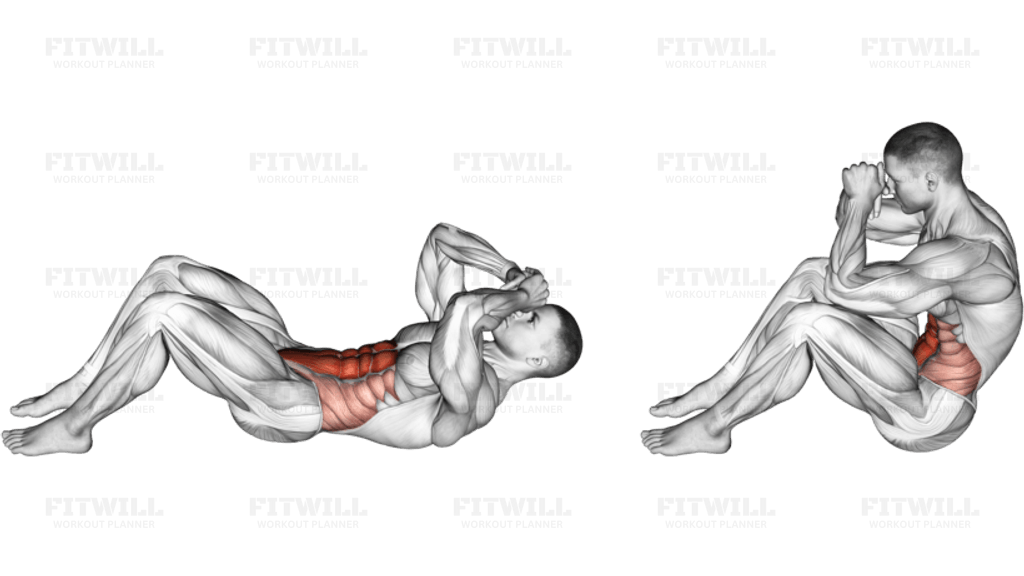
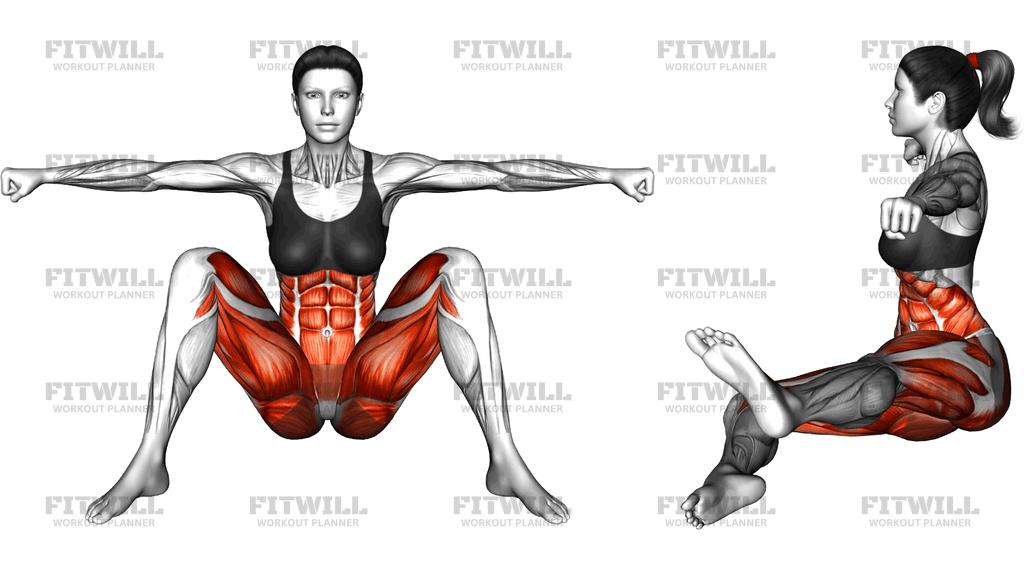
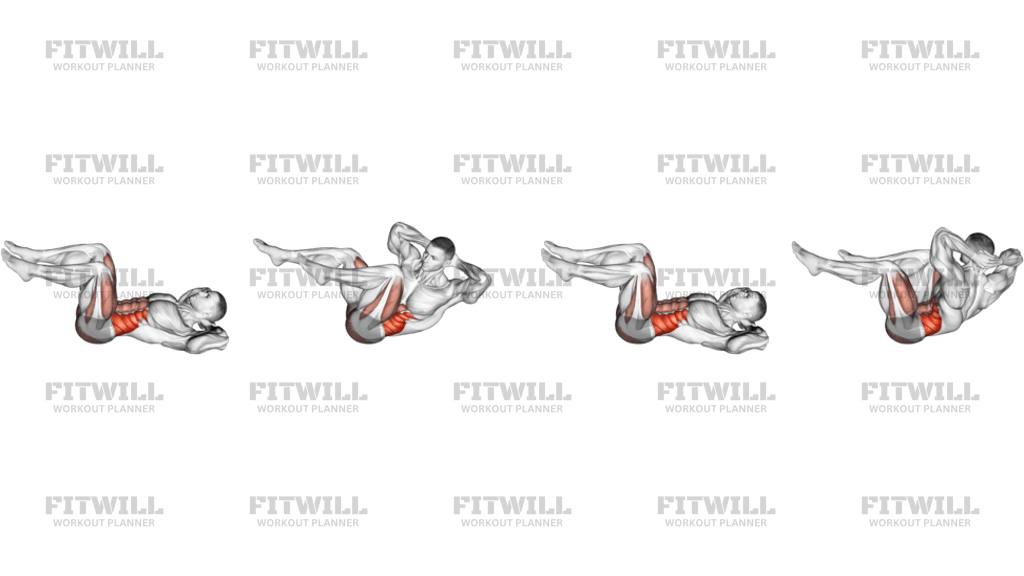
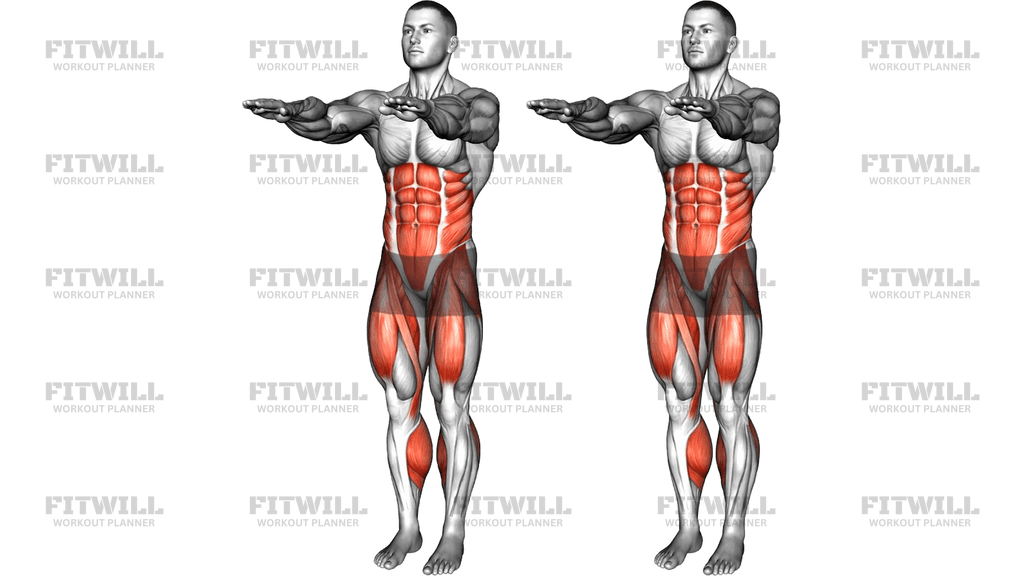
Russian Twist Legs Side Waves
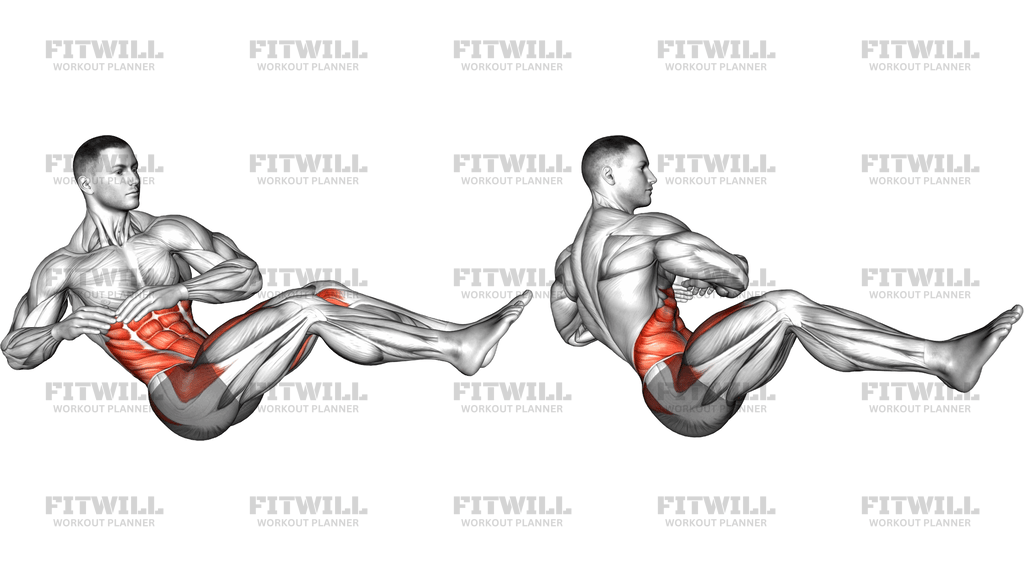
Russian Twist Legs Side Waves is a body-weight core exercise performed from a balanced V-sit position, with the feet lifted off the floor and the torso leaning back while you rotate and sweep your hands and upper body from side to side. Unlike a standard seated Russian twist where the heels stay anchored to the ground, this version keeps the legs hovering, which forces your midsection to stabilize continuously through every rotation. The result is a movement that trains rotational strength and anti-gravity trunk control at the same time.
The highlighted work in this movement comes from the entire abdominal wall, with the obliques driving the side-to-side rotation and the deep core holding the torso at the leaned-back angle. Because your legs are elevated, the hip flexors work hard to keep the thighs up, and the quadriceps assist in holding the bent-knee position. This makes it a demanding compound core drill rather than an isolated oblique exercise.
This variation suits people who already handle a basic feet-down Russian twist comfortably and want to progress the challenge without adding weight. It is commonly used in core finishers, calisthenics routines, and conditioning circuits for sports that demand rotation with a stable trunk, such as tennis, martial arts, baseball, and surfing. Balance is a genuine component here: with only your sit bones contacting the floor, every swing of the arms and legs challenges your ability to stay centered.
Setup matters more than speed. Sit on a mat or firm surface, lean back to roughly a 45-degree angle, lift the feet so the shins stay roughly parallel to the floor, and clasp your hands in front of your chest. If your lower back rounds or your hips wobble, bend the knees more toward the chest or hold the position for shorter sets until your control improves. A braced, long spine protects your lumbar area far better than a slouched one.
Execution should be deliberate. Rotate from the ribcage and shoulders rather than just flapping the arms, letting the clasped hands travel toward the floor beside one hip, then sweep across to the other side in a smooth wave-like rhythm. Keep breathing steadily instead of holding your breath, and stop the set when your legs start drooping or your lower back starts arching, since those are signs the stabilizing muscles have fatigued.
[ Workout Log & Planner ]
Put your next workout in Fitwill
Keep your plan and training log ready when you are.


Instructions
- Sit on an exercise mat with your knees bent and your feet flat on the floor to begin.
- Lean your torso back to about a 45-degree angle, keeping your chest lifted and your spine long rather than rounded.
- Clasp your hands together in front of your chest, then lift both feet off the floor so your shins stay roughly parallel to the ground and your weight rests on your sit bones.
- Brace your abdominal wall firmly, as if preparing for a light push to the stomach, and find your balance point before moving.
- Rotate your torso to one side, sweeping your clasped hands down toward the floor beside that hip while keeping your legs elevated and steady.
- In one controlled wave-like motion, rotate across the center and swing your hands toward the floor beside the opposite hip.
- Continue alternating side to side in a smooth rhythm, letting the rotation come from your ribcage and shoulders, not just your arms.
- Exhale as you sweep to each side and inhale during the transition through the middle.
- Complete your repetitions, then lower your feet to the floor, sit upright, and reset your posture before starting the next set.
Tips & Tricks
- If you keep losing balance backward, widen the angle between your torso and thighs slightly by tucking your knees closer to your chest; this shortens the lever and makes the V-sit easier to hold.
- The most common mistake is letting the legs sink toward the floor as the set continues, which turns the drill back into a feet-down twist; if your legs drop more than a few inches, end the set and rest.
- Avoid rounding your lower back into a C-shape as you lean back; think of keeping a proud chest and a long spine so the load stays on your abs rather than your lumbar discs.
- Do not chase speed. A slow, sweeping side-to-side wave with your ribs actually rotating beats fast arm-flapping that barely moves your trunk.
- Keep your shoulders down and away from your ears; hunching as you fatigue shifts tension into your neck and upper traps.
- If your tailbone feels sore from pressing into the floor, pad the area with a folded towel or perform the set on a thicker mat.
- To progress, pause for one second at each side or extend your legs slightly straighter; to regress, tap one heel to the floor between rotations.
- Your gaze should follow your hands lightly as they travel; staring straight ahead while the torso twists can cause neck stiffness over longer sets.
Frequently Asked Questions
Which muscles does Russian Twist Legs Side Waves work the most?
The abdominal wall, especially the obliques that drive the side-to-side rotation, is the primary target. Because the feet stay elevated, the hip flexors and deep core also work hard to hold the V-sit position.
How is this different from a regular Russian twist?
In a regular Russian twist your heels stay on the floor, so the legs are mostly passive. Here the legs hover off the ground the whole time, adding a balance and hip flexor demand on top of the rotation.
Can beginners do Russian Twist Legs Side Waves?
Beginners should first master the feet-down Russian twist and a basic V-sit hold. Once you can hold the leaned-back position with legs elevated for 15-20 seconds without your lower back arching, this movement is a reasonable next step.
Why do my legs keep dropping during the set?
Fatiguing hip flexors and abdominals are the usual cause. Tuck your knees closer to your chest to shorten the lever, or cut the set short; practicing with drooping legs trains poor positioning rather than strength.
Should I hold a weight or medicine ball during this exercise?
Not at first. The legs-up position already challenges your balance significantly, so master the body-weight version before adding load. When you do progress, a light medicine ball held at the chest works well.
How many repetitions should I aim for?
A common target is 10-20 controlled rotations per side, or 20-40 seconds of continuous wave-like movement. Stop when your legs sink or your lower back starts arching, since those are signs of losing trunk control.
Is it normal for my tailbone to feel uncomfortable?
Some pressure on the sit bones is normal since your full weight rests there, but sharp discomfort is not. Use a thicker mat or a folded towel under your hips and shift slightly onto the back of your sit bones rather than the tailbone itself.
What can I substitute if the balance is too difficult?
Drop your heels to the floor and perform a standard Russian twist with the same hand path, or hold the V-sit without rotating. Both build the components you need before combining them.
Should I feel this in my lower back?
You may feel mild effort in the trunk stabilizers, but no sharp or straining sensation in the lower back. If that occurs, sit up taller, reduce the lean-back angle, and brace more firmly before continuing.