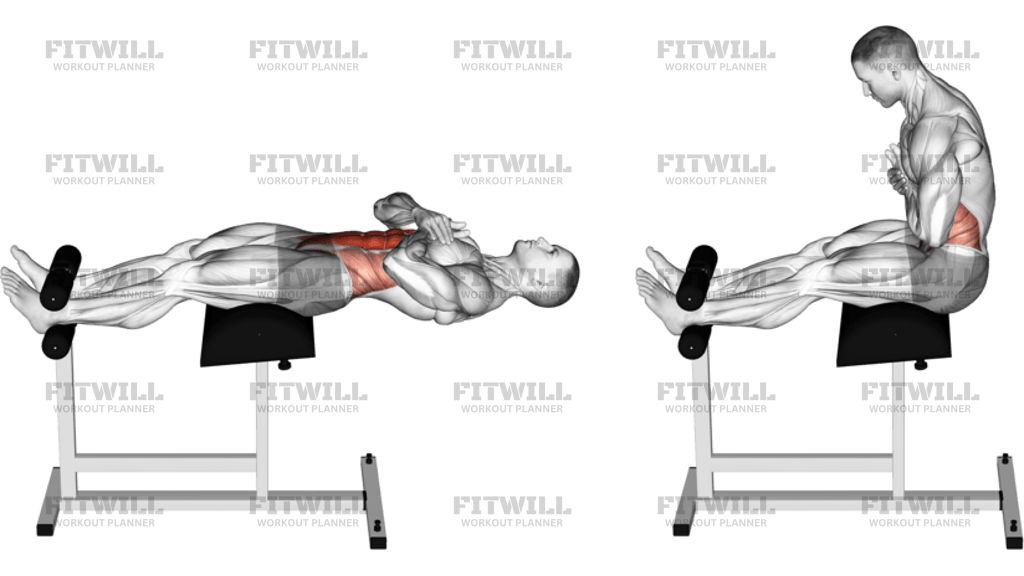
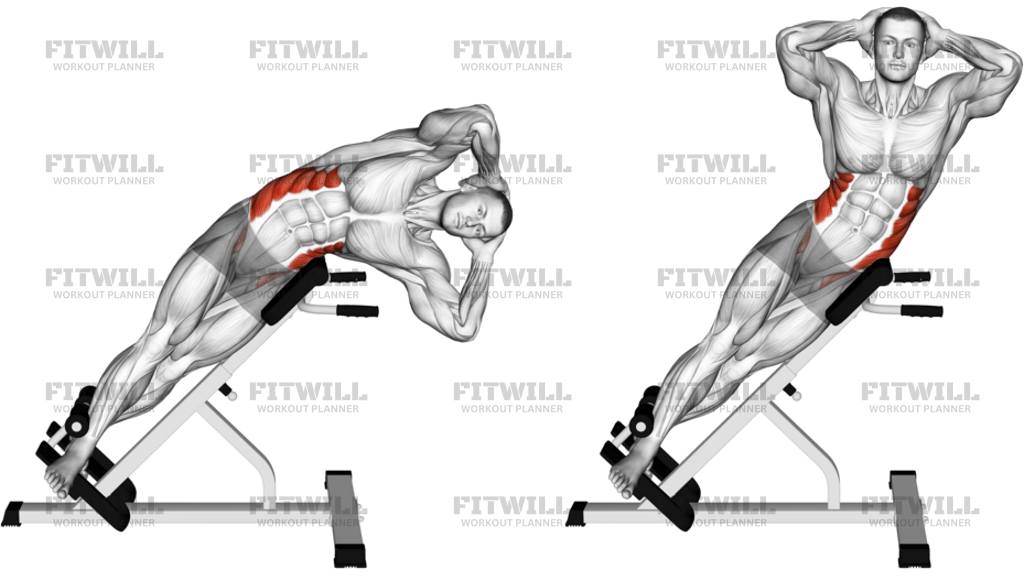
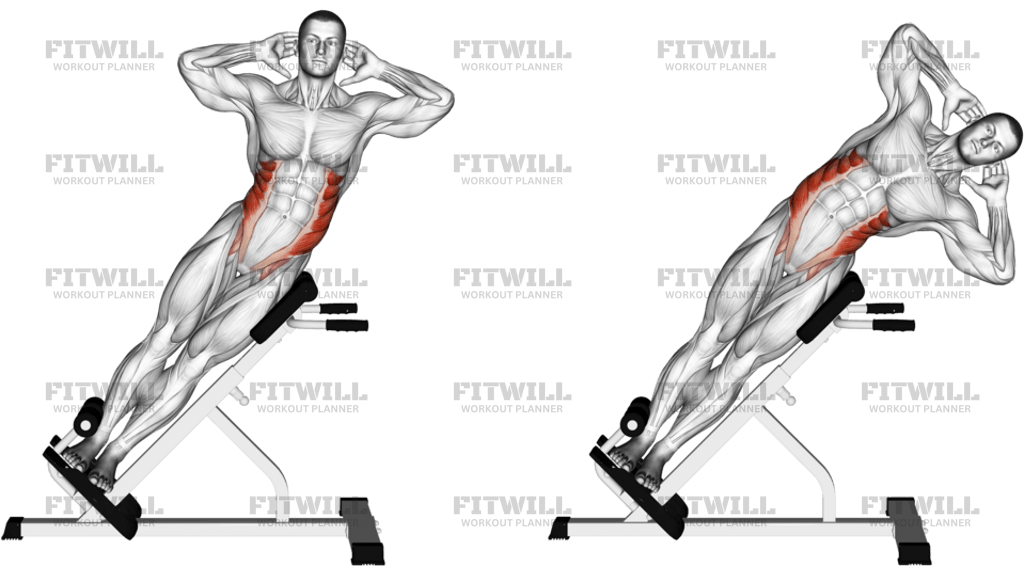
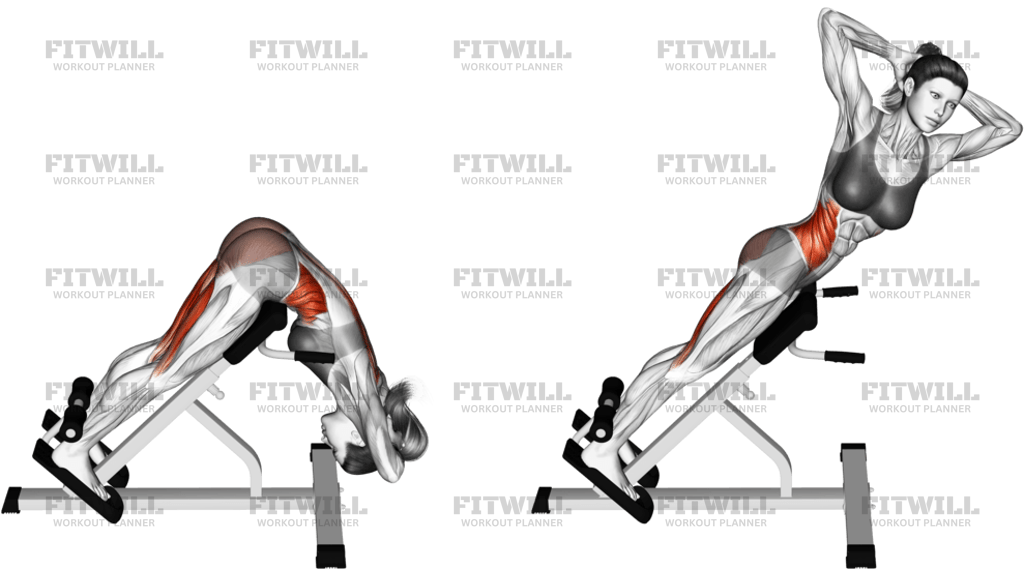
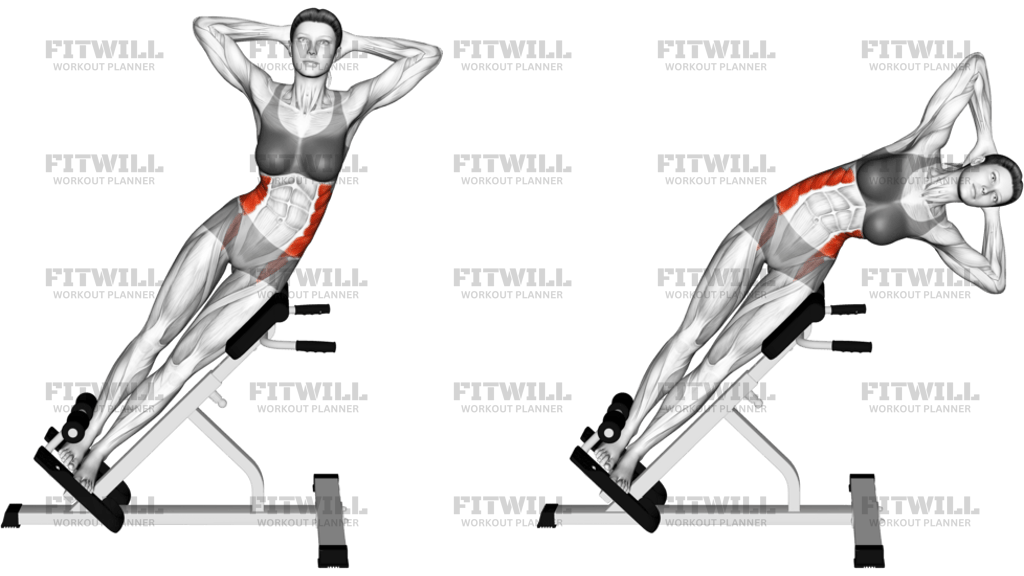
Glute Ham Developer Full Sit Up
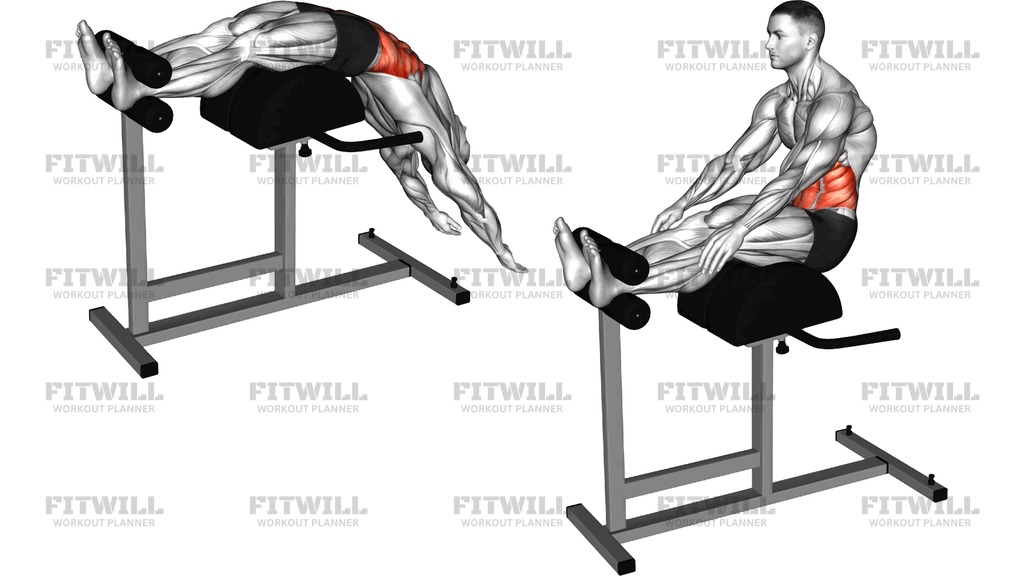
The Glute Ham Developer Full Sit Up is performed on a GHD bench, where your feet are anchored under the foot roller pads and your body works from a fully horizontal position rather than a fixed incline. Because the bench pad supports only your thighs and hips, your torso hangs over the edge, allowing you to extend backward until your whole upper body is below parallel and then curl all the way up to a seated position. That extended range is what separates this from a floor sit-up or an ab bench crunch.
The movement is a serious trunk-flexion exercise. The rectus abdominis does most of the visible work as you curl from a stretched, arched position into full spinal flexion, while the hip flexors assist in bringing the torso upright over the thighs. At the bottom, when your torso hangs below the pad and your spine is extended, your abdominals are loaded in a deep stretch, which is a position most ab exercises never touch.
Setup is everything on this lift. If your hips sit too far forward off the pad, you lose the stable pivot point and your lower back takes the strain; if your feet are not firmly hooked under the roller, you cannot pull yourself up from the horizontal position. Take a minute to adjust the machine before your first rep and the whole exercise feels controlled instead of like a fight against the bench.
This exercise suits intermediate to advanced lifters who already own solid floor sit-ups and some back-extension experience. CrossFit athletes use it regularly for conditioning, and strength athletes appreciate it because the stretched-position loading builds resilience through the trunk. Beginners can still benefit, but they should limit range first rather than dropping straight into the full below-parallel version.
To execute it well, think of the descent and the ascent as two distinct actions. Lower back with a long, flat torso like a back extension, then on the way up start with a curl of the ribcage toward the pelvis before the hip flexors swing you upright. Avoid yanking with the arms or whipping the head forward, and exhale hard through the sticking point of the climb. Treat it like a heavy lift: fewer quality reps beat endless sloppy ones.
[ Workout Log & Planner ]
Put your next workout in Fitwill
Keep your plan and training log ready when you are.


Instructions
- Adjust the GHD so the top of the pad sits just behind your hip crease when you lie face up, leaving your torso free to hang off the end of the bench.
- Hook your feet under the foot roller pads with the pads resting on your ankles or lower calves, then extend your legs so your whole body lies flat and horizontal, torso pointing toward the floor.
- Place your hands on your thighs or cross your arms over your chest, and take a breath into your belly before you begin the descent.
- Lower your torso back by extending at the hips and spine together, keeping your arms either on your legs or reaching toward the floor, until your upper body is below parallel and you feel a stretch through your abdominals.
- Pause briefly in the stretched bottom position without bouncing or letting your head snap back.
- Start the ascent by curling your ribcage toward your pelvis, rounding up through the spine segment by segment rather than lifting as one stiff plank.
- Continue curling and pulling with the hip flexors until your torso is fully upright and close to or over your thighs at the top.
- Exhale forcefully as you curl up, then inhale again as you lower back down under control.
- Reset your grip on your thighs, re-brace, and repeat, keeping each rep smooth rather than rushing the drop to the bottom.
Tips & Tricks
- Do not let your lower back cave into the bottom position; if you feel it in your lumbar spine instead of your abs, shorten the range so your torso stops just below parallel.
- A common mistake is sitting up like one rigid board from the horizontal position. Break the rep into a curl first, then a hip drive, and the top half becomes much easier.
- Keep your knees soft and slightly bent. Locking them out hard shifts tension to the hamstrings and makes the foot roller feel unstable.
- If your feet pop off the pads mid-set, your ankle hooks are too shallow. Push your heels down and back into the rollers before each rep.
- Do not throw your arms forward to generate momentum; hands sliding up the thighs is fine, but a hard arm swing robs the abs of the work.
- Stop the set the moment your speed drops noticeably. Fatigued GHD sit-ups tend to turn into jerky, spine-cranky reps very quickly.
- If you are new to the bench, limit your first sessions to a partial range above parallel so you can learn the curl before earning the full hang.
- Keep your chin tucked and your neck neutral as you descend; leading with the head on the way down is a common way people strain the front of the neck.
Frequently Asked Questions
Which muscles does the Glute Ham Developer Full Sit Up work?
The rectus abdominis is the prime mover, with the hip flexors such as the iliopsoas and rectus femoris assisting on the way up. The obliques and deep core stabilizers work to keep the torso aligned, especially in the stretched bottom position.
Is the Glute Ham Developer Full Sit Up safe for beginners?
It can be, but beginners should start with a reduced range, lowering only to parallel rather than hanging fully below it. Mastering controlled floor sit-ups and back extensions first makes the transition much smoother.
How far should my hips hang off the GHD pad?
The pad should support your thighs with the pad edge sitting just behind your hip crease, so your pelvis can tip freely. If your hips are fully supported you cannot extend back, and if they are too far forward you lose your pivot and strain the lower back.
Why do I feel the Glute Ham Developer Full Sit Up in my lower back instead of my abs?
That usually means you are extending too far at the bottom or hinging up as one rigid block instead of curling. Shorten the range, keep the chin tucked, and focus on rounding the ribcage toward the pelvis to start each rep.
What can I use instead of a Glute Ham Developer Full Sit Up if my gym has no GHD bench?
A decline bench set low, or a Roman chair with the pad positioned the same way, lets you replicate the extended range. Ab wheel rollouts and stability ball pike-ups also train the abs from a stretched position with similar demands.
How many reps of the Glute Ham Developer Full Sit Up should I do?
Because the abs are loaded in a deep stretch, treat it like a strength exercise: 3 to 4 sets of 8 to 15 controlled reps is plenty for most people. Higher volumes are common in conditioning work but should be earned gradually.
How is the Glute Ham Developer Full Sit Up different from a regular floor sit-up?
On the floor, your range stops when your shoulders touch the ground, but on the GHD your torso can hang below parallel, loading the abdominals through a much longer stretch. The foot anchoring also lets the hip flexors contribute far more on the way up.
Should my legs be straight or bent on the Glute Ham Developer Full Sit Up?
Keep your legs extended with only a slight knee bend, as shown in the standard setup. Fully straight, locked knees make the feet harder to keep hooked and pull tension away from the trunk.
Can I add weight to the Glute Ham Developer Full Sit Up?
Yes, holding a small plate against the chest or a light dumbbell overhead increases the demand, but only once bodyweight reps are smooth and pain-free. The stretched bottom position gets dramatically harder with load, so progress in small jumps.
How often should I include the Glute Ham Developer Full Sit Up in my training?
One to two sessions per week is enough for most lifters, since the deep-stretch loading creates significant muscle soreness at first. Space sessions at least a couple of days apart so your trunk can recover between them.