Shoulder Flexion
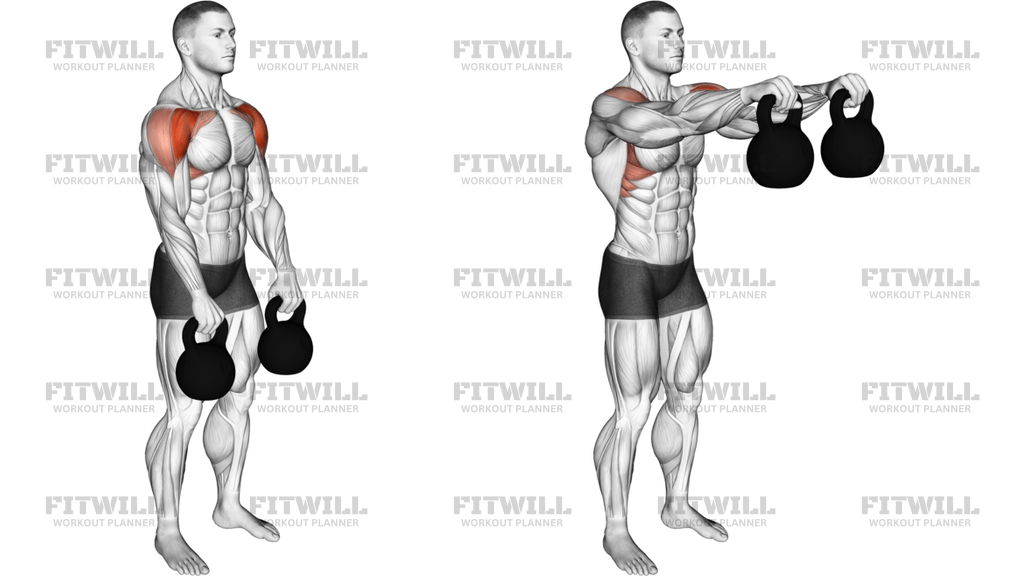
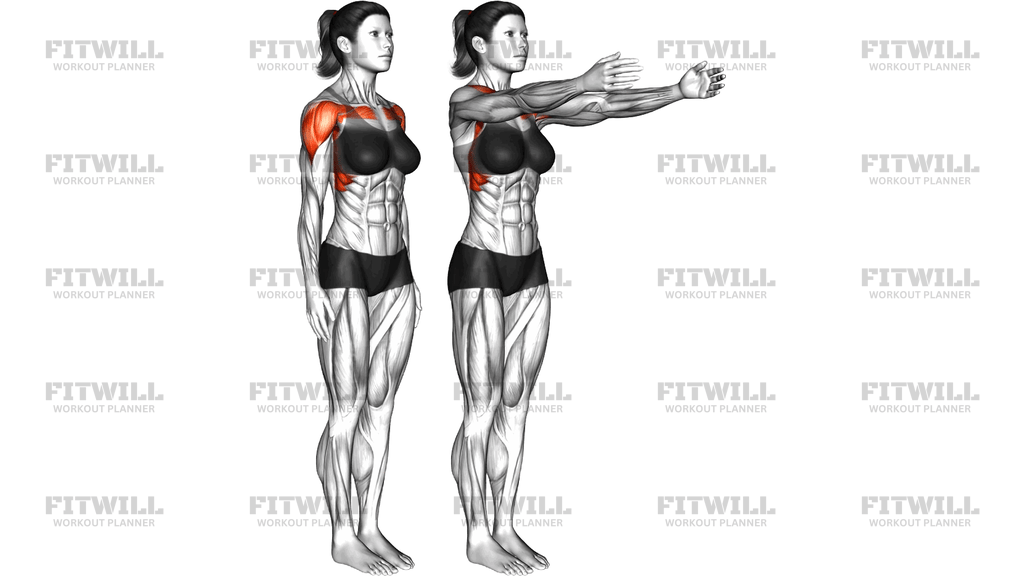
Shoulder Flexion is a simple standing bodyweight movement where you raise your straight arms forward and up to roughly shoulder height, then lower them back down with control. The highlighted area in the demonstration shows exactly where the work happens: the front of the deltoid at the cap of the shoulder, with support from the upper chest fibers where the collarbone meets the pec. Because there is no external load, the exercise isolates the movement pattern itself, which makes it a clean way to train or assess shoulder function.
This movement is useful for a wide range of people. Beginners use it to learn what proper overhead-shoulder mechanics feel like before adding dumbbells or bands. Rehab and warm-up settings rely on it because the arm's own weight provides just enough resistance to wake up the anterior deltoid without stressing the joint. Older adults and desk workers benefit too, since lifting the arms forward against gravity directly counteracts the shoulders-forward posture that comes from sitting and typing.
Setup matters more than it looks. Stand tall with feet about hip-width apart, arms relaxed at your sides, and ribs stacked over your pelvis. If your lower back arches or your shoulders shrug toward your ears as the arms rise, you are borrowing from your spine and upper traps instead of letting the deltoids do the job. Keeping the core lightly braced and the neck long creates the stable base the shoulder needs to move through its full range.
To execute well, raise your arms straight ahead with palms facing each other or down, leading with the hands and keeping the elbows nearly locked but not rigid. Stop when your arms reach shoulder height or slightly above, hold for a beat, then lower slowly rather than letting gravity drop them. The lowering phase is where control is built, so give it the same attention as the lift.
Common use cases include shoulder warm-ups before pressing or overhead work, physical therapy progressions, posture routines, and high-rep endurance circuits where adding weight would be unnecessary. Because the range closely mirrors everyday reaching, strength gained here transfers directly to lifting objects onto shelves, carrying, and pushing.
For safety, keep the movement pain-free and within a comfortable range. If you feel pinching at the top of the shoulder, lower the arm slightly less high or turn your palms to face each other, which gives the rotator cuff more room. Stop and reassess if any sharp or catching sensation appears.
[ Workout Log & Planner ]
Put your next workout in Fitwill
Keep your plan and training log ready when you are.


Instructions
- Stand upright with your feet hip-width apart, weight balanced evenly across both feet, and arms hanging relaxed at your sides.
- Stack your ribs over your pelvis, brace your core lightly, and draw your shoulder blades down your back so they are not already shrugged.
- Choose your hand position: palms facing each other in a neutral grip, or palms facing down toward the floor.
- Inhale, then raise both straight arms forward in front of your body, leading with your hands and keeping the elbows soft but extended.
- Continue the arc until your arms reach shoulder height or slightly above, in line with your ears if your mobility allows.
- Pause at the top for one to two seconds without shrugging your shoulders toward your ears or arching your lower back.
- Exhale as you lower your arms back down along the same forward path, taking two to three seconds rather than letting them fall.
- Reset your posture at the bottom, relax your shoulders briefly, and repeat for the desired number of repetitions.
Tips & Tricks
- If your shoulders creep up toward your ears as the arms rise, you are taking over with the upper traps. Deliberately press the shoulder blades down and think of lifting with the front of the shoulder instead.
- An arched lower back usually means the arms are going higher than your shoulder mobility currently allows. Stop a few degrees short of full height and let your range improve gradually.
- Keep the palms neutral (facing each other) if you feel any pinch at the front of the shoulder; the rotated position gives the rotator cuff more clearance under the collarbone.
- Slow down the lowering phase. Most people control the lift and then drop the arms, which wastes half the repetition.
- Do not lock the elbows hard at the top. Straight arms are correct, but slamming the joint into full extension under tension is unnecessary.
- Move both arms symmetrically. It is common for one side to drift slightly higher or faster; check yourself in a mirror to keep the path even.
- Treat this as a warm-up or endurance drill first: higher reps at a controlled tempo build the shoulder's stamina before you progress to front raises with a weight.
- If standing versions bother your back, try the same movement seated with your back supported to remove any temptation to lean.
Frequently Asked Questions
Which muscles does Shoulder Flexion work?
The anterior deltoid at the front of the shoulder is the primary mover, assisted by the clavicular head of the upper chest and, to a lesser degree, the side deltoids and upper traps as the arms reach shoulder height.
Is Shoulder Flexion good for beginners?
Yes, it is one of the best starting points for shoulder training because your arm weight is the only resistance, letting you learn the correct movement path before adding load.
How high should I raise my arms during Shoulder Flexion?
Aim for shoulder height to slightly above, roughly in line with your ears. If you arch your back or shrug to get higher, reduce the range until your mobility improves.
Should my palms face down or face each other?
Either works, but palms facing each other is usually more comfortable because it gives the rotator cuff more space at the top of the movement.
Can I add weight to Shoulder Flexion?
Yes, once you can control 15 to 20 clean reps, the natural progression is a front raise using light dumbbells, a band, or a cable handle while keeping the exact same path.
Why do my upper traps feel this exercise instead of my shoulders?
Your shoulders are shrugging as the arms lift. Keep the shoulder blades pulled down and focus on leading the lift from the front of the deltoid rather than hiking the arms with the traps.
How many repetitions should I do?
For warm-up or endurance purposes, 10 to 20 controlled reps work well. Since resistance is low, higher reps with a slow lowering phase are more productive than low-rep sets.
Is Shoulder Flexion safe if my shoulder pinches at the top?
Mild pinching is a signal to adjust, not push through. Lower the arms to a pain-free height, switch to a neutral palm position, and if the sensation persists, have it assessed before continuing.