Lying Prone W To Y
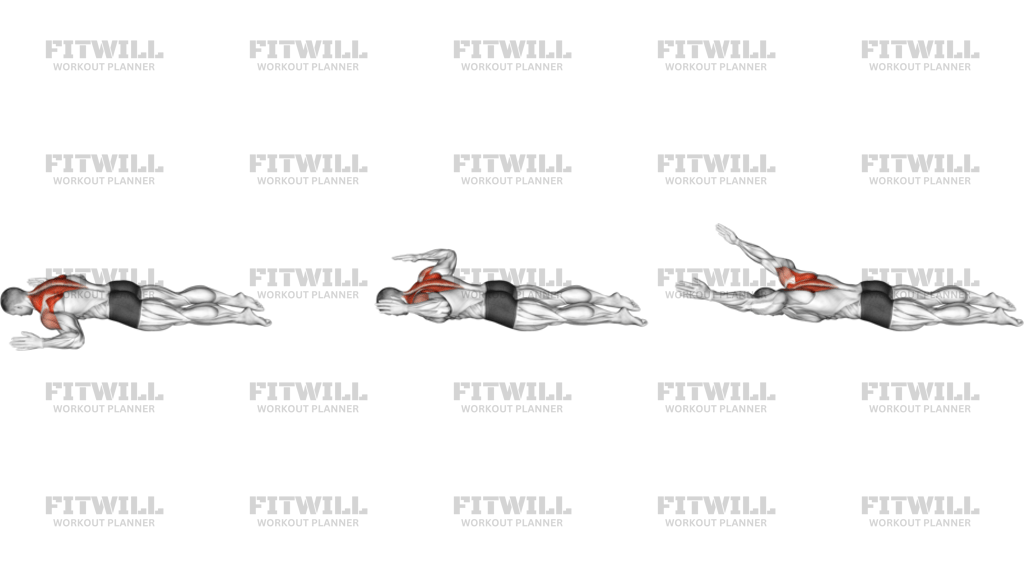
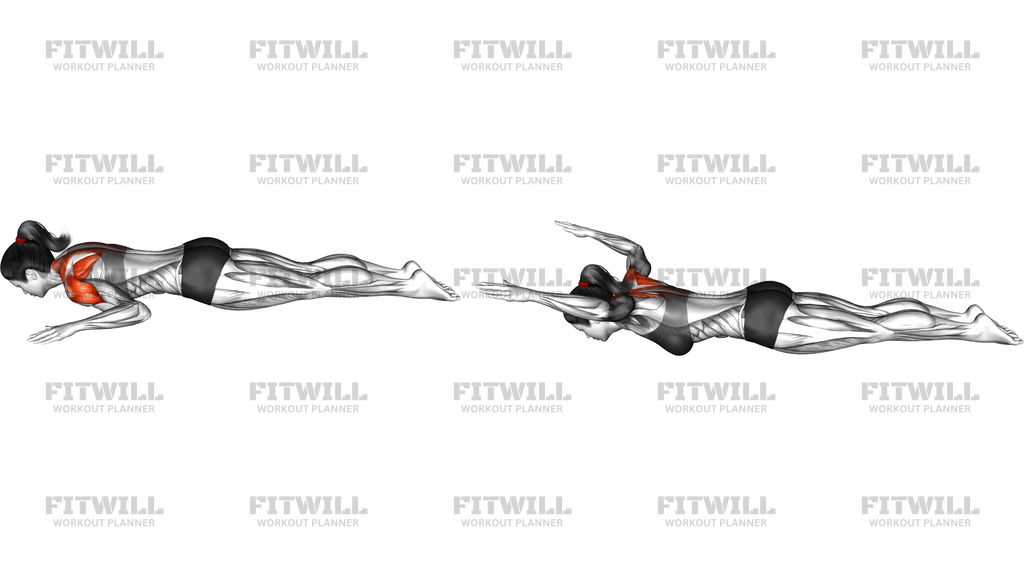
The Lying Prone W To Y is a bodyweight floor exercise performed face down, where you move your arms from a bent W-shaped position out and up into a long Y-shaped position. Both phases happen with your arms raised off the floor, thumbs pointing toward the ceiling, so your upper back and shoulder muscles have to work against gravity the entire time. It looks simple, but holding the arms airborne while switching shapes is what makes it effective.
The movement targets the mid and lower trapezius and the rhomboids, with strong support from the rear shoulders and the muscles along the spine that keep your chest lifted. The W phase emphasizes pulling the shoulder blades together and down, while the Y phase shifts the demand toward the lower trapezius as the arms reach overhead at an angle. Because the resistance is just your own arms and gravity, the exercise teaches scapular control rather than raw strength.
This is a useful drill for people who spend long hours sitting with rounded shoulders, since it trains exactly the opposite pattern: chest open, blades drawn back, arms reaching long. It is also a common rehabilitative and prehabilitative choice for shoulder health, often used before pressing workouts or in warm-ups for pulling days. Swimmers, throwers, and overhead athletes frequently use it to build endurance in the scapular stabilizers that keep the shoulder joint tracking well under load.
Setup matters more than most people expect. Lying flat on your stomach with your forehead just off or lightly touching the floor, legs extended and relaxed, gives you a stable base so the work stays in the upper back instead of leaking into your lower back through excessive arching. Keeping the chest lightly lifted throughout is correct, but cranking the torso high turns this into a back extension and dilutes the intended stimulus.
To execute it well, start with elbows bent and tucked close to your sides so your arms form a W, then lift them by squeezing the shoulder blades down and together. From there, glide the arms forward and outward into a wide Y without letting them drop, pause briefly, and reverse the path back to the W before lowering. The arms should never touch the floor between reps if you want continuous tension.
The most common faults are shrugging the shoulders toward the ears, snapping the arms up with momentum, and letting the low back overextend to buy extra height. Slowing the tempo down and accepting a smaller, cleaner range solves all three. Because the load is light, this exercise responds best to higher reps, deliberate pauses, and strict positions rather than speed.
[ Workout Log & Planner ]
Put your next workout in Fitwill
Keep your plan and training log ready when you are.


Instructions
- Lie face down on an exercise mat or firm floor with your legs extended straight behind you, the tops of your feet resting on the ground, and your arms at your sides.
- Bend your elbows and draw them in close to your ribs so your upper arms point slightly outward and your hands sit near shoulder level, forming a W with each arm, thumbs rotated up toward the ceiling.
- Gently brace your abdominals and lift your chest a few centimeters off the floor, keeping your neck long and your gaze down rather than craning upward.
- Raise both arms off the floor by squeezing your shoulder blades down and together, feeling the work between and just below your shoulder blades.
- Keeping the arms elevated, straighten your elbows and sweep your hands forward and outward at roughly a 45-degree angle until your body forms a wide Y, thumbs still facing up.
- Hold the Y position for one to two seconds, reaching actively through your fingertips without shrugging your shoulders toward your ears.
- Reverse the path by bending the elbows and pulling them back down toward your ribs, returning to the W position while keeping the arms off the floor.
- Lower your arms and chest back to the floor with control, take a breath, and reset your position before starting the next repetition.
- Exhale as you lift from the W into the Y, and inhale as you return to the W and lower down.
Tips & Tricks
- If you feel the burn mostly on top of your shoulders or up your neck, your upper traps are taking over. Reach longer and lower with your hands instead of lifting higher, and think about pulling your shoulder blades toward your back pockets.
- Keep your thumbs rotated toward the ceiling for the entire rep. This external shoulder rotation naturally biases the lower trapezius and keeps the shoulder joint in a safer path.
- Do not let your arms sag to the floor during the transition between W and Y. That drop-and-lift rhythm turns the exercise into two separate movements and removes the continuous tension that makes it valuable.
- Watch your lower back: a small, natural lift of the chest is fine, but if you are arching hard to raise your arms higher, reduce the range. Height should come from the shoulder blades, not spinal extension.
- Squeeze the floor lightly with your glutes and brace your abs before the first rep. This stabilizes your pelvis and stops the exercise from rocking your whole torso.
- A slow tempo, such as two seconds up to the Y, a one-second hold, and two seconds back to the W, exposes weak scapular control far better than fast reps.
- If full Y reach is uncomfortable at the shoulder, stop at a mid-position between W and Y where you can keep your thumbs up and your neck relaxed, and gradually increase the reach over time.
- Rest your forehead lightly on the mat or hover it just above it; lifting the head aggressively strains the neck and pulls you out of position.
- Because the load is light, treat this like an endurance drill. Two to three sets of eight to fifteen controlled reps usually beats chasing extra height or speed.
Frequently Asked Questions
What muscles does the Lying Prone W To Y work?
The primary targets are the mid and lower trapezius and the rhomboids, which control the shoulder blades. The rear shoulders assist during the Y phase, and the erector spinae along the spine work isometrically to hold your chest lightly lifted.
Is the Lying Prone W To Y suitable for beginners?
Yes, it is one of the most accessible upper back drills because the only resistance is your arms against gravity. Beginners should start with a shorter range, moving partway from W toward Y, and focus on keeping the shoulders away from the ears.
Why do my arms form a W and then a Y during this exercise?
The W position, with elbows bent and tucked near the ribs, biases the rhomboids and mid traps as you retract the shoulder blades. Moving into the Y straightens the arms and shifts emphasis toward the lower trapezius, so the two shapes cover complementary parts of the upper back.
Should my chest and head stay off the floor the whole time?
Your chest should lift slightly and stay lightly elevated, but only a few centimeters. Your head stays neutral, looking down; lifting it high arches the neck and adds nothing to the upper back stimulus.
Why do my shoulders shrug up toward my ears during the Y phase?
This usually means the upper traps are compensating for a lower trapezius that is not yet strong enough. Slow the tempo down, reduce the reach distance, and consciously press the shoulders down as you raise the arms.
Can I do the Lying Prone W To Y if my lower back gets sore?
Mild muscle fatigue in the back is normal because the spinal extensors hold your chest up, but sharp or pinching discomfort is not. Brace your abdominals, squeeze your glutes lightly, and reduce how high you lift your chest and arms.
How is this different from a prone T raise or prone Y raise alone?
The W To Y combines two phases in one rep: a bent-elbow retraction into a straight-arm overhead reach. Holding tension through the transition trains the shoulder blades to move smoothly between retracted and upward-rotated positions, which a single-position raise does not.
How many reps and sets should I do?
For endurance and control, two to three sets of eight to fifteen slow reps work well, either as a warm-up before pressing or pulling or as a standalone upper back drill. Stop the set when your shoulder position degrades, not when your muscles completely fail.
Can I add weight to the Lying Prone W To Y?
Yes, small dumbbells of one to three kilograms can be held in each hand once strict bodyweight reps feel easy, but most people get plenty of challenge from tempo and holds first. Adding load too early usually brings in the upper traps and lower back.
What can I use if lying on the floor is uncomfortable?
You can place a thin pad or folded towel under your chest and hips, or perform a similar W To Y pattern bent over at the hips or prone over an incline bench. The key is keeping the thumbs up and the shoulder blades doing the moving, whatever surface supports you.