Walk Leg Kick
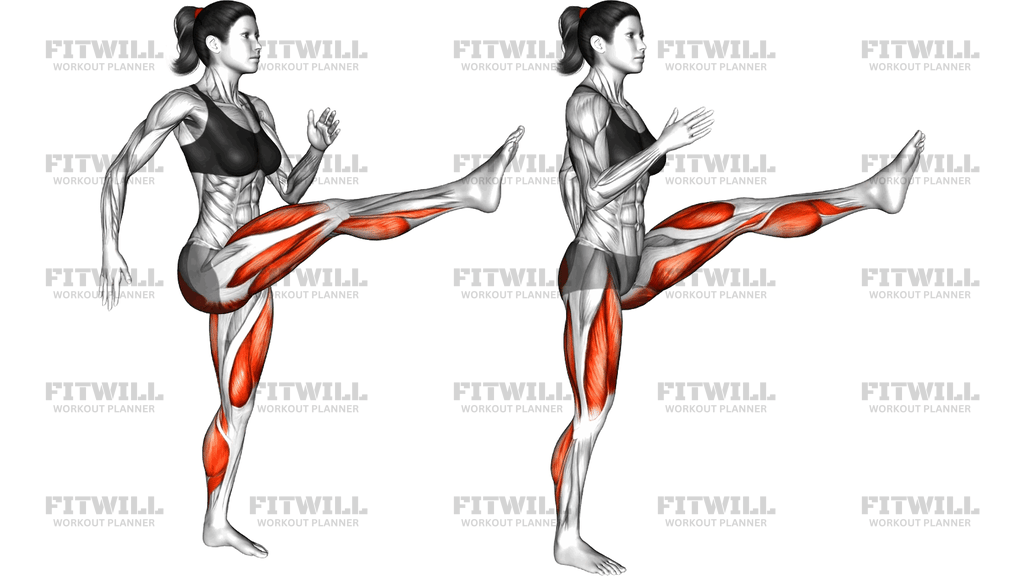
Walk Leg Kick is a dynamic warm-up drill where you walk forward and swing each leg up in a straight, controlled kick in front of you, aiming to bring the toes toward or above hip height with every step. It combines the rhythm of walking with a rising leg swing, so each kick lengthens the hamstrings of the lifting leg while the standing leg works to keep you balanced and tall. Because you alternate legs as you travel, the movement flows continuously and feels more like skipping with straight legs than like isolated stretching.
This drill is a staple in warm-ups for running, sprinting, martial arts, and field sports, and it is equally useful for anyone who sits a lot and feels tight at the back of the thighs. The repeated active reach into the kick lengthens the hamstrings dynamically, wakes up the hip flexors that drive the leg upward, and challenges the glutes and calves of the support leg. Unlike holding a static stretch, you are teaching the hamstrings to lengthen under control while moving, which is far more relevant to sprinting, kicking, and change-of-direction sports.
Setup matters more than most people expect. You need a clear strip of floor or grass of roughly ten to twenty meters, an upright posture, and a braced trunk. If you lean back and reach for your leg with a rounded spine, you turn a leg swing into a lower-back movement and lose the stretch where you want it. Keeping the torso tall, the chest open, and the kick driven by the hip itself is what separates a useful Walk Leg Kick from a sloppy flail forward.
To execute it well, walk at a steady pace and, on each step, swing the opposite leg up in front of you with the knee straight and the ankle relaxed. Let the arms swing naturally in opposition, the way they do when you run. Extend the kick only as high as you can keep the standing leg straight and your posture tall, then let the leg lower under control into the next step. The goal is smooth, repeatable swings, not one maximum-height kick followed by seven stiff steps.
A common use case is as the second or third drill in a dynamic warm-up, after light jogging and before sprint work, lunges, or jumping. It also works well as a standalone mobility break during long training sessions or desk-bound days. Two to three passes of ten to twenty kicks per leg is usually plenty.
For safety, keep the kick within a range you can control from start to finish, and never bounce or snap the leg up at the top. If your hamstrings complain at full height, lower the target to knee or mid-shin height for the first few passes and build up gradually. Stay on a flat, non-slippery surface, and if you have a history of hamstring strains, progress the height and speed slowly over several weeks.
[ Workout Log & Planner ]
Put your next workout in Fitwill
Keep your plan and training log ready when you are.


Instructions
- Find a clear, flat path of about ten to twenty meters where you can walk forward without obstacles.
- Stand tall with your feet hip-width apart, arms relaxed at your sides, and your gaze forward.
- Brace your trunk lightly as if bracing for a light push, keeping your ribs stacked over your pelvis.
- Step forward with your left foot and, as you settle onto it, swing your right leg up in front of you with the knee straight and the foot relaxed.
- Kick only as high as you can while keeping your torso upright and your standing leg straight, letting the toes rise toward hip height or just below.
- Swing your arms naturally in opposition, so the left arm drives forward as the right leg kicks.
- Lower the kicking leg under control so it lands a normal step length ahead, then immediately kick with the left leg as you continue walking.
- Exhale gently as each leg rises and inhale as it lowers, keeping the breathing rhythm tied to the steps.
- Continue alternating kicks down the length of your path, then turn around and repeat if you want another pass.
Tips & Tricks
- A rounded, forward-reaching torso is the most common mistake; it steals the stretch from the hamstrings and loads the lower back. Fix it by imagining a string pulling the crown of your head toward the ceiling.
- If your kicks top out stiff at knee height, your swing is likely coming from the knee snapping straight rather than from the hip. Lead with the thigh and let the lower leg stay loose.
- Bouncing the leg up at the top of the kick turns a controlled stretch into a ballistic yank on the hamstring. Rise at the same speed you lower.
- Keep the standing leg fully straight and the heel down; a soft, collapsed support knee makes the balance wobble and shortens the stretch on the kicking leg.
- Start your first pass at shin height even if you can kick higher, and raise the target only when every rep in the pass looks identical.
- If you wobble on each kick, slow the walking pace rather than narrowing the movement; the rhythm of the walk should stay smooth even when the range is small.
- Point the toes of the kicking leg loosely upward or let the foot hang relaxed; clenching the foot adds tension that travels up the whole leg.
- On cold days or after long travel, do a few easier passes with no kick at all, just exaggerated straight-leg steps, before adding height.
Frequently Asked Questions
What muscles does the Walk Leg Kick work?
It primarily lengthens and activates the hamstrings of the kicking leg while the hip flexors lift the leg. The glutes, calves, and core of the standing side work continuously to keep you balanced and upright.
Is the Walk Leg Kick a stretch or a strength exercise?
It is mainly a dynamic stretch used in warm-ups, though it also challenges single-leg balance and trunk control. It works best before running, sprinting, or kicking sports rather than as a standalone strength builder.
How high should I kick during the Walk Leg Kick?
Kick only as high as you can while keeping your torso tall and your standing leg straight. For most people that starts around knee to hip height and rises over weeks of practice.
Can beginners do the Walk Leg Kick?
Yes. Beginners should use a shorter kick height and a slower walking pace, focusing on a straight support leg and an upright torso before chasing range.
Why does my lower back feel this drill instead of my hamstrings?
That usually means you are rounding or arching your spine to reach the leg up. Keep your ribs stacked over your pelvis and reduce the kick height until the tension returns to the back of the thigh.
What can I substitute if I cannot do the Walk Leg Kick yet?
Try straight-leg marching in place, where you lift one straight leg to knee height without traveling, or a lying single-leg hamstring stretch to build range first.
How many kicks should I do per set?
Two to three passes of ten to twenty kicks per leg works well as a warm-up. Stop the pass as soon as your form or rhythm breaks down.
Is it safe to do Walk Leg Kicks after a hamstring strain?
Not until the hamstring is pain-free in daily walking and approved for dynamic loading. When you return, start with low, slow kicks and build height and speed gradually.
Should I hold each kick at the top?
No, this is a flowing drill, so the leg should rise and lower in one smooth motion tied to your walking rhythm. Pausing at the top turns it into a balance hold and changes the intent of the drill.