Suspender Squat
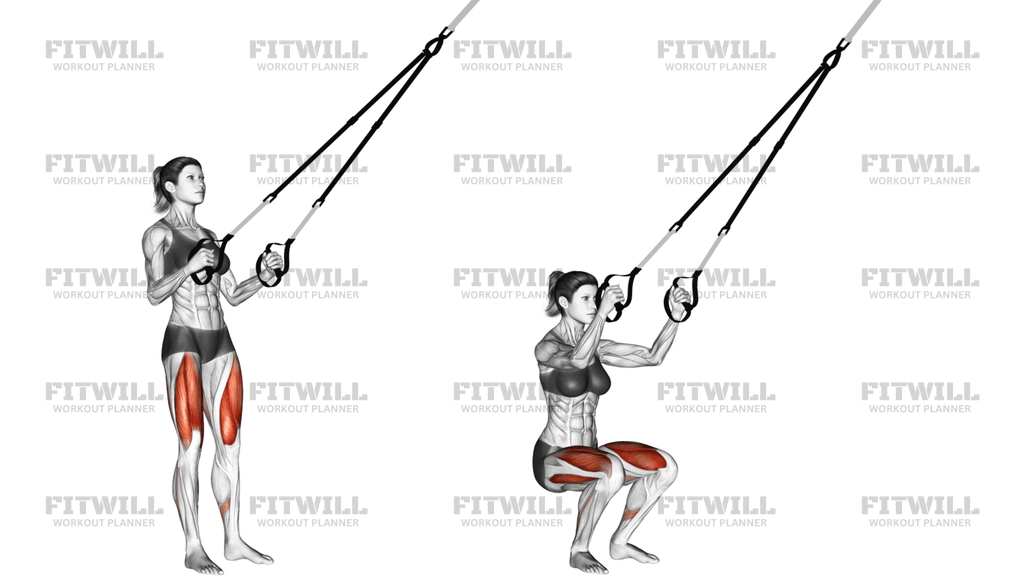
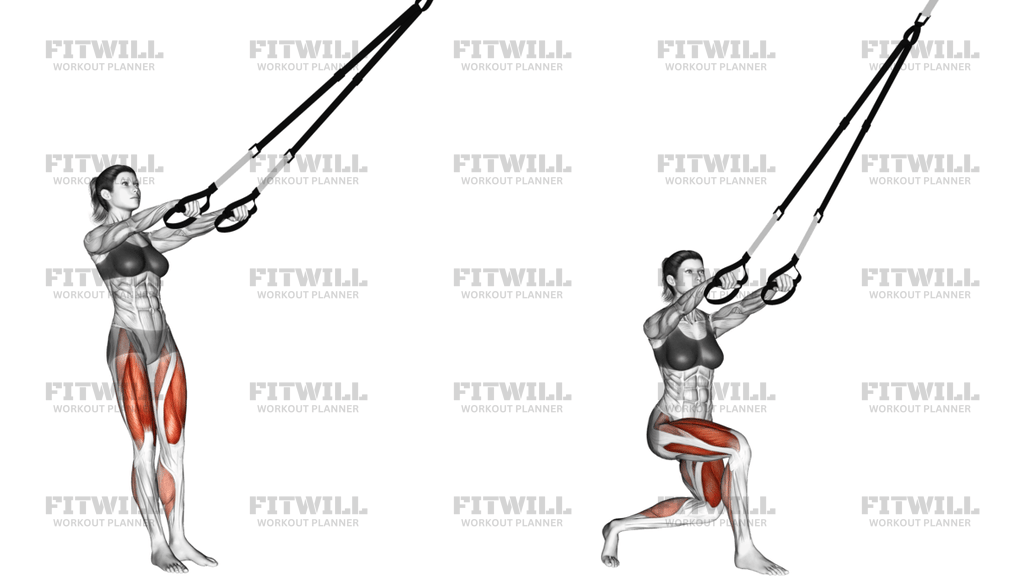
The Suspender Squat is a bodyweight squat performed while holding the handles of a suspension trainer, which is anchored overhead and set to a medium-long length. You face the anchor point, grip the handles with your arms extended in front of you, and lean back so the straps carry part of your weight as you sit down into a deep squat and drive back up. The straps act as a movable support, letting you control how much load your legs take and how deep you travel.
This movement is one of the best entry points into squatting. Because the suspension trainer supports your torso, you can keep your chest up and your spine neutral even at depths that would normally collapse your posture. That makes it a strong choice for beginners learning the squat pattern, older trainees returning after a layoff, or anyone with limited ankle or hip mobility who struggles to stay balanced in a free-standing squat. More advanced lifters use it too, either as a warm-up, as a high-rep finisher, or as a way to groove depth before loading a barbell.
The main work comes from the quads and glutes, which extend the knees and hips on the way up. The hamstrings assist at the hip, and the deep squat position challenges the adductors and hip mobility. Your core works isometrically the whole time: leaning back against the straps while keeping a straight torso puts real demand on the abdominals and the muscles that stabilize your spine, which is why many people feel their midsection working harder than they expect.
Setup matters more than it looks. The further your feet are from the anchor, the more the straps support you and the easier the squat becomes; stepping closer increases the load on your legs. Adjust the strap length so your arms extend comfortably at standing height and the handles don't go slack at the bottom. Keep tension in the straps throughout the rep, because slack followed by a sudden pull is the most common cause of losing balance.
To execute well, sit your hips back and down between your feet while your arms stay extended and your torso leans away from the anchor. Let the handles travel up and slightly outward as you descend, keep your knees tracking over your toes, and descend only as far as you can control with a flat back. Drive through your whole foot to stand, pulling lightly on the straps rather than hauling yourself up with your arms. If you find yourself yanking the handles to finish each rep, step slightly farther from the anchor and rebuild the depth gradually.
[ Workout Log & Planner ]
Put your next workout in Fitwill
Keep your plan and training log ready when you are.


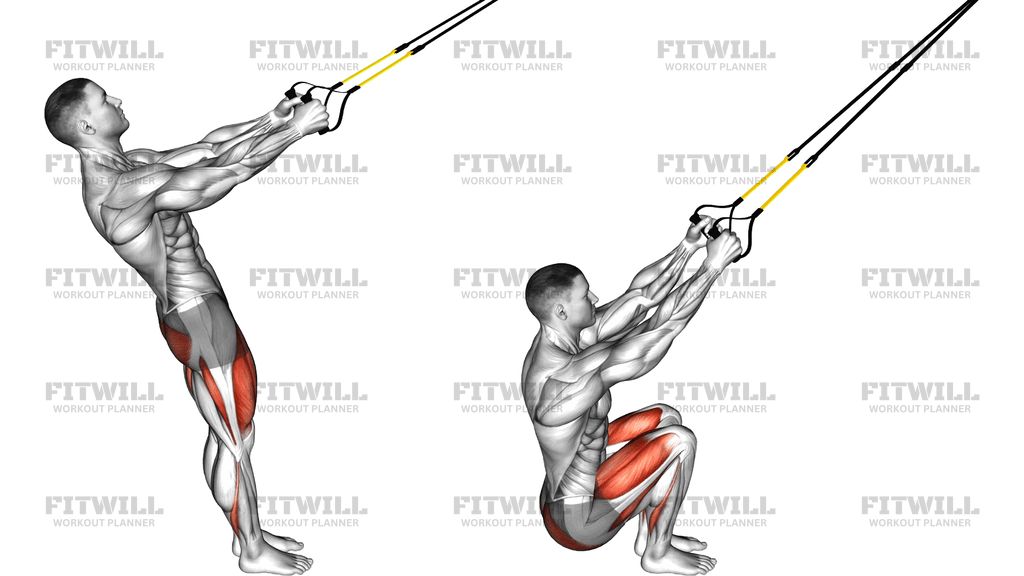
Instructions
- Anchor the suspension trainer securely overhead and adjust both straps to equal, medium-long length so the handles hang around waist to chest height.
- Face the anchor point and grip one handle in each hand with a neutral grip, then walk your feet back until your arms are fully extended and the straps are taut.
- Set your feet about shoulder-width apart with toes turned out slightly, and lean back so your body forms a straight line from head to heels with light tension on the straps.
- Brace your core and pull your shoulder blades down gently so your shoulders stay stable and your arms stay long.
- Inhale, then push your hips back and bend your knees to lower into a squat, letting your arms rise overhead as the straps pivot around the anchor.
- Descend until your thighs are at least parallel to the floor, or as deep as you can go while keeping your chest up, knees tracking over your toes, and the straps under constant tension.
- Exhale and drive through your heels and mid-foot to stand, extending your hips and knees together while your arms lower back in front of you.
- Keep the pull on the handles light and supportive; your legs, not your arms, should do the lifting.
- Reset your stance and strap tension at the top of each rep, and recheck that your torso stays rigid rather than hinging or rounding as you fatigue.
Tips & Tricks
- If your heels lift at the bottom, widen your stance a few degrees or place a thin book or wedge under your heels; the strap support should not be used to force depth your ankles cannot reach.
- Watch for slack in the straps at the top of each rep. If the handles go loose, you are leaning too far back or standing too close to the anchor, both of which turn the squat into an awkward row.
- A common mistake is pulling with the arms to finish the rep. Reduce the depth or step back from the anchor until your legs can complete the movement with only light finger tension on the handles.
- Keep your wrists neutral and elbows straight. Bending the elbows mid-rep shifts work toward your arms and lets your torso collapse forward.
- If your knees cave inward as you rise, think about spreading the floor with your feet and driving your knees out over your little toes.
- The farther your feet are from the anchor, the more upright and supported your torso becomes. Use foot position as your main intensity dial before adding reps.
- Do not let your hips shoot up first on the way out of the bottom; this turns the squat into a good morning and strains your lower back.
- For a harder version, pause two to three seconds in the bottom position or perform the squat with your feet elevated slightly on a step platform.
- If the handles irritate your wrists, hold the straps themselves just above the handles instead of gripping the foam grips.
Frequently Asked Questions
What muscles does the Suspender Squat work?
The quads and glutes do most of the work extending your knees and hips, with the hamstrings assisting. Your core, especially the abdominals, works isometrically to keep your torso rigid while you lean back against the straps.
Is the Suspender Squat good for beginners?
Yes, it is one of the most beginner-friendly squat variations because the suspension trainer supports part of your bodyweight and helps you keep an upright torso. You can adjust the difficulty simply by moving your feet closer to or farther from the anchor point.
How far should I stand from the anchor point?
Farther from the anchor means more support and an easier squat; closer to the anchor means more load on your legs. Start with your arms extended and your body at roughly a 45-60 degree lean, then adjust from there.
Why do the straps go slack during my Suspender Squat reps?
Slack usually means you are leaning back too far, standing too close to the anchor, or letting your arms drift behind your head. Keep constant light tension on the handles throughout the entire rep so the straps guide the movement.
How deep should I squat in the Suspender Squat?
Aim for thighs at least parallel to the floor, and go deeper only if you can keep your chest up, your heels down, and tension in the straps. Depth you can control with a neutral spine beats depth you force.
Can I use the Suspender Squat if I have limited ankle mobility?
Often yes, because the strap support lets you sit back and stay balanced even when your ankles restrict forward knee travel. A slight heel elevation can also help, and improving ankle range over time will carry over to free squats.
What can I use if I don't have a suspension trainer?
You can loop a sturdy resistance band around a secure overhead anchor and hold the ends, or hold a fixed upright, door frame, or squat rack post with both hands. The key is having something stable in front of you to lean back against.
Why do I feel the Suspender Squat in my arms and shoulders?
Your arms are holding the strap tension, so some shoulder and grip work is normal. If your arms fatigue before your legs, you are pulling too hard or bending your elbows; lighten the pull and keep your arms long.
Is the Suspender Squat safe for people with knee concerns?
It is generally well tolerated because the strap support reduces compressive load and lets you control depth precisely. Stay within a pain-free range, keep your knees tracking over your toes, and check with a qualified professional if you have a recent injury.