Cable Standing Cross Over High Reverse Fly
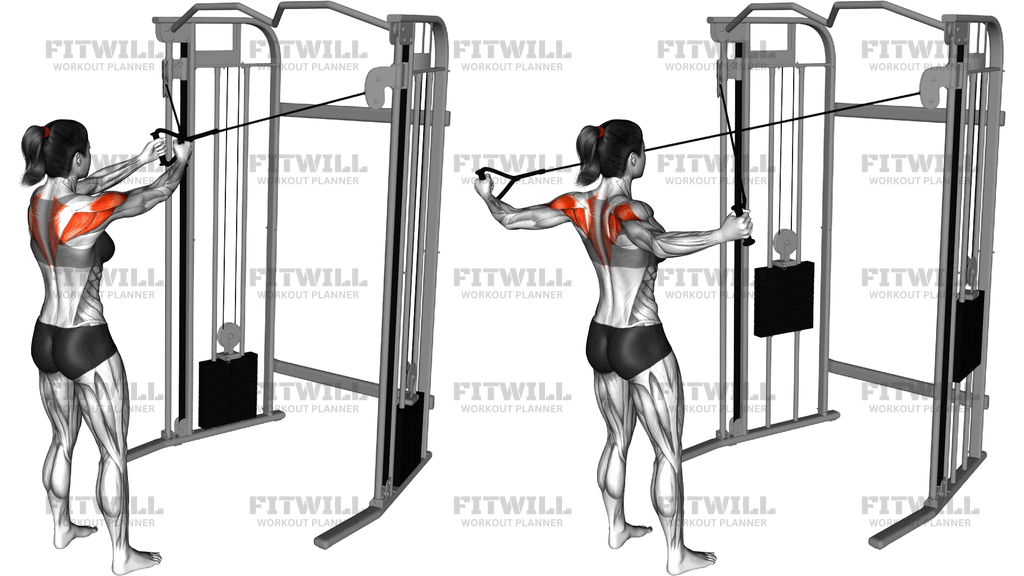
The Cable Standing Cross Over High Reverse Fly is a rear-delt isolation exercise performed on a dual-cable machine with the pulleys set high. You stand centered between the two stacks, reach across your body to take the opposite handle in each hand, and pull the cables out to the sides until your arms open into a wide T at shoulder height. Because each cable crosses in front of your chest, the resistance pulls diagonally across your body, which forces the rear delts and upper back to work hard through the entire arc in a way a dumbbell reverse fly cannot replicate.
This movement is especially useful for anyone whose training is heavy on pressing — bench presses, overhead presses, push-ups — and light on pulling. The rear delts and the muscles between the shoulder blades tend to lag behind, which can show up as rounded shoulders or an unbalanced upper body. Adding a crossed-cable reverse fly two to three times per week is one of the most direct ways to build that back-side shoulder density and improve shoulder girdle stability.
The crossed grip is what makes this version special. With the cables crossing over, tension is already loaded on the rear delts before you even start the rep, and the diagonal pull line keeps constant resistance from the first inch of the movement to the last. Standard dumbbell reverse flies, by contrast, are hardest only at the top and offer almost nothing at the bottom. That constant tension is exactly why this exercise rewards lighter weights and strict form.
Setup matters more than load here. The pulleys should sit at or slightly above head height, and you need to stand far enough forward of the machine that the cables pull at a consistent angle through the whole range. Your stance should be staggered or hip-width with a slight knee bend, torso upright, and shoulder blades pulled gently down before the first rep so the pull comes from your shoulders rather than a shrug.
To execute it well, keep your arms almost straight with a soft elbow bend, and open your arms in a wide arc rather than pulling the handles toward your torso. Finish with your hands roughly in line with your shoulders, pause briefly to feel the rear delts squeeze, then let the cables draw your arms back across your body under control. Common uses include accessory work after rows or pulls, shoulder-day finishers, and higher-repetition sets in the 12 to 20 range where the constant cable tension really pays off. Keep the weight honest — if you have to lean back or shrug to move it, the rear delts have stopped doing the job.
[ Workout Log & Planner ]
Put your next workout in Fitwill
Keep your plan and training log ready when you are.


Instructions
- Set both pulleys of a dual cable machine to the highest position and attach a single handle to each side.
- Stand centered between the two stacks, one step forward so the cables angle slightly down toward you, with feet hip-width apart or in a staggered stance and a soft knee bend.
- Reach across your body and grab the left handle with your right hand and the right handle with your left hand, so the cables cross in front of your chest with arms extended forward at about shoulder height.
- Draw your shoulder blades down and back, brace your core, and keep your chest tall without arching your lower back.
- Keeping your arms nearly straight with a slight elbow bend, pull the handles out and back in a wide arc until your arms form a T at shoulder height, letting the cables cross past your body.
- Pause for a beat at the open position and squeeze your rear delts and upper back.
- Slowly allow your arms to travel back across your chest, resisting the cables' pull until your hands nearly meet in front of you.
- Exhale as you open your arms out to the sides, and inhale as you control them back across your body.
- Complete all reps, then release one handle at a time carefully, since the tension on the crossed cables can snap your arms back if you let go abruptly.
- Reset your stance and shoulder position before starting the next set.
Tips & Tricks
- The most common mistake is turning this into a row: if the handles end up near your ribs, bend your elbows more and think about opening your arms wide instead of pulling them back.
- Watch for shrugging — if your upper traps take over, the weight is too heavy or your shoulder blades are creeping up; lower the load and keep your shoulders pressed down away from your ears.
- Keep the elbow bend fixed at roughly 10 to 20 degrees for the whole set. Straightening the arms as you pull changes the leverage and strains the elbow joint.
- Standing too close to the machine shortens the cable path and makes the start position awkward. Step forward until the cables track smoothly past your shoulders.
- Slightly tucking your chin and looking at a fixed point ahead helps you avoid craning your neck as the cables cross in front of your face.
- Use a thumb-down or neutral hand orientation and experiment with both — many people feel a stronger rear-delt contraction with a slight pronation of the hands at the open position.
- Control the return just as much as the pull. Letting the crossed cables yank your arms back across your body wastes half the rep and can strain the shoulder's front side.
- Start with a very light weight the first time. The crossed cable angle creates more resistance than most people expect at the moment the cables pass your body.
- If one side feels weaker, do single-arm sets grabbing the opposite handle only, so the strong side cannot compensate.
Frequently Asked Questions
Which muscles does the Cable Standing Cross Over High Reverse Fly work?
The rear delts are the primary movers, supported by the rhomboids, mid and lower traps, and the small rotator cuff muscles that stabilize the shoulder. Your core also works isometrically to keep your torso upright against the diagonal cable pull.
Why do the cables need to cross over in this exercise?
Crossing the cables puts the rear delts under tension from the very start of the rep and keeps resistance constant through the whole arc. It also adds a slight stretch across the front of the shoulders, giving a deeper working range than a standard reverse fly.
How high should I set the pulleys?
Set them at or just above head height so the cables pull roughly level with your shoulders when your arms are extended forward. If the pulleys are too low, the movement drifts toward a face pull or row and the rear-delt emphasis fades.
Is the Cable Standing Cross Over High Reverse Fly suitable for beginners?
Yes, as long as the weight is kept light and the focus stays on the wide arcing path rather than the load. Beginners often benefit from starting with the single-arm version to learn the shoulder movement before coordinating both crossed cables.
How is this different from a dumbbell reverse fly?
Dumbbells only resist you vertically against gravity, so tension drops off at the start of the rep, while the crossed cables pull diagonally across your body the entire time. The cable version also lets you train one side at a time with an identical angle on each rep.
What should I do if my upper traps take over the movement?
Reduce the weight, actively press your shoulder blades down before each rep, and shorten the range slightly so your hands stop at shoulder level rather than drifting higher. Shrugging is the clearest sign the load has exceeded what the rear delts can handle.
Can I substitute this exercise if my gym has no dual cable machine?
A single cable column works if you perform it one arm at a time, taking the handle from the opposite side. Resistance bands anchored high and crossed in front of the body are a reasonable home alternative with very similar mechanics.
How many sets and reps work best for this movement?
Because the rear delts respond well to constant tension and controlled tempo, sets of 12 to 20 reps for 2 to 4 sets tend to work best. Place it near the end of a shoulder or upper-body session after your heavier pulling or pressing work.
Is it safe to release the crossed handles mid-set?
No — the crossed cables are under tension across your chest, so letting go suddenly can snap your arms back and strain the shoulders. Finish the set or lower the weight to a controlled stop, then release one handle at a time.
Should my elbows stay bent or straight during the pull?
Keep a fixed, slight bend of about 10 to 20 degrees throughout the rep, as if your arms are tracing a wide arc. Locking the elbows hard or bending them more as you pull shifts the work away from the rear delts.