Smith Seated Single Arm Neutral Grip Shoulders Pr
The Smith Seated Single Arm Neutral Grip Shoulder Press is a unilateral overhead press performed on a Smith machine with your palm facing inward toward your midline. You sit on a flat bench positioned inside the Smith machine, hold the bar with one hand at shoulder height, and press it straight up along the machine's fixed vertical path until your arm is fully extended overhead. The machine replaces the free-weight barbell, so the bar can only travel up and down, which lets you concentrate entirely on driving the weight and controlling the descent.
This movement primarily trains the front and side delts of the working arm, with strong involvement from the triceps as they lock out the press and the upper traps as they assist near the top. Because you work one side at a time, the stabilizing demand shifts away from the pressing arm's balance and toward your trunk, which has to keep your torso square and upright while one side of your body is loaded. That makes it a useful exercise for exposing and correcting left-to-right strength differences that often hide behind bilateral pressing.
The setup matters more here than in a standing dumbbell press. The bench height and your position under the bar determine whether the bar tracks cleanly from your shoulder to lockout. Sit tall with the bench set so the bar descends to roughly the level of your upper chest or chin, and plant your feet wide and flat for a stable base. The neutral grip also matters: with your palm facing in, the shoulder sits in a slightly more externally rotated position than in a pronated press, which many lifters find more comfortable at the shoulder joint.
Execution is straightforward but rewards discipline. Unrack the bar with a firm grip, brace your core, and press by driving your elbow up and in so the bar rises in a straight line. Avoid twisting your torso toward the working arm or shrugging the weight up with your upper trap. Lower under control until your elbow is just below shoulder level, then reset and repeat for the target repetitions before switching sides.
This exercise suits intermediate lifters who want a guided overhead press with less balance demand, anyone rehabilitating around minor shoulder grip discomfort with a neutral hand position, and lifters running hypertrophy programs who want strict, isolated shoulder work without a spotter. Keep loads conservative at first, since the fixed bar path removes your ability to adjust around a bad rep.
[ Workout Log & Planner ]
Put your next workout in Fitwill
Keep your plan and training log ready when you are.


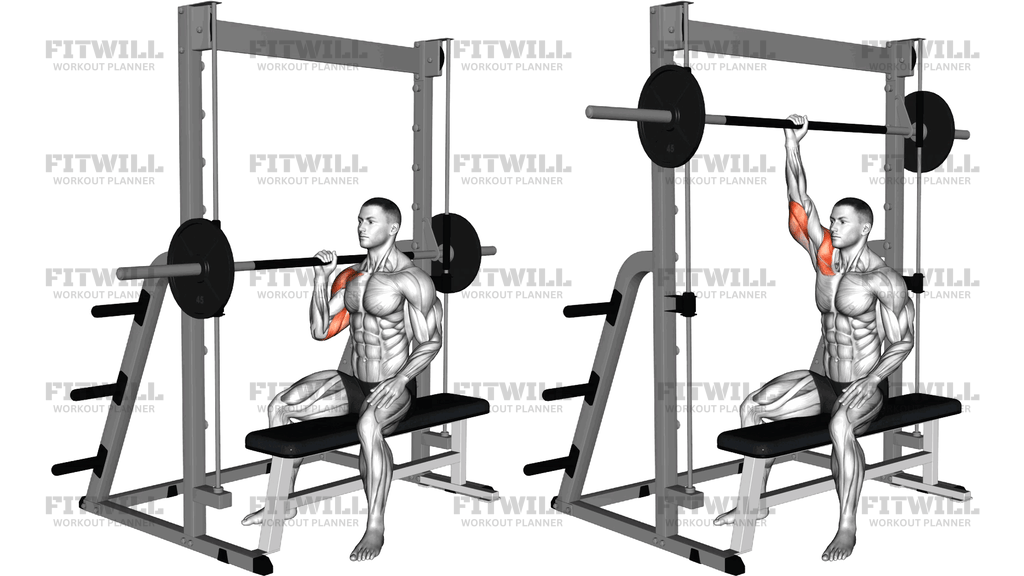
Instructions
- Place a flat bench inside the Smith machine and set the bar height so it sits around your upper chest or chin level when you are seated.
- Sit on the bench with your feet flat and wide, your back tall, and your body positioned so the bar lines up directly over your working shoulder.
- Grip the bar with one hand at roughly shoulder width, palm facing inward toward your head in a neutral grip.
- Rotate the bar to disengage the Smith machine hooks and lift it off the rests to the starting position at shoulder height.
- Brace your core and keep your non-working hand resting on your thigh for balance throughout the set.
- Press the bar straight up along the machine's vertical path until your arm is fully extended overhead, without leaning or twisting your torso.
- Pause briefly at the top with your bicep near your ear, then lower the bar under control until your elbow is just below shoulder level.
- Exhale as you press up and inhale as you lower the bar back to the starting position.
- Complete all repetitions on one arm, then re-rack the bar, switch hands, and match the repetitions on the other side.
Tips & Tricks
- If the bar drifts forward of your shoulder at the top, slide the bench slightly back so your shoulder sits directly under the machine's track.
- Do not rotate your spine toward the working arm as fatigue builds; this usually means the weight is too heavy for a strict press.
- Keep your wrist stacked directly over your elbow rather than letting the bar pull your hand back, which loads the wrist joint instead of the delt.
- Stop the descent when your elbow reaches roughly 90 degrees; dropping the bar far below shoulder height with the fixed path can pinch the shoulder.
- Perform your weaker arm first and match its rep count with the stronger arm to close any strength gap over time.
- Keep your neck neutral by looking straight ahead; craning up to watch the bar travel strains the upper traps unnecessarily.
- Because the Smith machine locks the path, warm up with very light single-arm presses to find the seat position before adding real weight.
- If your lower back arches at the top of the press, tighten your abs and think about pressing your ribcage down toward your hips.
Frequently Asked Questions
Which muscles does the Smith Seated Single Arm Neutral Grip Shoulder Press work?
The front delts and side delts do most of the pressing work, while the triceps extend the elbow to lockout. The upper traps assist near the top and your core stabilizes your torso against the one-sided load.
Why use a neutral grip instead of a regular overhand grip on this press?
The neutral grip keeps the shoulder slightly externally rotated, which many lifters find more comfortable through the overhead range. It also changes the delt emphasis slightly toward the front of the shoulder.
Is the Smith Seated Single Arm Neutral Grip Shoulder Press good for beginners?
Yes, with light weight. The fixed bar path removes balance demands, but beginners should master seated dumbbell pressing form first and use modest loads since the bar cannot be repositioned mid-rep.
How should I position the bench in the Smith machine?
Set the bench so your working shoulder sits directly under the bar's track with the bar descending to around chin or upper-chest height. If the bar drifts forward at lockout, shift the bench slightly backward.
Why do one arm at a time instead of pressing with both hands?
Single-arm work reveals and corrects side-to-side strength differences and forces your trunk to resist rotation, adding an anti-rotation challenge to the set.
Can I substitute dumbbells if my gym has no Smith machine?
Yes, a seated single-arm neutral grip dumbbell shoulder press is the closest substitute. You will gain freedom of path but lose the guided track and the easy hook-in re-rack between sets.
How deep should I lower the bar on each rep?
Lower until your elbow is roughly at or slightly below shoulder height, around a 90-degree bend. Going much deeper with the fixed vertical path can compress the shoulder joint uncomfortably.
What is the most common mistake on this exercise?
Twisting the torso or shrugging the upper trap to help the bar up as the set gets hard. Keep your chest square, your core braced, and let the delt and triceps finish the rep.
Do I need a spotter for the Smith Seated Single Arm Neutral Grip Shoulder Press?
No spotter is required because the machine's hooks catch the bar when you rotate it back in. That said, never lower a heavy single-arm press to failure without knowing where the re-rack point is.
How heavy should I go on this movement?
Start lighter than your two-arm press would suggest, since one arm handles the full load and the fixed path offers no room to grind around a stalled rep. Add weight only when every rep stays strict and untwisted.