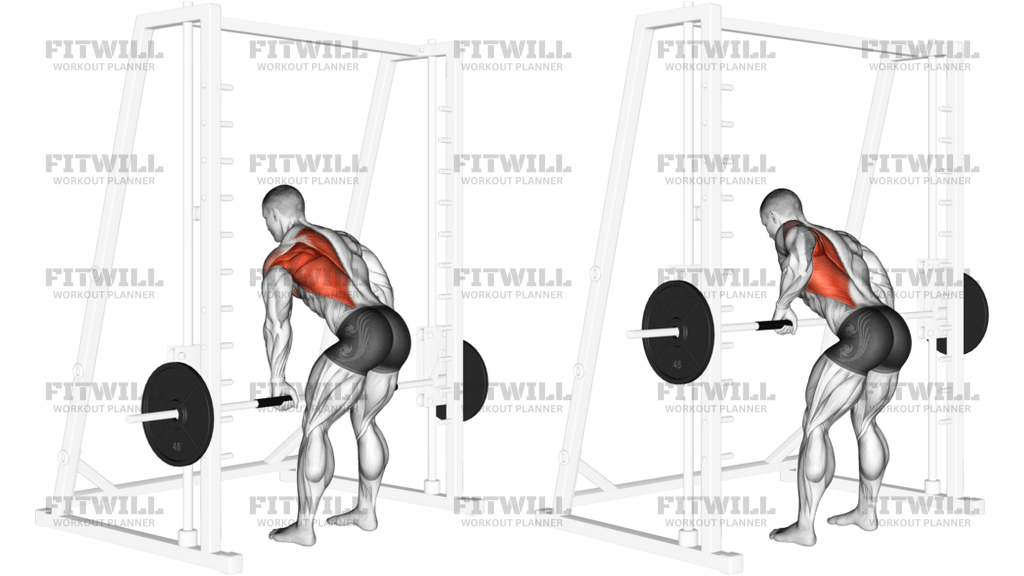
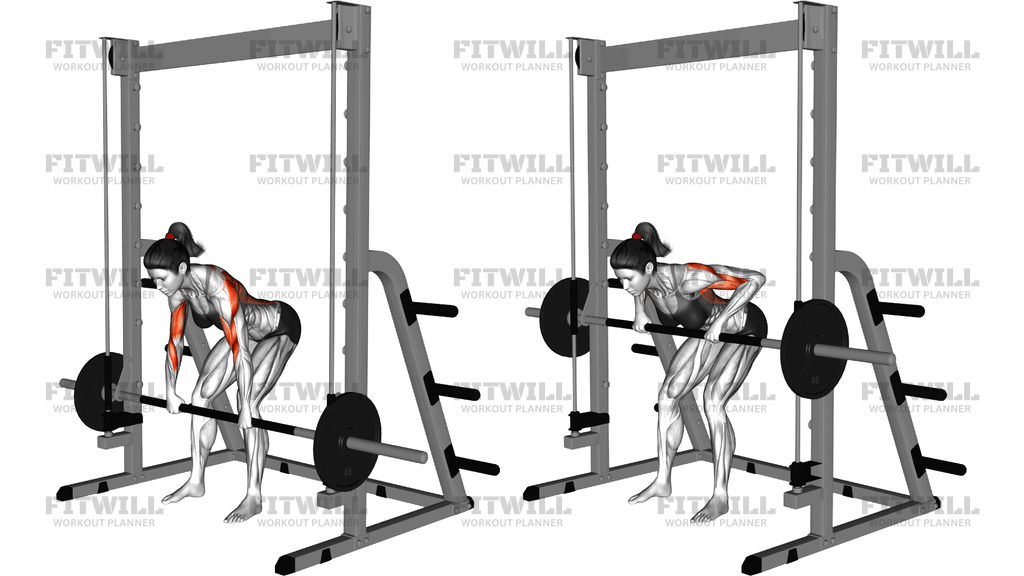
Smith Reverse-Grip Bent-Over Row
Smith Reverse-Grip Bent-Over Row is an underhand rowing movement that builds thickness through the upper back while also challenging the lats, biceps, and rear shoulders. The Smith machine fixes the bar path, which makes it easier to stay strict, keep tension on the pulling muscles, and repeat the same groove from rep to rep.
The reverse grip changes the emphasis compared with an overhand row. With your palms facing up, the elbows usually track closer to the torso and the pull tends to travel toward the lower ribs or upper abdomen, which is why the exercise is often used to train the traps and mid-back with a strong lat and arm contribution. It is a useful accessory lift when you want back work that feels controlled rather than explosive.
The hinge position matters more than the load. A solid set starts with a stable stance, soft knees, and a torso angle that you can hold without rounding your lower back or jerking the bar with your hips. Because the bar path is guided, the challenge is keeping your trunk fixed while the shoulders and elbows do the work.
Smith Reverse-Grip Bent-Over Row is usually best for moderate weights, deliberate reps, and clean pauses at the top. It fits well in back-focused sessions, upper-body days, or as an accessory after heavier compounds, especially when you want to train the upper back without needing as much balance as a free barbell row. Keep the neck long, the wrists stacked, and the pull smooth so the exercise stays on the target muscles instead of turning into a lower-back hold.
If your torso starts rising each rep, the weight is too heavy or your hinge is too shallow. If your wrists or elbows complain, narrow the grip a little less aggressively and keep the bar path close to the body. Done well, this exercise builds a strong, repeatable row pattern that carries over to other pulling lifts and gives the upper back a hard but controlled training stimulus.
[ Workout Log & Planner ]
Put your next workout in Fitwill
Keep your plan and training log ready when you are.


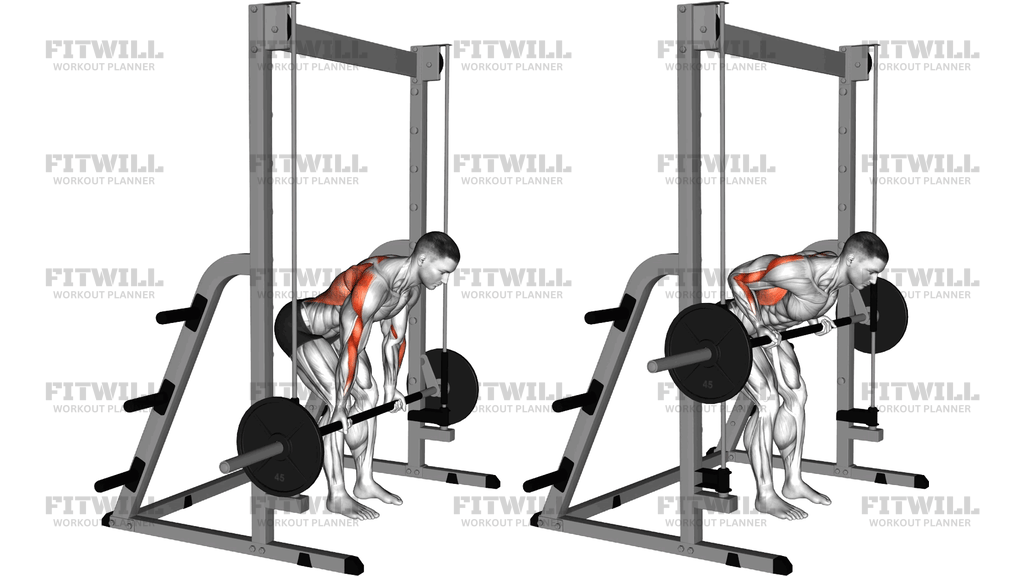
Instructions
- Stand facing the Smith bar with your feet about hip-width apart and take an underhand grip slightly inside shoulder width.
- Hinge at the hips until your torso is roughly 30 to 45 degrees from the floor, with soft knees and a long, neutral neck.
- Let your arms hang straight so the bar starts below your thighs and your wrists stay stacked over your forearms.
- Brace your midsection, lift your chest, and keep your lower back set before the first pull.
- Drive your elbows back close to your sides and pull the bar toward your lower ribs or upper abdomen.
- Squeeze your shoulder blades together at the top without jerking your torso upward.
- Lower the bar slowly until your arms are straight again and your shoulders reach a controlled stretch.
- Keep the same torso angle, breathe out on the pull and in on the return, and stop the set if the bar starts bouncing or your back position changes.
Tips & Tricks
- Keep the grip only slightly inside shoulder width; an overly narrow reverse grip can irritate the wrists and elbows.
- Pull to the lower ribs, not the belt line, so the row stays on the upper back instead of turning into a hip heave.
- Think about driving the elbows behind you instead of yanking with the hands.
- Let the shoulder blades reach forward a little at the bottom so each rep starts from a real stretch.
- If your torso keeps rising, reduce the load before the set turns into a partial upright row.
- Use a torso angle you can hold for the whole set; a shallow hinge usually shifts stress into the lower back.
- Keep the wrists straight and the bar in the palm, not rolled back into the fingers.
- Straps can help if your grip fails before the upper back does.
- A short pause at the top makes this movement much stricter than bouncing the Smith bar.
- Stop one or two reps before form breaks down, especially if the lower back starts feeling crowded.
Frequently Asked Questions
What muscles does Smith Reverse-Grip Bent-Over Row work most?
It mainly hits the traps, rhomboids, lats, and biceps, with the rear shoulders helping stabilize the pull.
Is Smith Reverse-Grip Bent-Over Row more for traps or lats?
It trains both, but the reverse grip and tucked elbows usually give the upper back and traps a slightly bigger role while the lats still contribute strongly.
How far should I hinge forward on Smith Reverse-Grip Bent-Over Row?
Use a torso angle you can hold rigidly, usually around 30 to 45 degrees. If your lower back rounds or your chest keeps popping up, the hinge is too aggressive or the load is too heavy.
Where should the bar touch on Smith Reverse-Grip Bent-Over Row?
The bar should travel toward the lower ribs or upper abdomen, not high to the chest and not so low that you start turning the row into a hip drive.
Can beginners do Smith Reverse-Grip Bent-Over Row?
Yes, it is beginner-friendly if the load stays light and the torso angle stays fixed. The Smith machine can make it easier to learn a strict row pattern than a free barbell row.
What are the most common mistakes in Smith Reverse-Grip Bent-Over Row?
The biggest mistakes are standing too upright, swinging the torso, and letting the bar travel away from the body. Those errors shift work off the back and onto momentum.
How is Smith Reverse-Grip Bent-Over Row different from a regular barbell row?
The Smith machine locks the bar path, so balance is less of a factor and it is easier to keep the same groove. That can make the movement feel stricter, but it also means you need to match the bar path to your body position.
What should I do if my wrists or elbows bother me?
Reduce the grip width slightly, keep the wrists straight, and avoid curling the bar with your arms. If discomfort continues, use less load or switch to a neutral-grip row variation.