Chest Dip On Straight Bar
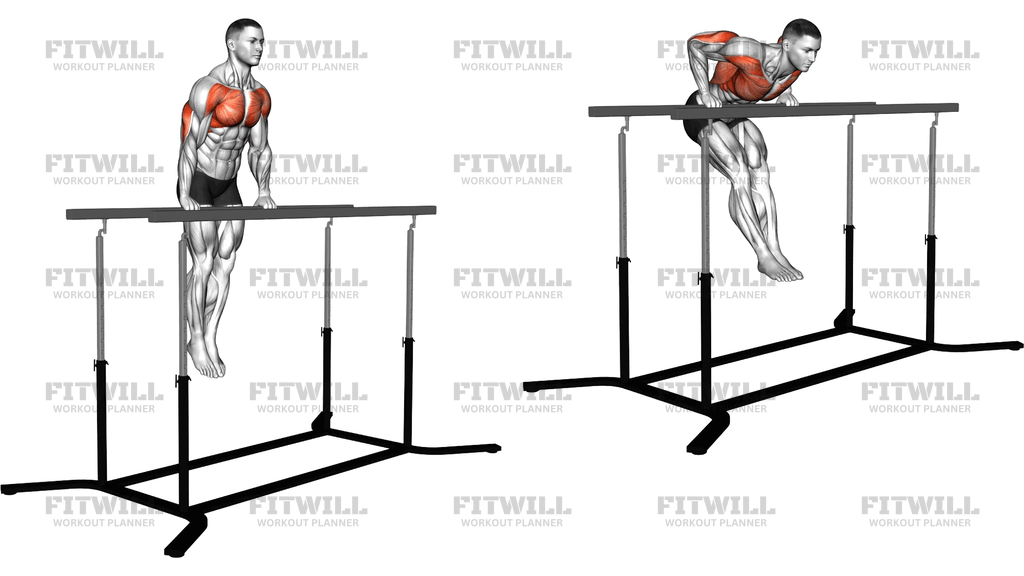
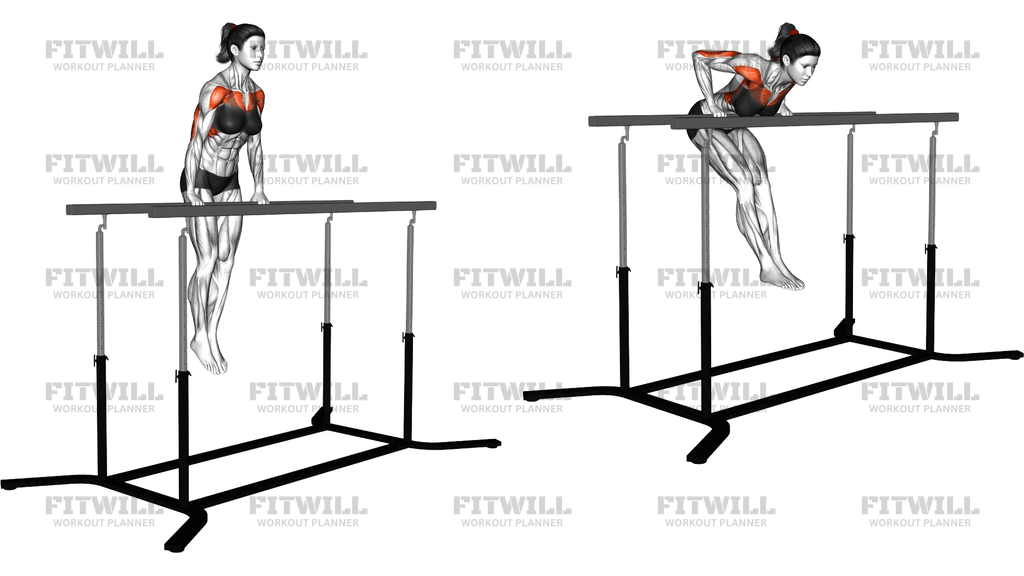
The Chest Dip On Straight Bar is a bodyweight pressing movement performed on a single straight bar rather than the two parallel bars used in a traditional dip. You support yourself with your hands gripping the bar on either side of your hips, arms locked out, and your body suspended above it. From there you lean your torso forward and lower until your chest approaches the bar, then press back up to the top. Because all your weight rides over one bar instead of being split between two, the shoulders sit slightly ahead of the hands and the chest takes on a bigger share of the work than it does on parallel bars.
The main target is the chest, especially the sternal portion, with the triceps and front delts assisting throughout the press. The forward lean also stretches the pecs through a long range at the bottom, which is one reason this variation is valued for chest development. Your core stays braced the whole time to keep the legs from swinging, and the shoulder stabilizers work hard to control the bar path as you move up and down over a single fixed line of support.
This exercise suits intermediate lifters who can already perform several clean parallel bar dips and want a harder, chest-biased version. It is common in calisthenics programs and in gyms equipped with a dip station or a straight bar set at hip height. Because you support your full bodyweight, it doubles as a strength and control exercise rather than pure muscle building, and adding reps before adding load is the sensible progression.
Setup matters more here than in most pressing exercises. Bar height determines whether you can mount cleanly without jumping excessively or scraping your legs, and where you place your hands relative to your hips decides how far forward you can lean. Grip too narrow and the movement turns into a triceps press with the shoulders rolled inward; grip too wide and the wrists get loaded awkwardly. Hands roughly in line with the shoulders, or just slightly outside them, gives most people the best balance between chest stretch and joint comfort.
To execute it well, mount the bar, lock the elbows, and shift your weight forward so your shoulders travel past your hands as you descend. Keep the elbows tracking back at roughly a forty-five degree angle rather than flaring straight out to the sides. Lower under control until you feel a solid stretch across the chest, then drive the bar down and slightly back as you press to the top. The forward lean should stay consistent through the whole rep; standing upright mid-set shifts stress onto the triceps and the shoulder joint.
The most common safety issue is dropping into the bottom position too fast. The stretched position under load is where the shoulder is most vulnerable, so treat the descent as a deliberate part of the rep. If you cannot control the last few inches before the bar touches your chest, shorten the range until you can, and build depth over time.
[ Workout Log & Planner ]
Put your next workout in Fitwill
Keep your plan and training log ready when you are.


Instructions
- Set a straight bar at roughly hip height, either on a dip station or securely in a rack, so you can mount it without a large jump.
- Grip the bar with palms facing forward and hands about shoulder-width apart or a touch wider, then press down to lift your body so your arms are fully extended and your feet clear the floor.
- Bend your knees and cross or tuck your ankles behind you so your legs hang still and do not swing.
- Lean your torso forward over the bar so your shoulders sit slightly ahead of your hands, and brace your core to hold that angle.
- Inhale, then bend the elbows and lower your body in a controlled line, letting your chest travel down toward the bar while the elbows stay at about forty-five degrees to your torso.
- Descend until your chest is near the bar or you feel a strong stretch across the pecs, with shoulders no lower than you can control.
- Press down through the bar and drive your body back up, keeping the same forward lean until the arms are nearly locked.
- Exhale as you press up, and finish each rep with the elbows extended but not jammed hard into lockout.
- Complete the set, then dismount by stepping or lowering one foot to the floor at a time rather than dropping off the bar.
- Reset your grip and body position before the next set so every rep starts from the same stable top position.
Tips & Tricks
- Keep the forward lean constant for every rep; if you drift upright as you fatigue, the set turns into a triceps dip and the shoulder ends up in a weaker pressing position.
- Do not bounce out of the bottom. The stretched position over a single bar loads the shoulder heavily, so pause briefly or move smoothly through it instead of rebounding.
- If your wrists ache at the bottom, try turning the grip slightly outward so the bar sits closer to the heel of the palm rather than the middle of the wrist.
- Chin tucked and eyes slightly forward helps hold the lean; looking straight down tends to collapse the chest and round the upper back.
- Start with a shortened range and work toward chest-to-bar depth over several weeks; forcing full depth on day one is the most common reason this exercise irritates the shoulders.
- Keep the knees tucked and ankles quiet. Swinging legs turn the movement into a momentum-driven press and rob the chest of tension.
- If you cannot yet do five controlled reps, use a band looped over the bar under your knees or an assisted dip machine before forcing full bodyweight reps.
- Chalk or a firm grip helps on a single bar, since all your weight presses through one narrow line and slipping hands shift the whole body position instantly.
- Warm up the shoulders with a lighter pressing variation, such as parallel bar dips or push-ups, before loading the deeper stretched position on the straight bar.
Frequently Asked Questions
Which muscles does the Chest Dip On Straight Bar work?
The chest is the primary mover, with the triceps and front delts assisting through the press. The core and shoulder stabilizers also work to keep you balanced over the single bar.
How is a Chest Dip On Straight Bar different from a regular parallel bar dip?
On a straight bar your hands are on one line instead of two parallel bars, so your torso leans farther forward and the chest works through a longer stretch. Parallel bar dips spread the load between two contact points and are generally easier to balance.
Is the Chest Dip On Straight Bar suitable for beginners?
It is best treated as an intermediate progression. Beginners should build capacity on parallel bar dips or band-assisted straight bar dips first, since supporting full bodyweight over one bar demands both strength and balance.
How deep should I go on the Chest Dip On Straight Bar?
Lower until your chest is close to the bar or you feel a strong pec stretch, whichever comes first with control. Depth beyond the point where your shoulders stay stable adds risk without extra benefit.
What is the most common mistake with this exercise?
Losing the forward lean and dropping too fast into the bottom. Staying upright shifts stress to the triceps and front of the shoulder, and an uncontrolled descent is the main cause of discomfort in this variation.
Where should my hands be placed on the straight bar?
Roughly shoulder-width, or just a little wider, with the bar running across the middle of your palm. Narrow grips make the wrists twist and turn the rep into a triceps press.
Can I substitute the Chest Dip On Straight Bar with another exercise?
Parallel bar dips with a deliberate forward lean are the closest substitute. Weighted push-ups and decline presses also train the chest through a comparable pressing pattern if no bar is available.
How do I progress the Chest Dip On Straight Bar once bodyweight reps feel easy?
Add reps first, then use a dipping belt with a plate or a weighted vest. Adding load before your range and lean are consistent usually exposes the weakest point of the movement quickly.
Is it safe for the shoulders?
For most people with healthy shoulders and controlled technique, yes. Keep the descent smooth, respect a pain-free range, and build depth gradually; anyone with a history of shoulder issues should check with a qualified professional before loading the movement.