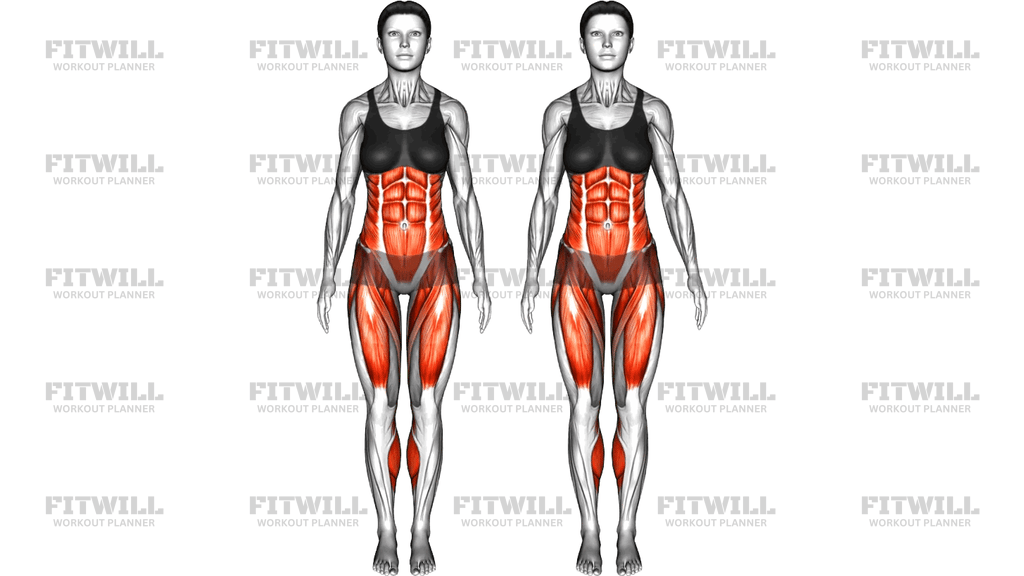
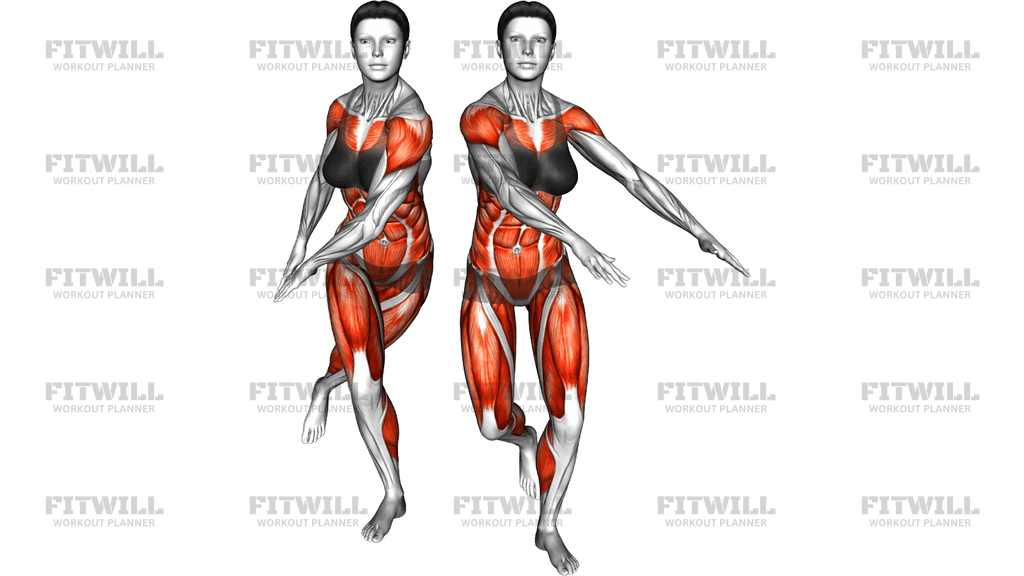
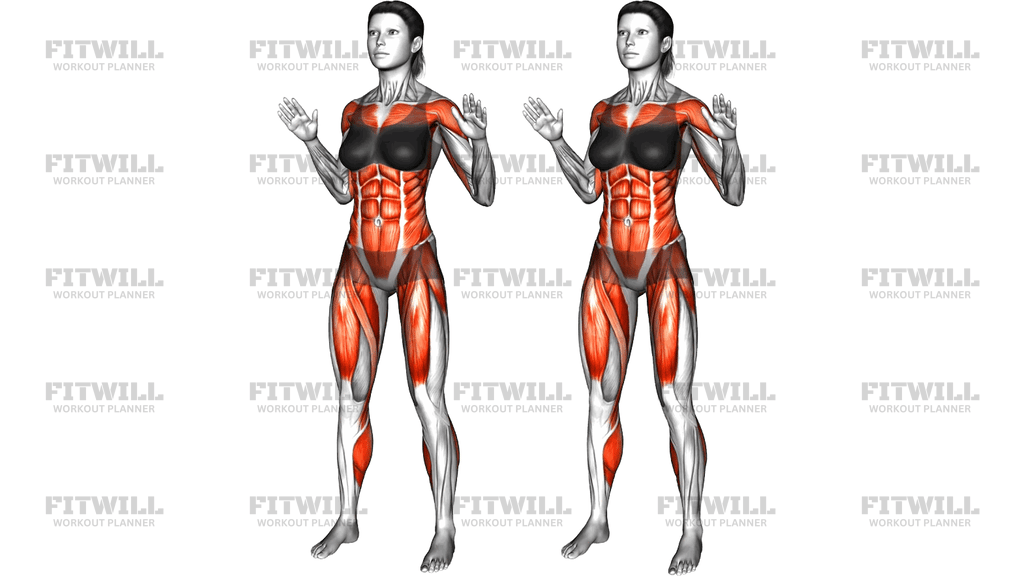
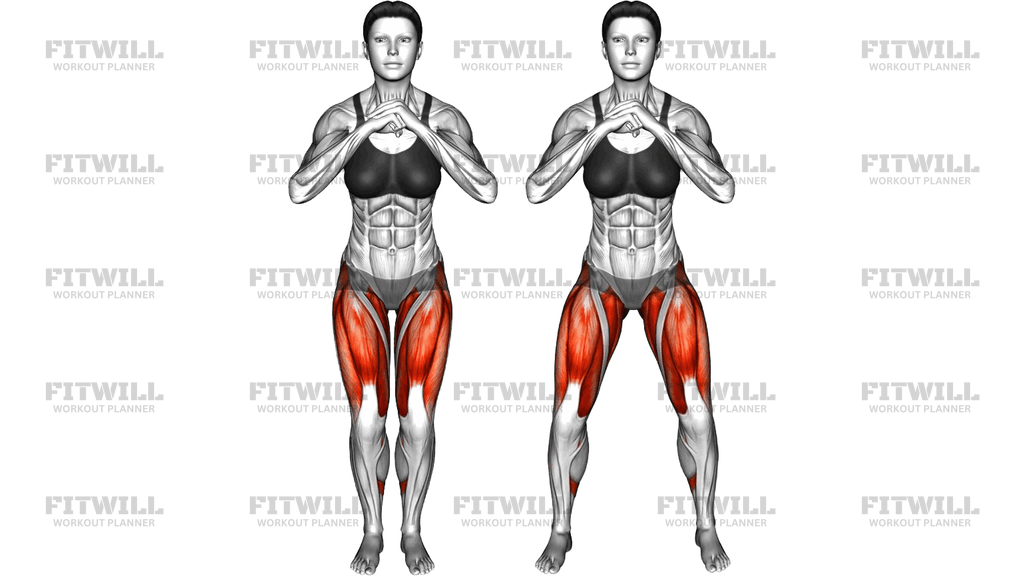
Bodyweight Half Split Squat Hold
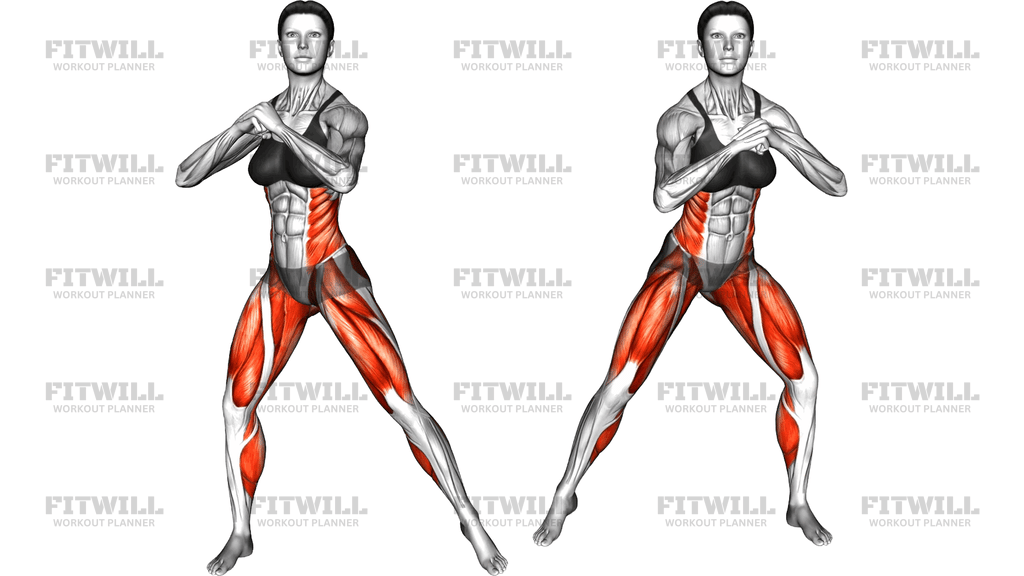
The Bodyweight Half Split Squat Hold is an isometric lower-body exercise where you drop into a split stance, lower to roughly the midpoint of a split squat, and simply stay there. Your hands stay clasped in front of your chest, your front shin stays vertical, and your rear heel lifts off the floor as you balance on the ball of that back foot. There is no equipment required and no movement once you are in position — the entire challenge comes from holding your body still under tension.
Because it is a static hold rather than a repetition-based movement, it challenges the quadriceps in a slightly different way than a regular split squat. Instead of moving through a range of motion, your front-leg muscles have to sustain continuous tension for the length of the hold, which builds local muscular endurance and teaches you to stay composed in the hardest part of the lunge pattern — the midpoint, where the front knee is bent and the load feels heaviest. The rear leg works too, especially the hip flexors and calf of the back leg as they hold the trailing position.
This exercise is useful for a wide range of people. Beginners use it to learn split-stance balance and build the strength needed for full lunges without the coordination demands of repeated reps. Runners, lifters, and field-sport athletes use it as a finisher or warm-up tool to reinforce single-leg stability. It is also a low-fatigue way to accumulate training volume for the legs when you want to avoid heavy loading or joint stress.
Setup matters more than people expect. Your stance width determines everything: too narrow and you will wobble, too wide and your hips cannot stay squared. Aim for a stance long enough that your front knee stacks roughly over the middle of your front foot at the bottom, with the rear heel lifted and the back knee bent underneath your hips. Keep your torso tall and your hands at chest height to help with balance rather than leaning forward to cheat the hold.
To execute it well, lower with control to the half-depth position, exhale, brace your trunk lightly, and commit to holding still. Small shakes are normal — they are your stabilizers doing their job. Time your holds rather than counting reps, breathe steadily throughout, and switch legs so both sides get equal work. Stop the set when your position breaks down, not when your legs simply burn.
From a safety standpoint, keep the front knee tracking over the foot and never let it collapse inward. If your balance is the limiting factor, hold onto a wall or rack lightly with one hand rather than shortening your stance. Progress by adding seconds to each hold before adding difficulty in any other way.
[ Workout Log & Planner ]
Put your next workout in Fitwill
Keep your plan and training log ready when you are.


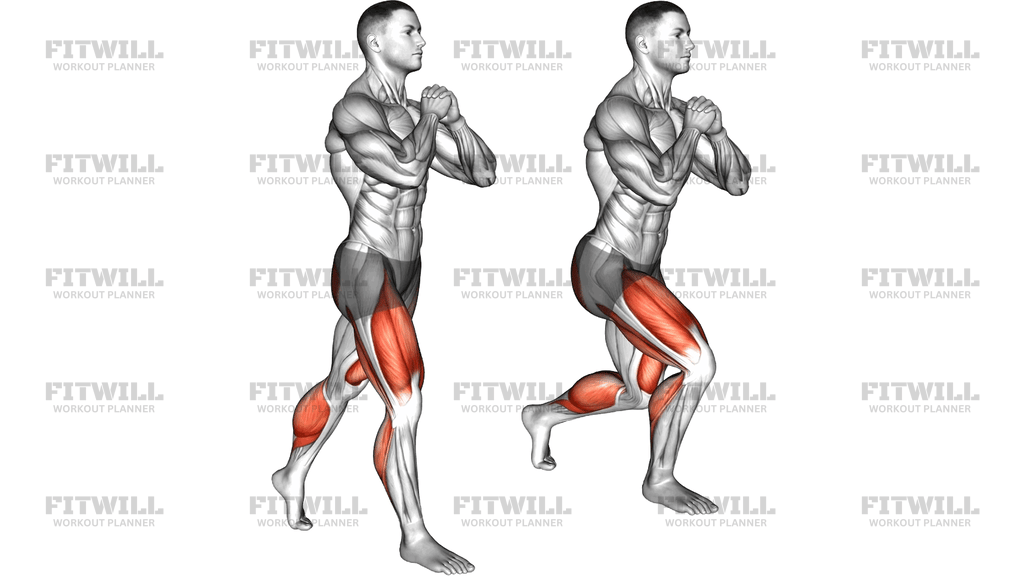
Instructions
- Stand tall with your feet hip-width apart and clasp your hands together in front of your chest at about sternum height.
- Step one leg forward into a split stance, roughly one stride length, then rise onto the ball of your rear foot so the back heel lifts off the floor.
- Keeping your torso upright and shoulders stacked over your hips, bend both knees and lower to the midpoint of a split squat — your front knee bent to roughly 90 degrees or slightly less, back knee bent beneath your hips.
- Check that your front shin is close to vertical and the knee tracks over the middle of your front foot, not caving inward.
- Exhale, brace your core lightly, and hold this half-depth position completely still for your target time.
- Breathe in a slow, steady rhythm through the hold — avoid holding your breath as the burn builds.
- Keep your hands clasped at your chest and resist the urge to lean your torso forward or round your lower back as fatigue sets in.
- When the hold ends or your form starts to slip, push through your front heel to stand back up with control.
- Step your feet back together, shake out your legs briefly, then repeat the hold on the other leg for the same duration.
Tips & Tricks
- If you keep losing your balance, widen your stance slightly front to back rather than shortening it — a cramped stance is harder to stabilize than a proper one.
- A common mistake is letting the front knee drift past the toes and inward; reset by sitting your hips straight down and pressing the whole front foot into the floor.
- The rear heel will want to sag toward the floor as you fatigue; keep actively pressing the ball of the back foot down to maintain tension in the back leg.
- Start with 15-20 second holds per side and build toward 45-60 seconds before making the exercise harder in any other way.
- Do not let your hands drop or your elbows flare wide during the hold — keeping the hands anchored at your chest helps you stay tall and balanced.
- If the midpoint is too hard at first, hold slightly higher (a quarter-depth position) and sink a little lower each week as your strength improves.
- Breathe through the burn instead of clenching your jaw and holding your breath — tensing up makes the hold feel harder than it is.
- Watch for the torso pitching forward; imagine a string pulling the crown of your head toward the ceiling for the entire hold.
- Use this as a finisher after squats or lunges, or as a primer before running or leg day to wake up your stabilizers.
Frequently Asked Questions
What muscles does the Bodyweight Half Split Squat Hold work?
The main muscles are the quadriceps of the front leg, with strong support from the glutes and hamstrings of both legs. The hip flexors and calf of the rear leg also work to hold the trailing position, and your core stays engaged to keep your torso upright.
Is the Bodyweight Half Split Squat Hold good for beginners?
Yes, it is one of the best ways to learn split-stance balance because there are no reps to coordinate — you just hold still. Beginners can start with shorter holds or a slightly higher position and progress from there.
How low should I go for the half hold position?
Lower until your front knee is bent to roughly 90 degrees or a little less — the midpoint of a split squat, not the bottom. If you cannot hold that depth with good position, hold higher and sink lower over time.
Why does my back leg shake so much during the hold?
The rear leg balances on the ball of the foot, so its calf and hip stabilizers work hard the entire time. Shaking is normal at first and usually fades as your single-leg control improves.
How long should I hold the Bodyweight Half Split Squat Hold?
Start with 15-20 seconds per side and build up to 45-60 seconds. Once you can hold a minute with solid form, add a light load or move to full-range split squats for a new challenge.
My front knee hurts during the hold — what should I change?
Check that your knee is stacked over the middle of your front foot and not drifting inward or far past your toes. Also make sure your stance is long enough; a cramped stance forces the knee into a sharper angle.
Can I do the Bodyweight Half Split Squat Hold every day?
Because it is bodyweight and low in fatigue, it can be done most days as a warm-up or mobility-adjacent drill. If your legs are still sore from the previous session, take a rest day first.
What can I use instead if I struggle with balance?
Stand next to a wall or squat rack and rest one fingertip on it for support while keeping your stance the same. Reduce the support over time rather than shortening the stance, so you still train the correct position.
Should I hold the same amount of time on each leg?
Yes, match the weaker or less stable side and let the stronger side follow. Most people have a noticeable difference between legs at first, and equal work helps close that gap.