Seated Single Leg Foot Side To Side
Seated Single Leg Foot Side To Side is a small, precise ankle exercise performed from a chair. You sit tall, extend one leg forward with the heel hovering above the floor, and sweep the foot side to side so the sole rolls from facing inward to facing outward. The motion comes entirely from the ankle joint, which makes it one of the simplest ways to isolate inversion and eversion without any load or equipment beyond something to sit on.
The muscles doing the work sit on either side of the shin. Rolling the sole inward and lifting the arch recruits the tibialis anterior and tibialis posterior along the front and inner shin, while turning the sole outward engages the peroneus longus on the outer lower leg. These are the muscles that steady your ankle every time you walk on uneven ground, change direction, or correct a stumble. Because only one leg works at a time, each side gets its own focused set, which helps you spot and fix a left-to-right difference in ankle control.
This is a useful drill for runners and hikers who want more resilient ankles, for anyone returning from an ankle sprain who has been cleared to rebuild strength, and for older adults working on the balance skills that reduce the risk of rolling an ankle in daily life. It also fits neatly into a warm-up before lower body training, since the extended-leg position lightly loads the ankle through a range that most gym exercises never touch.
The setup matters more than it looks. Sitting on a firm chair with your torso upright lets the hip and knee stay still, so the ankle has to do the moving. If you let the leg swing or the knee drift, the foot simply falls side to side and the ankle muscles get a free ride. Keeping the heel hovering rather than planted means the foot can rotate freely through its full side-to-side arc.
Execute the sweep slowly and deliberately: turn the sole of the foot inward, pause for a beat, then rotate outward and pause again. The tempo should feel almost tedious — the control at the turning points is where the benefit lives. Keep the movement smooth rather than snappy, and stay within a range that feels comfortable at the front of the shin and along the outer ankle.
As for safety, this is a low-load movement, but the ankle is a joint people often push too hard after an injury. Expect mild muscle work, not pain. If you feel sharp discomfort at the ankle bones or along the shin, reduce the range or stop and progress back gradually.
[ Workout Log & Planner ]
Put your next workout in Fitwill
Keep your plan and training log ready when you are.


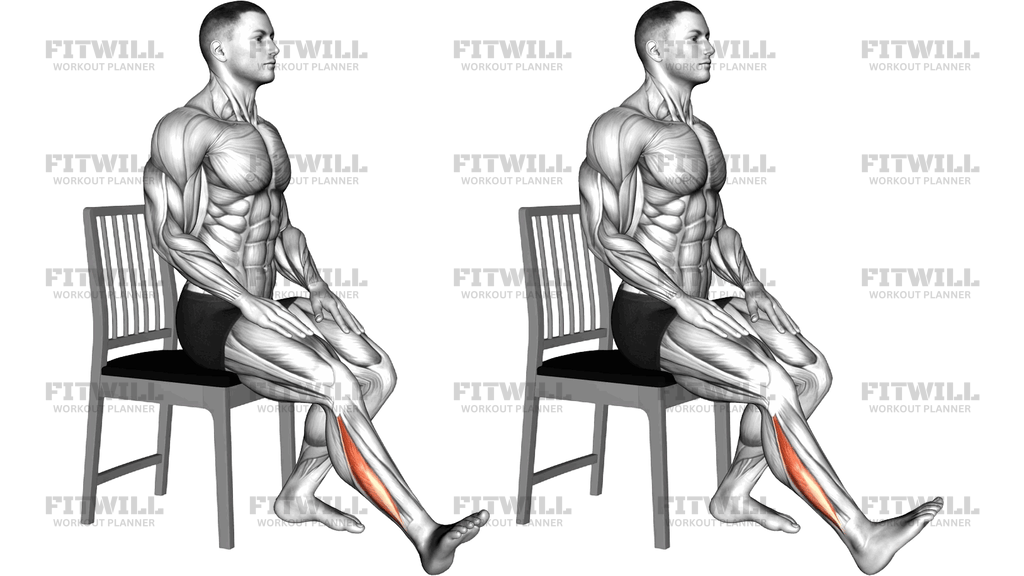
Instructions
- Sit on a sturdy chair or bench with your torso upright, both feet flat on the floor, and your hands resting on your thighs.
- Extend one leg forward so the knee is nearly straight and your heel hovers an inch or two above the floor.
- Lightly brace your abdominals and keep your weight centered on the seat so your torso does not lean as the foot moves.
- From this position, rotate your ankle to turn the sole of the foot inward, as if trying to look at the inside edge of your foot.
- Pause briefly at the inward turn, then sweep the foot the opposite way until the sole faces outward and the outer edge of the foot lifts.
- Keep the extended leg still throughout — the knee points up and the thigh does not swing side to side.
- Continue the windshield-wiper style sweep at a slow, even tempo, feeling the muscles along the inner and outer shin work at each end.
- Breathe steadily throughout, inhaling and exhaling naturally without holding your breath at the turning points.
- Complete your repetitions on one leg, lower the foot to the floor, then switch to the other leg and match the reps.
Tips & Tricks
- The most common mistake is swinging the whole leg from the hip. Rest one hand lightly on the extended thigh to confirm it stays motionless while only the ankle rotates.
- If your foot flops quickly from side to side, slow down and add a one-second pause at each end — the turning points are where the shin and outer-ankle muscles actually earn their work.
- Keep the heel hovering just off the floor rather than dragging it. A planted heel blocks the rotation and forces compensation through the knee.
- Avoid curling or scrunching your toes to force a bigger turn. Let the toes stay relaxed and let the ankle do the rotating.
- Start with a smaller arc than feels necessary. Most people get more out of a controlled half-range sweep than a forced, wobbly full turn.
- Watch for the knee drifting inward or outward as the foot rotates; a light brace through the thigh keeps the knee stacked and the movement honest at the ankle.
- If the front of your shin cramps, which is common when the tibialis anterior is untrained, shorten the set and rest a little longer between legs.
- Do the weaker or stiffer ankle first and match its reps on the other side rather than letting the good side set the volume.
Frequently Asked Questions
What muscles does Seated Single Leg Foot Side To Side work?
The muscles that turn the sole of the foot inward and outward do the main work — the tibialis anterior and tibialis posterior along the shin, and the peroneus longus on the outer lower leg. Together they act as the ankle stabilizers that keep your foot steady under you.
Why is only one leg extended during Seated Single Leg Foot Side To Side?
Working one leg at a time isolates each ankle so the stronger side cannot take over, which is valuable for correcting a side-to-side imbalance. The extended position also frees the foot to rotate fully without the floor blocking the motion.
Is Seated Single Leg Foot Side To Side suitable for beginners?
Yes, it is one of the most beginner-friendly ankle drills because it uses only body weight and a chair. Beginners should start with a small arc and a slow tempo, then gradually widen the sweep as control improves.
How far should I turn my foot side to side?
Turn only as far as you can control smoothly without the leg swinging or pain at the ankle. A comfortable, deliberate sweep beats a forced maximum range every time, and the range usually expands on its own with practice.
Can Seated Single Leg Foot Side To Side help after an ankle sprain?
It is commonly used to rebuild ankle strength and control once you have been cleared to load the joint, because it trains the exact inversion and eversion motions sprains often compromise. Always follow the guidance of your physical therapist or doctor before adding any exercise after an injury.
Why does the front of my shin burn during this exercise?
The tibialis anterior rarely gets isolated work in daily life, so it fatigues and cramps quickly at first. Shorten your sets, rest longer between legs, and the sensation typically fades as the muscle adapts.
What equipment do I need for Seated Single Leg Foot Side To Side?
Just a sturdy chair or bench to sit on. The resistance comes entirely from your own body weight and the ankle moving against gravity with the leg extended.
How does this exercise differ from calf raises?
Calf raises move the ankle up and down and train the gastrocnemius and soleus, while Seated Single Leg Foot Side To Side rotates the ankle inward and outward to train the muscles on the inner and outer shin. The two complement each other rather than replace one another.
Should my knee move while my foot sweeps side to side?
No — the knee should stay pointed up and the thigh completely still. If the leg is swinging, the hip is doing the work and the ankle stabilizers are missing the stimulus, so lighten the effort and re-isolate the motion.
When is the best time to do Seated Single Leg Foot Side To Side?
It works well as a warm-up before running, hiking, or lower body training, and it can also stand alone as a short ankle-strength block. Doing it when you are fresh makes it easier to keep the sweep slow and controlled.