Standing External Rotation Slide With Towel
The Standing External Rotation Slide With Towel is a low-load shoulder mobility and rotator cuff drill performed with your forearm resting on a towel placed on a smooth, waist-to-chest height surface such as a table, bench, or plyo box. You stand beside the surface with your elbow bent to roughly 90 degrees, then slide your forearm outward across the towel while letting the shoulder rotate externally so your palm turns toward the ceiling. The towel reduces friction so the arm glides instead of dragging, which lets the shoulder move through its range without the muscles gripping or compensating.
This movement is a staple in shoulder rehab and warm-up settings. It is useful for anyone rebuilding external rotation after a period of rest or immobility, dealing with stiffness from desk work or throwing sports, or looking for a gentle way to wake up the rotator cuff before pressing, pulling, or overhead work. Because the surface supports the weight of the arm, the small stabilizing muscles around the shoulder joint can work without being overloaded by gravity or resistance.
The main work comes from the external rotators of the shoulder, primarily the infraspinatus and teres minor, with support from the posterior deltoid. The sliding motion also encourages the scapula to stay settled on the ribcage rather than hiking up, which trains the mid-back musculature to hold the shoulder blade in a stable position while the arm moves. That combination of mobility and stability is exactly what most shoulders are missing.
The setup matters more than it looks. The height of the surface determines where your shoulder sits, so choose one that lets your upper arm hang relaxed and your elbow rest at roughly a right angle without shrugging. The elbow should stay in contact with your side or just in front of it throughout the slide. If the elbow drifts away from the body, the movement stops being a true shoulder external rotation and starts borrowing from the chest and front shoulder instead.
To execute it well, think of the hand leading the motion. As your forearm slides outward, let the palm rotate up until you feel a comfortable stretch across the back of the shoulder or into the chest, pause briefly, then slide back to the start under control. Keep your torso square and your neck relaxed. The movement should feel smooth and unhurried, closer to a mobility flow than a strength set.
You will see this exercise used most often as a warm-up before upper-body training, as a restorative drill between pressing sessions, and in return-to-training programs for the shoulder. It pairs well with band external rotations and wall slides. If the sliding surface is rough or the towel bunches up, reset the towel flat before continuing so the arm keeps gliding cleanly rather than catching.
Fitwill
Log Workouts, Track Progress & Build Strength.
Achieve more with Fitwill: explore over 9600 exercises with images and videos, access built-in and custom workouts, perfect for both gym and home sessions, and see real results.
Start your journey. Download today!




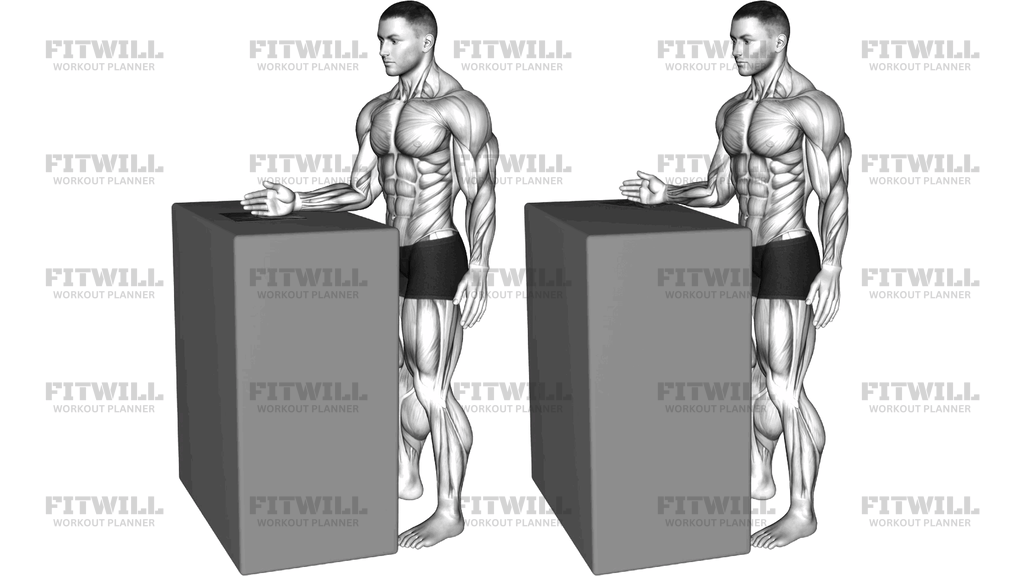
Instructions
- Stand sideways to a smooth, stable surface such as a table, bench, or box that reaches roughly hip to lower-chest height, and lay a towel flat on top of it.
- Place the hand of your working arm flat on the towel with your palm facing down, and bend your elbow to about 90 degrees so your forearm rests on the surface and your upper arm hangs close to your side.
- Stand tall with your feet about hip-width apart, square your torso toward the surface, and let your shoulders drop away from your ears.
- Brace your core lightly and keep your elbow fixed in place, either touching your side or just in front of it, for the entire set.
- Slide your forearm outward across the towel, letting your shoulder rotate so your palm turns upward as your hand travels away from your body.
- Continue sliding until you feel a gentle stretch in the back of the shoulder or across the chest, and hold that end position for one to two seconds without shrugging or leaning.
- Slowly slide the forearm back along the towel to the starting position, turning the palm back toward the floor as you return.
- Exhale as you slide out and inhale as you return, keeping the breath steady rather than holding it.
- Complete the desired repetitions on one side, then reposition the towel and repeat on the other arm.
- Between reps, smooth the towel flat again if it has folded so the forearm keeps sliding instead of catching on the surface.
Tips & Tricks
- The most common mistake is letting the elbow drift away from the torso during the slide, which turns the drill into a general arm swing. Pin the elbow lightly against your side or keep it just in front of the ribs to keep the rotation honest.
- If your shoulder hikes up toward your ear at the end of the slide, you have gone past your usable range. Shorten the slide distance and rebuild it gradually rather than forcing the reach.
- Use a towel that is thick enough to let your forearm glide but not so bulky that your wrist bends sideways over it. A flat, even surface keeps the forearm tracking straight.
- Keep the wrist neutral as the hand turns over. Bending the hand back to gain extra range only stresses the wrist and hides the true end point of the shoulder rotation.
- If your torso twists toward the working arm to extend the slide, reset your stance and square your chest to the surface before each rep.
- Pause for a second at the end range instead of bouncing. The held position is where the shoulder gains most of its mobility benefit.
- A smooth surface works best; on a rubber-coated or textured bench the towel will drag, so switch to a polished table or place a slicker cloth underneath if the glide feels gritty.
- Do this drill before pressing or overhead work rather than after, when the shoulder tissues are cold and the range will be noticeably smaller.
Frequently Asked Questions
Which muscles does the Standing External Rotation Slide With Towel work?
It primarily targets the external rotators of the shoulder, especially the infraspinatus and teres minor, with help from the posterior deltoid. The mid-back muscles also work isometrically to keep the shoulder blade from riding up as the arm slides.
Why does this exercise use a towel instead of just moving the arm freely?
The towel lets the forearm glide across a low-friction surface, which removes the demand of holding the arm against gravity. That support makes it easier to move through external rotation cleanly, which is why it is popular for warm-ups and shoulder recovery.
Is the Standing External Rotation Slide With Towel suitable for beginners?
Yes. The surface supports the weight of the arm and there is no external load, so beginners can learn the external rotation pattern safely. Start with a smaller slide and expand the range as comfort allows.
How high should the table or surface be for this exercise?
Choose a surface that lets your upper arm hang relaxed with your elbow bent to about 90 degrees and your forearm resting flat. If your shoulder shrugs or your torso leans to reach the surface, the height is wrong.
How far should I slide my forearm during the Standing External Rotation Slide With Towel?
Slide only until you feel a mild stretch at the front or back of the shoulder without your elbow leaving your side or your shoulder hiking up. Range should improve over weeks, not within a single session.
What is the most common mistake with this exercise?
Losing the elbow position. Once the elbow drifts away from the ribs, the rotation stops coming from the shoulder's external rotators and the drill loses its purpose.
Can I replace the Standing External Rotation Slide With Towel with band external rotations?
They complement each other but are not identical. Band external rotations add resistance, while the slide emphasizes friction-free range and control, so the slide is usually the better choice early on or before heavy pressing.
How many sets and reps should I do?
One to three sets of eight to twelve slow slides per side works well as a warm-up or mobility drill. Prioritize smooth, controlled slides over high rep counts.
Should I feel pain at the end of the slide?
No. A gentle stretch is expected, but sharp or pinching discomfort means you have pushed past a useful range. Reduce the slide distance, check that your elbow stays at your side, and if the pain persists, have it assessed before continuing.
Do I need to train both arms with the Standing External Rotation Slide With Towel?
Yes, even if only one shoulder feels stiff. Working both sides keeps the range symmetrical, and the less mobile side often benefits from an extra set or a longer pause at end range.