Boxing Cross (With Bag And Gloves)
The Boxing Cross (With Bag And Gloves) is the rear-hand straight punch thrown from your fighting stance into a heavy bag. In an orthodox stance, that means the right hand fires down the middle; in a southpaw stance, it's the left. It's the power punch of the basic arsenal because it draws force from the ground up: the back foot pivots, the hips rotate, the torso turns over, and all of that rotation gets delivered through the fist at the end of a straight line. Wearing bag gloves lets you hit with intent instead of just shadowing the movement, and the bag gives you real feedback on whether the punch lands straight and heavy.
This is one of the best compound upper-body movements you can do without weights. The front shoulders and chest drive the punch, the triceps lock it out, and the obliques and deep core handle the rotational transfer. What most people miss is how much the legs contribute: the push off the rear foot and the rotation through the glutes and quads are where a cross actually gets its pop. Done for rounds, it also drives the heart rate up hard, which is why it shows up in both boxing gyms and general conditioning circuits.
Setup matters more than beginners expect. Your stance width, the angle of your rear heel, and the distance from the bag all decide whether the punch comes out straight or looped. Stand too close and you'll punch with a bent, cramped arm; too far and you'll lean in and lose balance. A solid starting point is bag distance where the punch fully extends right at the surface of the bag with your shoulder finished high, roughly an arm's length plus a half step.
To execute well, think of the cross as a rotation, not an arm swing. Push off the ball of the rear foot, let the hip turn toward the bag, and let the hand travel straight from your chin to the target, with the other glove staying glued to your cheek to guard. Exhale sharply on impact, snap the hand back along the same path, and land right back in your stance. The punch should feel like a whip cracking, not a shove.
Common use cases range from learning proper punching mechanics for the first time to heavy-bag rounds for conditioning to stress relief after a long day. Because there's no eccentric load on a locked-out joint the way there is under a barbell, it's friendly to repeat at high volumes, but sloppy, hyperextended elbows and unrotated hips are the usual culprits when wrists and shoulders get cranky. Keep the arm slightly soft at full extension, keep the wrist straight behind the fist, and build speed gradually rather than maxing out on day one.
[ Workout Log & Planner ]
Put your next workout in Fitwill
Keep your plan and training log ready when you are.


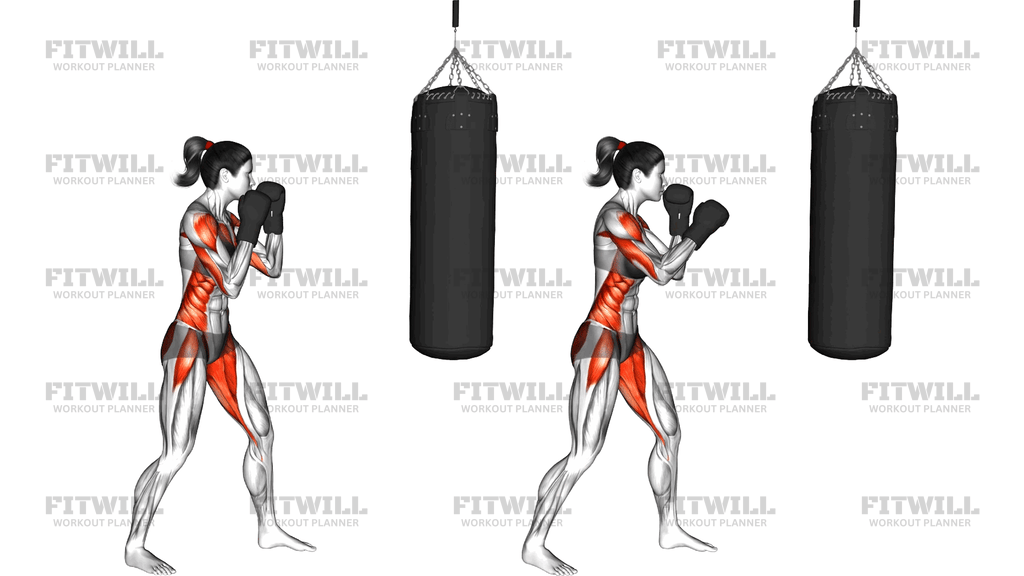
Instructions
- Put on your bag gloves and face the heavy bag in your fighting stance: lead foot forward pointing at the bag, rear foot back and angled out slightly, feet about shoulder-width apart or a touch wider.
- Set your distance so the rear-hand cross extends fully just as the glove meets the bag surface, then bend your knees slightly and sink your weight evenly over both feet.
- Bring both gloves up to chin level, elbows tucked close to the ribs, and look at the spot on the bag you intend to hit.
- Brace your core as if about to take a light tap to the stomach, and keep your chin down behind your lead glove.
- Push off the ball of your rear foot and pivot that heel outward while your rear hand travels in a straight line from your chin toward the bag.
- Rotate your hip and torso into the punch so your rear shoulder comes around and finishes high, with your fist landing knuckles-forward and wrist straight.
- Keep your lead glove pressed to your cheek the entire time so the guard never drops while the rear hand works.
- Exhale sharply as the glove makes contact, striking the bag rather than pushing into it.
- Snap the hand back along the same straight path to your chin, letting the hip return to its original angle so you're fully back in your stance.
- Reset your footing and breathing between punches, then chain crosses together or alternate with jabs once the single punch feels clean.
Tips & Tricks
- If your punches feel weak, check the rear heel first. A flat rear foot blocks hip rotation and turns the cross into an arm punch; pivot that heel every single rep.
- Watch for the rear elbow flaring out to the side on the way in. This loops the punch and stresses the shoulder; cue the elbow to travel close to your ribs until the last few inches.
- Don't drop the lead hand to generate power. It's the most common habit on the heavy bag and it trains a guard you can't rely on later; keep it welded to your cheek.
- Avoid locking the elbow hard at full extension against the bag. Stop just shy of a full snap so the joint isn't jamming with impact every rep.
- If you lose your balance or drift toward the bag, you're leaning instead of rotating. Shorten your distance slightly and think about turning the hip, not reaching with the shoulder.
- Hit through the target, not at it. A light tap stops at the surface; aim for a point a few inches inside the bag with a compact impact so the glove bounces back on its own.
- Breathe out on every punch with a short 'tss' or sharp exhale. Holding your breath through combinations is a fast track to gassing out mid-round.
- Start at maybe 60-70% speed for your first few rounds with the bag. Power built on sloppy mechanics just gets you injured wrists once you add real speed.
- Keep your knees soft throughout. Stiff-legged punches leak power from the legs and beat up your joints when the bag swings back into you.
Frequently Asked Questions
What muscles does the Boxing Cross (With Bag And Gloves) work?
The punch is driven by the shoulders and chest, locked out by the triceps, and powered by the obliques and core through hip and trunk rotation. The glutes and quads contribute significantly because the rear-leg push and pivot start the whole chain.
Is the Boxing Cross suitable for complete beginners?
Yes, it's one of the first punches taught in boxing. Start slow with single crosses at moderate intensity, focusing on the foot pivot and straight hand path before adding speed or combining punches.
How far should I stand from the heavy bag for a cross?
Set your distance so the punch extends fully just as the glove contacts the bag, with your rear shoulder finishing high. If your arm is cramped or you're lunging forward, step back or in until that contact point feels natural.
Why does my cross feel weak even though I'm hitting hard with my arm?
You're most likely punching with the arm alone while the rear foot stays flat and the hips never rotate. Push off the ball of the rear foot, pivot the heel, and turn the hip so the body weight travels through the punch.
Should I fully straighten my elbow on impact with the bag?
Extend almost fully but keep a trace of softness in the elbow, and land with the wrist stacked straight behind the fist. Snapping into a hard lock against a heavy bag with gloves on is the main cause of sore elbows and wrists in beginners.
What can I substitute if I don't have a heavy bag?
The same cross can be trained as a shadowboxing movement with no equipment, or against focus pads if a partner is available. The mechanics of the pivot, rotation, and straight hand path stay identical; you just lose the impact feedback.
How do I stop the bag from swinging back into me after a cross?
Strike sharply and retract the hand immediately rather than pushing through, and reset your stance between punches while the bag settles. If it keeps swinging hard, your punches are more shoves than snaps, so shorten contact time and crisp up the retraction.
Is the Boxing Cross good cardio or mainly a strength movement?
It's both, depending on how you dose it. Single crisp crosses at low volume build rotational punching strength, while continuous rounds on the bag push your heart rate up and work as conditioning.
What's the difference between the cross and the jab?
The jab is the lead hand thrown without much hip commitment, while the cross is the rear hand fired with a full foot pivot and hip rotation behind it. The cross is slower to recover but carries far more body weight.
How many crosses should I do per session on the bag?
A practical starting point is 3 rounds of 2-3 minutes, mixing single crosses and doubles with rest in between. Keep quality higher than volume, and stop a set when your form or hand position starts breaking down.