Kettlebell Reverse Lunge From Deficit
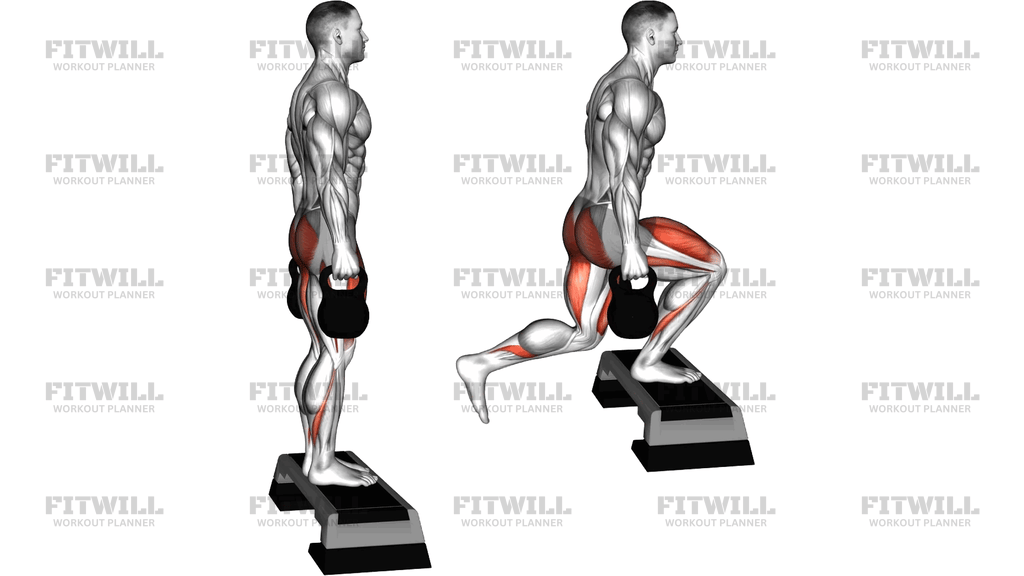
The Kettlebell Reverse Lunge From Deficit is a single-leg strength exercise where you stand on a step platform or low box, hold a kettlebell at your side, and step one foot back down to the floor behind you. Because your front foot starts elevated, your rear leg travels further down than it would in a standard reverse lunge, which increases the range of motion at the front hip and knee. The added depth places a stronger stretch on the glutes and hamstrings of the working leg while demanding more control through the ankle and stance foot.
This movement suits lifters who have already mastered flat-ground split squats and reverse lunges and want a harder version without adding much load. The deficit emphasizes the bottom portion of the lunge, where the glute of the front leg is lengthened under tension. It is commonly used in lower-body sessions focused on glute and quad development, and by runners, cyclists, and field-sport athletes who need strong, stable single-leg mechanics.
Holding the kettlebell in one hand at the same side as the working front leg keeps the load low and close to the body, which challenges your grip and obliques to keep your torso square. If balance is the limiting factor, you can hold the kettlebell on the opposite side or use both hands, but the one-sided carry version gives you the most core and stabilizer work per rep.
Execution matters more than depth alone. Keep most of your weight over the front foot on the platform, drop the back knee straight down toward the floor rather than letting it drift forward, and stop when the rear knee is just above or lightly touching the ground. Drive up through the front foot to return, and resist the urge to push off the back leg. The step platform raises the stakes for balance, so control on the way down and on the way back up is where most of the benefit lives.
A practical safety point: this variation loads the front ankle and knee at end range more than a standard lunge. Start with a low platform of two to four inches, use a lighter kettlebell than you would for regular lunges, and only increase the deficit once you can perform smooth, wobble-free reps with your heel staying planted.
[ Workout Log & Planner ]
Put your next workout in Fitwill
Keep your plan and training log ready when you are.


Instructions
- Place a step platform or low box on the floor and stand on top of it with both feet, holding a kettlebell in one hand at your side with your arm relaxed and fully extended.
- Set your feet about hip-width apart near the center of the platform, toes pointing forward, and shift your weight fully onto the leg that will stay on the step.
- Brace your abs, lift your chest, and pull your shoulders back so your torso is tall before you step.
- Take a long step straight back off the platform with your free leg, planting the ball of that foot on the floor behind you.
- Lower your back knee directly down toward the floor until it is just above or lightly touching the ground, keeping your torso upright and your front heel glued to the platform.
- Pause briefly at the bottom with your weight stacked over the front foot and the kettlebell hanging steady at your side.
- Drive through your front heel and mid-foot to push yourself back up, bringing the rear foot back onto the platform to the starting stance.
- Exhale as you press up out of the lunge and inhale as you step back and lower down.
- Complete all reps on one side, then switch the kettlebell to the other hand and work the opposite leg.
Tips & Tricks
- If your front heel lifts off the platform at the bottom, the deficit is too high for your ankle mobility; drop to a shorter step before adding weight.
- Do not let the kettlebell pull your shoulder down and rotate your torso; keep both hips and shoulders facing forward for the whole set.
- A common mistake is stepping back too short, which turns the movement into a shallow shuffle; reach back far enough that your front shin stays roughly vertical.
- Grip the kettlebell handle firmly but keep your arm loose; a tense, shrugged shoulderfatigues your upper traps before your legs are done.
- If you wobble on the platform, hold a wall or rack lightly with your free hand for the first few sessions until your ankle stabilizers adapt.
- Push the floor away with the front leg on the way up instead of dragging the rear foot forward; the back leg should travel last.
- Keep your ribs stacked over your pelvis; arching the lower back as you tire is a sign to reduce the kettlebell weight or end the set.
- Alternate which hand holds the kettlebell between sets so one side of your core and grip does not develop a strength gap.
Frequently Asked Questions
Which muscles does the Kettlebell Reverse Lunge From Deficit work the most?
The glutes and quads of the front leg do most of the work, with the deficit placing extra stretch-loaded tension on the glutes and hamstrings at the bottom. Your calves, grip, and obliques also work to keep you balanced on the platform.
Is the deficit version harder than a regular kettlebell reverse lunge?
Yes, in two ways: the increased range of motion deepens the stretch on the front hip, and standing on the platform makes balance and ankle stability more demanding. Start with a much lighter kettlebell than you use for flat-ground lunges.
How high should the step platform be for the Kettlebell Reverse Lunge From Deficit?
Two to four inches is enough for most people to feel the extra depth without losing heel contact or form. Only raise the height once you can lower smoothly and keep your whole front foot planted.
Why does the kettlebell go in one hand instead of both?
The one-sided hold adds an anti-rotation challenge for your core and trains your grip, which fits the single-leg nature of the exercise. Switching sides each set keeps the workload even.
My rear knee hurts when I lower to the floor. What should I change?
Control the descent more and stop the rear knee an inch or two above the floor rather than tapping it, and make sure you are stepping back far enough that the load stays on the front leg. A mat under the rear foot also helps if the surface is hard.
Can beginners do this exercise?
Beginners are better served by flat-ground reverse lunges or split squats first, since the deficit magnifies balance and mobility demands. If you want to try it early, use body weight or a very light kettlebell and a very low step.
What can I use if I don't have a step platform?
Any stable, low surface such as a solid aerobic step, a low plyo box, or a sturdy stack of rubber tiles works. Avoid anything that rocks or shifts, since your front foot carries your full weight on it.
Should my front knee track over my toes during the deficit lunge?
Some forward travel is normal at this depth, but aim to keep the knee lined up over the middle of the foot rather than caving inward. If the knee travels far past the toes and your heel lifts, reduce the deficit height.