Dumbbell Goblet Squat With Calf Raise
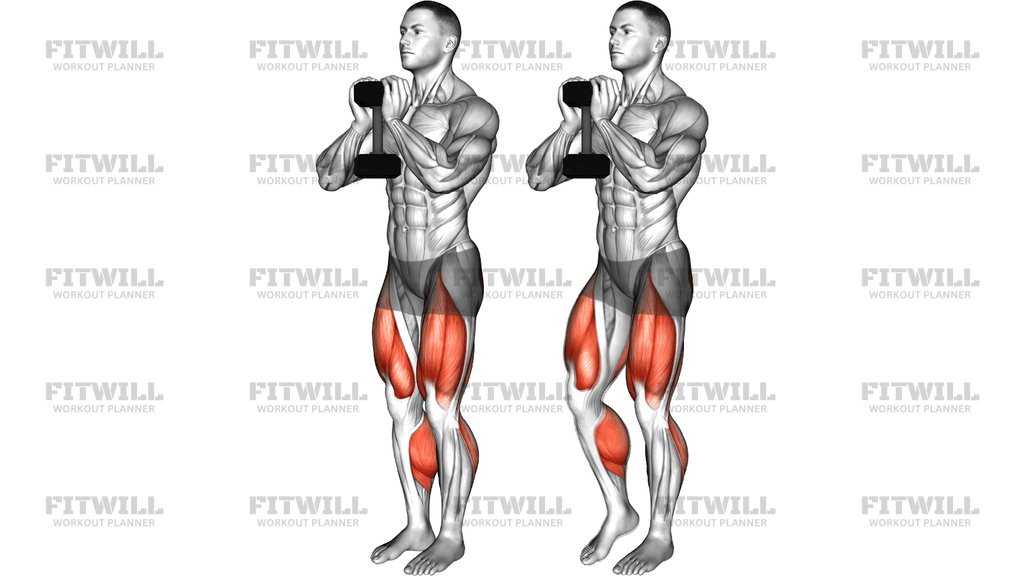
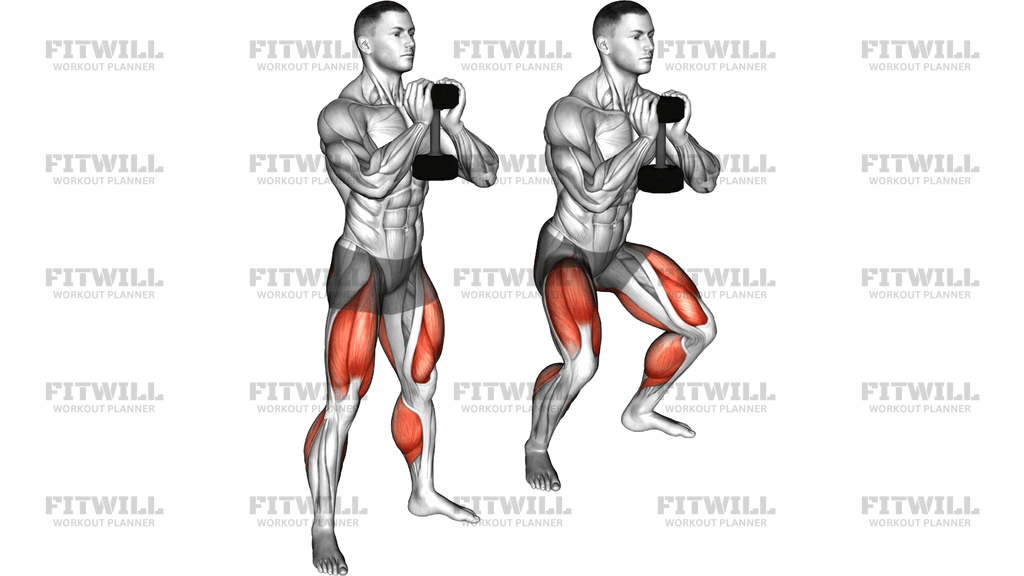
The Dumbbell Goblet Squat With Calf Raise combines two fundamental lower-body patterns into one efficient movement. You hold a single dumbbell vertically against your chest in the goblet position, squat down with control, then drive up through the floor and finish each rep by rising onto the balls of your feet into a full calf raise before the heels settle back down. This means one rep trains the entire chain from the mid-back down to the ankles.
The lower-body emphasis splits between the thigh-dominant squat portion and the ankle-dominant raise. The quads and glutes handle the squat, the hamstrings and inner thighs assist with control and knee tracking, and the calves take over at the top of each rep as you press up onto the toes. Because the weight sits at chest height rather than on your back, your core and upper back also work overtime to keep your torso tall and the dumbbell from pulling you forward.
This is one of the most beginner-friendly ways to load a squat. The front-loaded weight acts as a counterbalance, letting you sit back into a deeper squat while keeping your chest up, which is exactly why coaches use it to teach squat mechanics. Adding the calf raise makes it especially useful for home lifters with limited equipment who want to train the whole leg with a single dumbbell in minimal space.
Setup matters more than it looks. Holding the dumbbell by one vertical head with both hands cupped underneath, elbows tucked close to your ribs, keeps the load centered over your midline. If the weight drifts away from your chest or your elbows flare wide, your lower back and shoulders pick up stress they should not have to manage. Keep the weight snug to the sternum and your ribcage stacked over your pelvis throughout every rep.
Execution comes down to sequencing. Sink into a squat where your thighs reach at least parallel or as deep as your mobility comfortably allows, keep your whole foot planted during the descent, then stand with intent. At the top, without pausing or leaning back, press through the balls of your feet to lift your heels as high as they will go, squeeze the calves briefly, then lower the heels with control before starting the next rep.
A few practical points will keep this movement productive. Choose a dumbbell you can hold at your chest for all reps without your grip or shoulders failing first, keep your knees traveling in line with your toes, and treat the calf raise as its own deliberate rep rather than a quick bounce. If balance is shaky during the raise, stand near a wall or rack until your ankles and calves adapt.
[ Workout Log & Planner ]
Put your next workout in Fitwill
Keep your plan and training log ready when you are.


Instructions
- Stand with your feet about shoulder-width apart, toes turned out slightly, and hold a dumbbell vertically by one head with both hands cupped underneath the top end.
- Pull the dumbbell in against your sternum, tuck your elbows down toward your ribs, and brace your core as if bracing for a light punch.
- Set your weight evenly across both feet and keep your chest tall with your gaze forward or slightly ahead.
- Inhale, then push your hips back and bend your knees to descend into a squat, keeping the dumbbell glued to your chest and your knees tracking over your toes.
- Lower until your thighs are at least parallel to the floor, or to the deepest position you can hold with a flat back and heels down.
- Exhale and drive through your whole foot to stand back up, keeping your torso angle unchanged as you rise.
- At the top of the squat, without stopping, press through the balls of your feet and lift your heels as high as possible into a calf raise.
- Pause for a beat at the top of the raise and squeeze your calves, keeping your knees straight but not locked.
- Lower your heels back to the floor under control, reset your brace, and begin the next squat.
- Breathe in on the way down and out as you stand and rise onto your toes throughout the set.
Tips & Tricks
- Do not let the dumbbell drift forward as you fatigue; if your elbows start pointing outward and the weight pulls your shoulders round, end the set or drop to a lighter bell.
- Keep the calf raise and the squat as two distinct actions. Bouncing off the top of the squat into the raise robs the calves of work and turns the rep into momentum practice.
- If your heels lift early during the squat descent, that is an ankle mobility issue, not a cue to roll onto your toes. Work on ankle mobility separately and squat only as deep as your heels can stay planted.
- Squeeze your inner thighs gently by thinking about spreading the floor apart with your feet; this keeps the knees from caving inward as you tire.
- A common mistake is leaning back at the top to balance during the calf raise. Keep your ribs stacked over your hips and your torso perfectly vertical; the raise should happen at the ankles only.
- Perform the raise with straight legs but avoid snapping the knees backward. Soft knees protect the joint while the calves still do the lifting.
- Grip failure usually ends this exercise before the legs do. Chalk or a towel can help, and switching to a lighter dumbbell with strict form beats a heavy one held loosely.
- If balancing on your toes feels unsteady, stand beside a wall and let your fingertips hover near it for light support until your ankle stabilizers adapt.
- Slow the lowering phase of the squat to two or three seconds on some sets; the goblet position makes tempo work easy and exposes any tendency to collapse forward.
Frequently Asked Questions
Which muscles does the Dumbbell Goblet Squat With Calf Raise work?
The quads and glutes do most of the squat work, the calves take over during the raise at the top, and the core and upper back work isometrically to hold the dumbbell at your chest. The hamstrings and inner thighs assist with control and knee tracking.
Is the Dumbbell Goblet Squat With Calf Raise good for beginners?
Yes, it is one of the best beginner lower-body exercises because the front-loaded dumbbell acts as a counterbalance that helps you keep your chest up and sit into a deep squat. Just master the squat portion first and add the calf raise once your balance is solid.
Should I do the calf raise at the top of the squat or stay on my toes the whole time?
Keep your heels down during the squat and perform the raise only once you are standing tall. Staying on your toes during the descent shifts stress away from the quads and glutes and makes balance far harder without adding benefit.
How heavy should the dumbbell be for this exercise?
Choose a weight you can hold snugly against your chest for all reps without your grip or shoulders giving out before your legs. Because the calf raise adds demand at the end of each rep, most people go slightly lighter than they would for a standard goblet squat.
Why do my calves cramp during the Dumbbell Goblet Squat With Calf Raise?
The calves perform a full raise at the end of every rep while also stabilizing your ankle during the squat, which is more volume than they are used to. Reduce the range of the raise slightly, add a proper warm-up, and progress slowly as they adapt.
What can I use if I do not have a dumbbell?
A kettlebell held by the horns at your chest replicates the goblet position closely, and a single heavy weight such as a weighted ball or a jug can work in a pinch. The key is keeping the load centered against your sternum with both hands.
How deep should I squat before standing up to do the calf raise?
Aim for thighs at or just below parallel, or as deep as you can go with a flat back and heels fully planted. Depth that forces your heels off the floor or rounds your lower back defeats the purpose of the front-loaded position.
My knees cave inward when I stand up from the squat. How do I fix it?
This usually points to weak glutes or simply fatigue. Cue yourself to press your knees outward over your pinky toes, reduce the weight, and consider adding dedicated glute work such as glute bridges to strengthen hip control.
How many reps and sets should I do of the Dumbbell Goblet Squat With Calf Raise?
For general strength and muscle, 3 to 4 sets of 8 to 12 reps works well, with the calf raise counted as part of each rep. For muscular endurance, higher rep ranges of 15 to 20 with a lighter dumbbell are effective.
Is it safe to do this exercise if I have knee or ankle discomfort?
If you have an existing injury or persistent discomfort, get clearance from a qualified professional before loading this pattern. Reduce the squat depth and the height of the calf raise to a pain-free range, and stop any movement that causes sharp or worsening symptoms.