Landmine Kneeling 180s
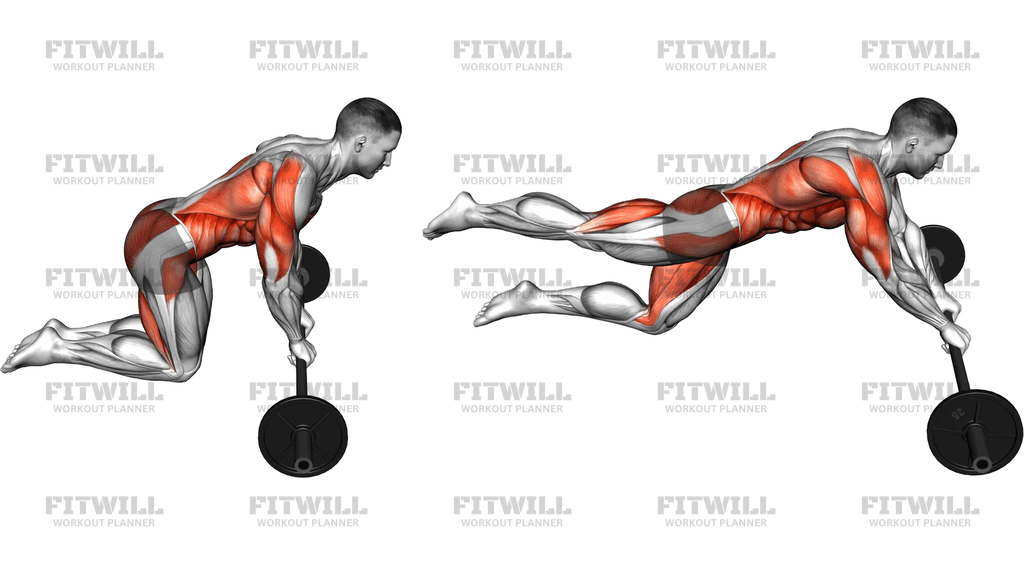
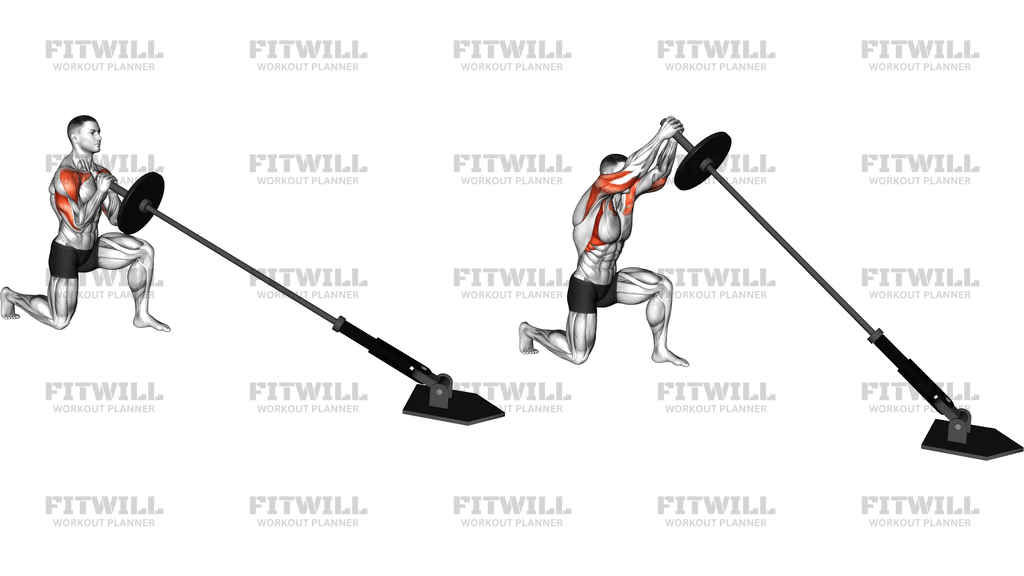
Landmine Kneeling 180s are a rotational core and shoulder exercise performed with one end of a barbell anchored in a landmine attachment or corner while you kneel and control the free sleeve. You hold the loaded end at chest level with both hands, press it up and away from your body, and arc it in a controlled half-circle from one side of your body to the other, so the bar travels roughly 180 degrees around you. The kneeling position is what makes this version special: with no leg drive available, your trunk and shoulders have to do all of the work.
This movement is especially useful for athletes in rotational sports like baseball, tennis, golf, and lacrosse, where transferring force across the midline matters. It is also a smart choice for general lifters who want direct oblique and trunk rotation work without the spinal compression that comes from holding a heavy implement in the hands while twisting. Because the bar pivots around a fixed point, the resistance stays predictable and the arc feels natural rather than jerky.
The main muscles worked are the obliques on both sides of your waist, along with the deep core muscles that stabilize your spine as the load sweeps across your body. The front delts and chest drive the pressing portion of the arc, the upper back helps control the bar as it travels overhead and out to the side, and your hips and quads stay engaged isometrically to keep you upright in the kneeling position. The highlighted work happens when the bar moves away from the anchor, where leverage makes it feel heaviest.
Setup matters more here than in most core exercises. Your distance from the anchor determines the arc: kneel too close and the bar will drift over your head awkwardly; kneel too far and you will fight the leverage instead of rotating smoothly. A tall kneeling posture, with hips stacked directly over the knees and ribs pulled down, protects your lower back from arching under the load as it swings past the midline.
To execute well, keep your hands interlocked around the sleeve and close to your chest to start, press the bar up and slightly away, and let your shoulders and torso rotate as the bar arcs to the opposite side. Think of the arms as struts holding the bar on its path while the trunk does the turning. Reset your torso to face the bar at the bottom of each side, then reverse the same arc back. Start light, because the leverage multiplies quickly as the bar moves away from the anchor.
In programming, Landmine Kneeling 180s fit well as a mid-workout core movement or a finisher, typically for 6 to 10 controlled reps per direction. Because each rep ends with the bar on the opposite side, reps are usually counted per full sweep or per side. If a landmine attachment is unavailable, wedging the barbell sleeve securely into a corner with a towel underneath is a workable substitute, as long as the bar cannot slip during the set.
[ Workout Log & Planner ]
Put your next workout in Fitwill
Keep your plan and training log ready when you are.


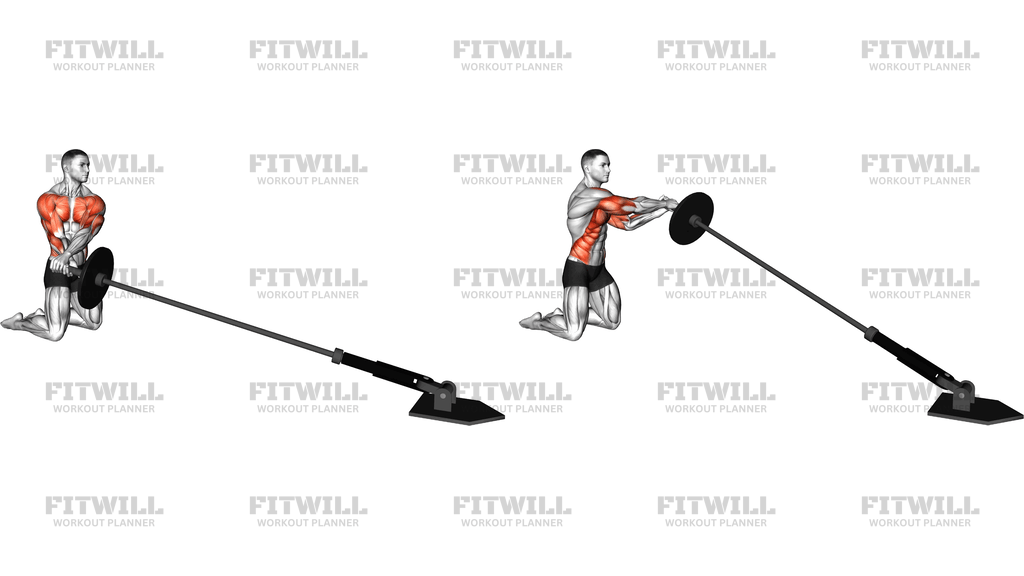
Instructions
- Anchor one end of a barbell in a landmine attachment or wedged securely into a corner, and load a plate onto the free sleeve.
- Kneel on a mat beside the bar so the loaded sleeve is at one side of your chest, facing perpendicular to the bar's line.
- Grip the sleeve with both hands, fingers interlocked or one palm over the other, and pull the bar end in tight to your sternum.
- Sit tall with hips stacked over your knees, squeeze your glutes, and brace your abs like you are about to take a light push to the ribs.
- Press the bar up and away from your chest, then sweep it in a smooth arc across the front of your body toward the opposite side.
- Let your shoulders and torso rotate with the bar while your arms stay mostly extended, guiding it down until the sleeve points away on the other side of your body.
- Pause briefly with the bar at the far side, keeping your ribs down and your lower back from arching as the weight moves overhead.
- Reverse the exact same arc, pulling the bar back across your body until it returns to the starting side at your chest.
- Exhale as the bar presses away and inhale as you pull it back, keeping the breath steady rather than holding it through the whole sweep.
- Complete all reps in one direction or alternate sides each rep, then set the bar down safely before standing up.
Tips & Tricks
- The most common mistake is letting the hips drift or the knees twist off the mat during the arc; instead, rotate through the shoulders and upper back while the kneel stays planted.
- If the bar crashes down on the far side, the plate is too heavy or you are racing the rep; drop the load and own the last third of the arc, where the leverage is worst.
- Keep the bar end close to your chest at the start of every rep. Starting with the arms already extended turns this into a pressing exercise and steals the rotation from your trunk.
- Watch that your ribs do not flare and your lower back does not arch as the bar passes overhead; if you catch yourself leaning back, shorten the arc until your core can control it.
- Interlock your fingers and keep both wrists stacked over the sleeve. A staggered grip lets the bar twist in your hands and pulls your shoulders out of line.
- Place a folded mat or pad under your knees, especially on hard floors, so discomfort does not distract you from bracing.
- Face the correct direction relative to the anchor: kneeling perpendicular to the bar lets the sleeve sweep freely, while kneeling along the bar line jams the arc.
- Think about drawing a rainbow with the plate, high over your head in the middle and low at each side, rather than pushing the bar in a flat, straight line across your body.
- Keep the movement slow enough that you could stop it at any point. If momentum, not muscle, is carrying the bar through the middle of the arc, the weight is too heavy.
Frequently Asked Questions
What muscles do Landmine Kneeling 180s work?
The obliques and deep core do most of the rotational work, while the front delts and chest handle the pressing portion of the arc. The lower back and hip muscles work isometrically to keep you stable in the kneeling position.
Why is this done kneeling instead of standing?
Kneeling removes the legs from the equation, so you cannot cheat the rotation with a hip turn or momentum from the floor. It forces the trunk and shoulders to control the bar through the entire 180-degree sweep.
How heavy should I go on Landmine Kneeling 180s?
Start with a single small plate or even an empty sleeve and master the arc first. Because the bar pivots around the anchor, a plate that feels light at your chest becomes very challenging once it swings out to the side.
How far should I kneel from the landmine anchor?
Kneel far enough out that the loaded sleeve sits comfortably at your chest with the bar at a low angle, and adjust so the sleeve clears your head during the arc. If the bar jams or drags at the bottom of the sweep, move a few inches farther from the anchor.
Should my knees rotate with the bar?
Keep your knees pointing the same direction throughout and let the rotation come from your shoulders, upper back, and trunk. Twisting at the knees turns this into an unstable, joint-stressing position with no added benefit.
How many reps and sets should I use?
Six to ten controlled sweeps per side for two to three sets works well, either as a core block mid-session or as a finisher. Because the leverage is unforgiving, quality reps beat heavy sloppy ones every time.
What can I use if I do not have a landmine attachment?
Wedge the bare sleeve of a barbell securely into a corner of a room, ideally with a towel wrapped around it to protect the wall and stop slipping. Confirm the bar cannot slide before adding any weight to the far end.
Is this exercise safe for the lower back?
It is generally well tolerated when you keep the ribs down and avoid arching as the bar passes overhead. The risk comes from using too much weight or letting the bar drop with momentum, so progress gradually and stay braced.
Can beginners do Landmine Kneeling 180s?
Yes, and the kneeling setup actually makes it beginner friendly because the load is light and the anchored bar is predictable. Begin with an empty sleeve, learn the arc, and only add a plate once each sweep is smooth and controlled.