Dumbbell Single Arm Overhead Carry
The Dumbbell Single Arm Overhead Carry is a loaded carry where you press a dumbbell straight overhead and walk with it locked out in one hand. Because the weight sits on only one side of your body, your shoulder has to hold the dumbbell steady while your core fights to keep your torso from leaning sideways. Every step you take adds a small, unpredictable shift that your stabilizers have to correct.
This movement is popular with strength coaches because it trains several qualities at once: overhead shoulder stability, grip strength, trunk control, and upright posture under load. It is especially useful for lifters who want healthier shoulders, athletes who need to transfer force across their midsection, and anyone whose core work has been limited to planks and crunches. Carrying a weight overhead while walking also builds foot, ankle, and hip control that static exercises simply cannot touch.
The primary work comes from the deltoid of the working arm, along with the upper traps, which keep the shoulder girdle elevated and packed around the weight. The rotator cuff and the muscles of the forearm work hard to keep the dumbbell balanced over the shoulder joint. On the opposite side, the obliques and deep core muscles contract continuously to stop your spine from bending toward or away from the load, while the glute medius stabilizes your hips on every stride.
Setup matters a great deal here. The dumbbell should sit directly over your shoulder joint, not drifting forward behind your head or out to the side. If the weight is even slightly out of position, your shoulder and lower back take on stress that your stabilizers should be handling. Take the time to press the dumbbell up with a locked elbow, stack your ribs over your hips, and settle your breathing before you take your first step.
To execute the carry well, walk with short, deliberate steps and keep your torso tall and square to the direction you are moving. Resist the urge to rush; the value of this exercise comes from time under tension and constant small corrections, not speed. A typical set is a 20 to 40 meter walk per side, switching hands once the dumbbell comes down.
This is a practical exercise with real-world carryover to lifting, throwing, climbing, and everyday tasks like placing items on high shelves. Start lighter than you think you need. If you cannot keep your torso vertical or your arm fully locked out, the weight is too heavy to produce good stabilization work, and the exercise stops training what it is designed to train.
[ Workout Log & Planner ]
Put your next workout in Fitwill
Keep your plan and training log ready when you are.


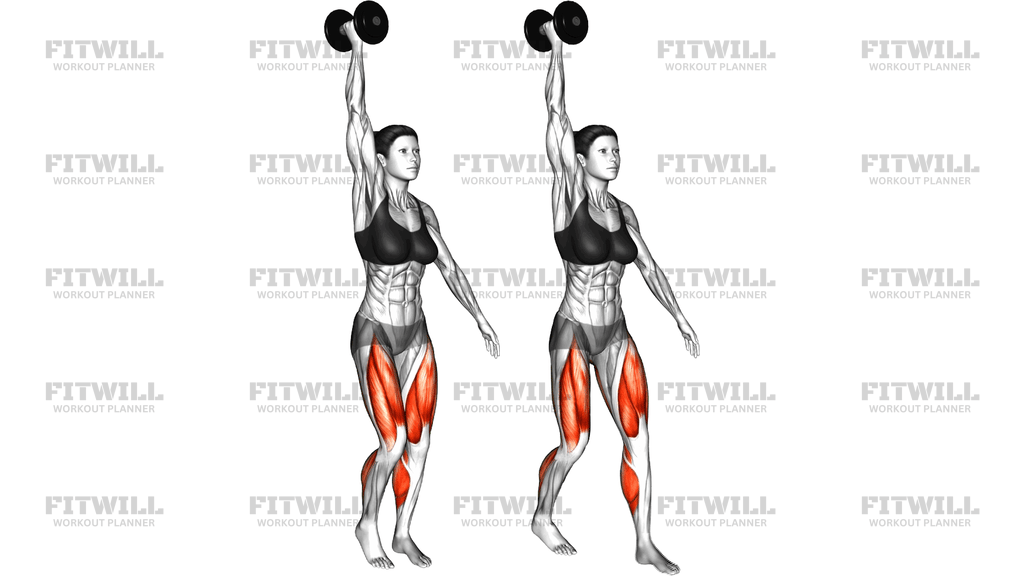
Instructions
- Stand tall with your feet about hip-width apart and a dumbbell on the floor next to your right foot.
- Hinge down and grip the dumbbell's handle firmly in your right hand with a full wrap-around grip, then stand up and clean it to your shoulder.
- Press the dumbbell straight up until your arm is fully locked out, with the weight positioned directly over your shoulder joint and your biceps close to your ear.
- Brace your abs as if preparing for a light punch, pull your ribs down over your hips, and squeeze the glute on the opposite side to level your pelvis.
- Begin walking forward with short, controlled steps, keeping your torso square and your eyes on a point ahead of you.
- Keep your elbow completely straight and your shoulder packed throughout the walk; do not let the dumbbell drift forward or behind your head.
- Breathe in shallow, steady sips through your nose and exhale slowly through your mouth, never letting the brace collapse as you walk.
- Continue for your target distance or time, typically 20 to 40 meters, then stop with your feet together.
- Lower the dumbbell under control by first bringing it down to your shoulder, then hinging and setting it on the floor rather than dropping it.
- Rest briefly, then pick the dumbbell up with your left hand and repeat the same distance to keep both sides even.
Tips & Tricks
- The most common mistake is letting the dumbbell drift in front of the shoulder, which turns the carry into a strain on the elbow and neck. Check your alignment by making sure the weight, your shoulder, and your hip form one vertical line.
- If you catch yourself leaning away from the weight as you fatigue, shorten the distance rather than the brace; a shorter walk with a vertical torso beats a long walk with a bent spine.
- Watch for the shoulder shrugging up toward your ear. Keep the shoulder blade depressed and stable so the traps work without the shoulder riding up into the joint.
- Walking too fast is a frequent error. Speed lets momentum hide the corrections your core should be making, so slow the pace down and feel each foot strike.
- Grip failing before your shoulder or core does is a sign the dumbbell is too heavy or too smooth-handled. Chalk can help, but a slightly lighter weight often solves it.
- Keep the ribs stacked over the pelvis. If your lower back arches and the ribs flare, reset the brace before taking another step instead of pushing through it.
- Do not twist your torso to look around mid-set. Pick a fixed point ahead of you before you start walking and keep your head neutral.
- Alternate which hand starts each session so one side does not always get the freshest, strongest set.
- If balancing is difficult at first, practice the lockout position standing still for 15 to 20 seconds before adding steps.
Frequently Asked Questions
Which muscles does the Dumbbell Single Arm Overhead Carry work the most?
The working side is dominated by the deltoid and upper traps holding the dumbbell overhead, while the forearm muscles handle the grip. On the opposite side, the obliques and deep core muscles work to keep your torso from tipping, and the hips stabilize every stride.
Is the Dumbbell Single Arm Overhead Carry suitable for beginners?
Yes, provided you can press and hold a light dumbbell overhead with a locked elbow. Beginners should start with a weight they could comfortably hold overhead for 30 seconds and use short walks of 10 to 15 meters.
How heavy should the dumbbell be for the Dumbbell Single Arm Overhead Carry?
Choose a weight that challenges your stability rather than your max press strength. If your torso leans, your elbow bends, or the dumbbell drifts away from your shoulder, drop down until you can walk with clean positions.
How is the Dumbbell Single Arm Overhead Carry different from a regular farmer's carry?
A farmer's carry holds weight at your sides, so the shoulders only need to prevent the arms from being pulled down. The overhead version places the load above the shoulder joint, which demands constant shoulder and upper back control and makes the anti-side-bend role of the core much harder.
Why does my grip give out first during the Dumbbell Single Arm Overhead Carry?
Overhead carries expose grip endurance because the forearm must actively squeeze and balance the handle the entire time. Use chalk, wrap your thumb fully around the handle, or reduce the weight slightly until your grip catches up.
Should my arm stay completely straight during the carry?
Yes, keep the elbow locked out with the biceps near your ear so the dumbbell stacks over the shoulder joint. A soft elbow forces the triceps and shoulder to hold a static contraction the whole walk, which fatigues quickly and shifts the work away from the core.
How far should I walk on each set of the Dumbbell Single Arm Overhead Carry?
A practical range is 20 to 40 meters per side, or roughly 30 to 45 seconds of walking. When form breaks down before you reach that distance, cut the set short instead of pushing through with a leaning torso.
Can I substitute a kettlebell for the dumbbell in this exercise?
Yes, a kettlebell works well and its center of mass sits slightly differently over your hand, which some people find easier to balance. Start with a lighter kettlebell than your usual dumbbell because the offset load changes the feel.
Is it safe to walk with a weight held overhead?
It is safe for most healthy trainees when the weight stays stacked over the shoulder and the torso stays upright. Avoid this exercise if you currently have an acute shoulder impingement or any condition that makes overhead positions painful, and always set the dumbbell down under control.