Kettlebell Side Bend
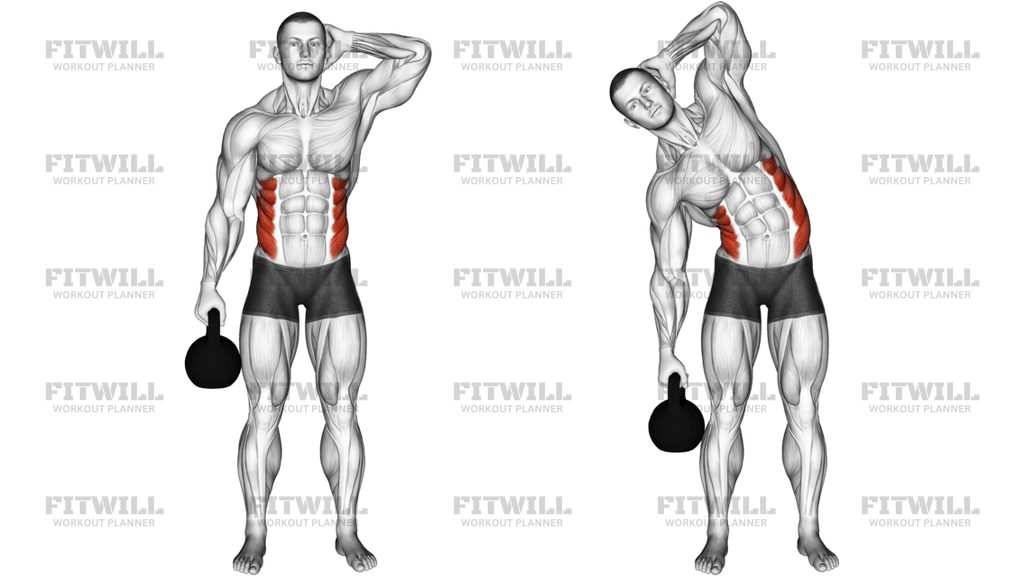
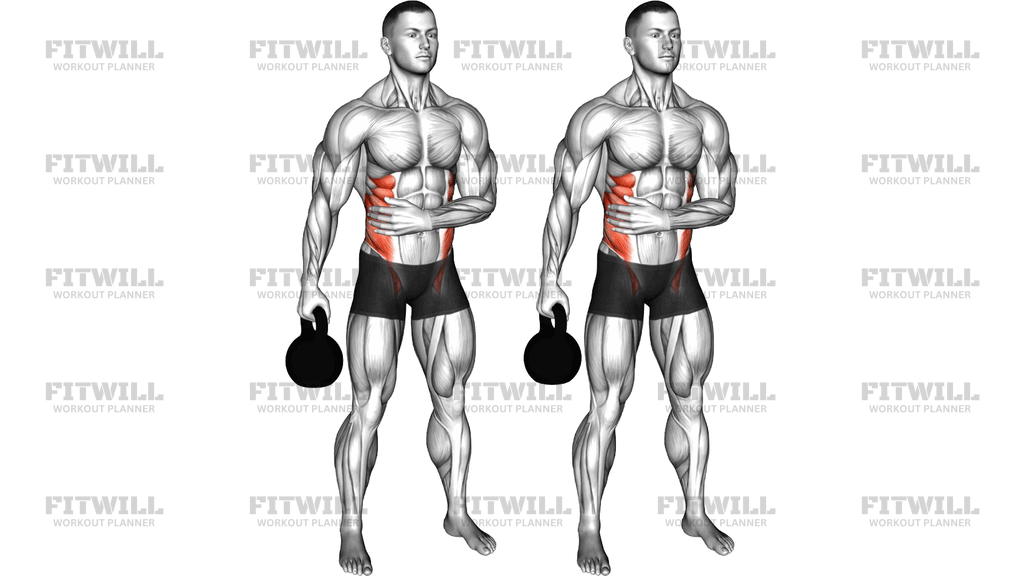
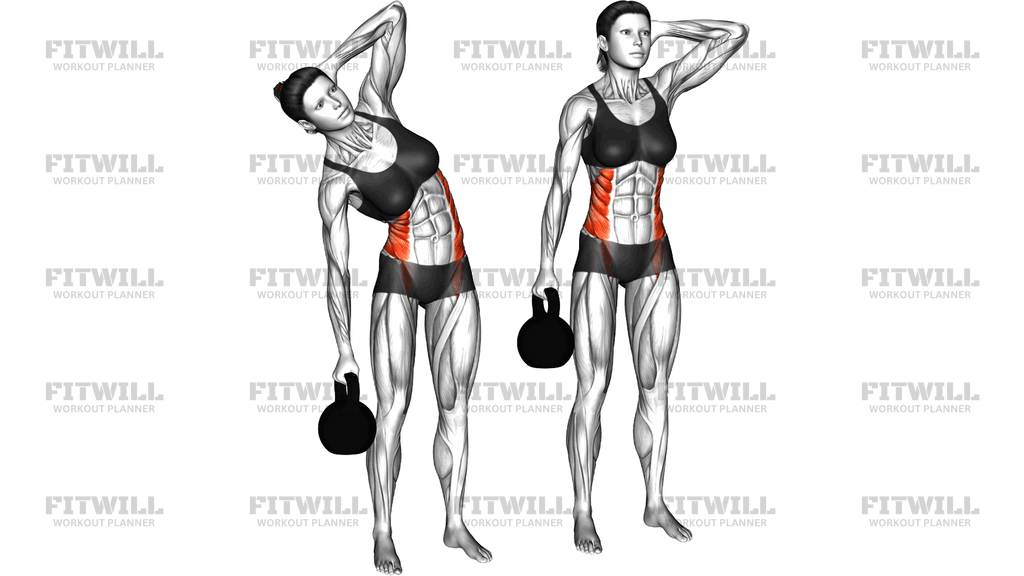
The Kettlebell Side Bend is a standing lateral flexion exercise that targets the muscles running along the side of your trunk. You hold a kettlebell in one hand at your side, place your free hand behind your head for balance and postural feedback, and bend sideways toward the weighted side before pulling yourself back upright. The highlight in the movement diagram falls squarely on the flank of the torso, which tells you exactly where the work should be felt: the obliques and the deep side-wall muscles that control side-to-side bending.
This lift earns its place in a program because lateral bending is one of the least-trained directions of trunk movement. Most core work lives in the sagittal plane, like crunches and planks, or in rotation. Standing side bends with load train the obliques and quadratus lumborum the way they actually work in life and sport, resisting and producing side-to-side lean under a real downward pull. That carries over to carrying heavy groceries on one side, swinging a bat or racket, and stabilizing a barbell in a heavy squat.
The setup matters more than the weight. A kettlebell hanging freely at your side gives a clean, vertical resistance line, so any sideways lean you create comes from your trunk, not from momentum or an angled apparatus. Placing the free hand behind your head serves two purposes: it opens the ribcage on the working side and gives you a physical reference point. If that hand drifts forward or your torso starts rounding, you know your posture is breaking down.
To execute well, stand tall with feet about hip-width apart, weight even through both feet. Hinge only sideways at the waist, letting the kettlebell slide down your thigh toward the knee, then use the side of your trunk on the opposite side to pull yourself back to a tall stand. The bend should feel like a controlled arc, not a collapse. Keep your hips level and facing forward the entire time; the movement happens above the pelvis.
Common use cases include core accessory work after main lifts, unilateral trunk strengthening for lifters who feel lopsided, and general waist conditioning. Because the load is light relative to typical kettlebell work, this fits well near the end of a session for higher repetitions. Keep the weight modest: if you need to swing the bell or rotate your hips to move it, the set becomes a hip exercise with a side-bend costume on, and your lower back pays the difference.
[ Workout Log & Planner ]
Put your next workout in Fitwill
Keep your plan and training log ready when you are.


Instructions
- Stand with your feet roughly hip-width apart, toes pointing forward, and place a kettlebell on the floor just outside your right foot if you are starting on that side.
- Hinge slightly at the hips and grab the kettlebell handle with a firm overhand grip, then stand tall so the bell hangs at arm's length beside your right thigh.
- Place your left hand behind your head with the elbow flared out to the side, and brace your trunk as if bracing for a light punch to the side of the waist.
- Set your hips square and level, both shoulders facing forward, and keep your weight evenly distributed through both feet.
- Exhale as you bend sideways to the right, letting the kettlebell slide down along the outside of your thigh toward the knee, bending only at the waist.
- Stop at the point where the stretch along your left obliques is strong but you can still control the position, typically a torso lean of 20 to 40 degrees.
- Pull yourself back upright by driving your left ribcage down toward your left hip, contracting the obliques on the opposite side of the bell.
- Finish each rep standing fully tall with your shoulders level before starting the next bend, rather than bouncing out of the bottom.
- Breathe out on the way down and inhale as you return upright, keeping the breath smooth and never holding it through the whole set.
- Complete all repetitions on one side, re-grip the kettlebell, then switch to the other side with the opposite hand behind your head.
Tips & Tricks
- The most common fault is craning the neck sideways to look down at the kettlebell. Keep your head neutral and eyes forward; the movement is in your trunk, not your cervical spine.
- If your hips swing sideways during the bend, imagine your pelvis is bolted between two walls. The arc should come from the waist while the pelvis stays facing forward.
- Resist the urge to chase depth. A deep bend achieved by rounding the lower back trains nothing extra; stop where the side of your waist does the work and stay in control.
- Do not let the kettlebell drift forward away from your body. It should track straight down your thigh, which keeps the resistance pulling purely sideways.
- Switch sides without resting long between them if you want balanced fatigue, but always complete the set on one side before picking up with the other hand.
- If you feel the work in your neck or shoulder of the raised arm, soften that elbow slightly and stop pulling your head with the hand. The hand rests behind the head; it does not yank the skull.
- Start with a weight you could hold at your side for a full minute. Load should challenge the obliques on the return, not drag you down on the descent.
- If the lower back aches instead of the waist, you are likely bending with a rounded spine rather than hinging sideways. Re-set tall, brace, and shorten the range.
Frequently Asked Questions
Which muscles does the Kettlebell Side Bend actually work?
The main movers are the obliques on the side opposite the kettlebell, which contract to pull you upright, along with the quadratus lumborum deep in the flank. The rectus abdominis and lower back muscles assist to keep the trunk controlled throughout the arc.
Should I bend toward the kettlebell or away from it?
You bend toward the side holding the kettlebell, letting the weight lower along your thigh, then pull yourself back upright with the obliques on the opposite side. Bending away from the weight is a different stretch-focused variation.
Why does one hand go behind the head during the Kettlebell Side Bend?
The raised hand opens the ribcage on the working side and gives you a posture reference: if it drifts forward or pulls on your neck, your form is slipping. It also discourages using the free arm for momentum.
Is the Kettlebell Side Bend safe for the lower back?
It is generally safe when performed with a moderate weight, a braced trunk, and a controlled range, bending at the waist without rounding the spine. If you have a history of back issues, use a lighter bell, shorten the range, and stop if you feel sharp pain rather than muscular effort.
Can beginners do the Kettlebell Side Bend?
Yes, and it is a good first loaded lateral core exercise. Start with a very light kettlebell or even bodyweight side bends to learn the hip-still, waist-only arc before adding load.
How heavy should the kettlebell be for this exercise?
Choose a weight you can control for 10 to 15 slow reps per side without swinging the bell or leaning your hips sideways. Most lifters do well with a much lighter bell here than they would use for swings or carries.
Why do I feel the Kettlebell Side Bend in my hips instead of my waist?
That usually means your pelvis is tilting or shifting sideways to create the movement instead of the trunk bending. Re-set with hips level and square, and practice the arc with no weight until the bend happens purely at the waist.
What can I substitute if I do not have a kettlebell?
A single dumbbell held at your side works the same way, and a low cable pulley with a handle gives an angled resistance line that changes the challenge slightly. Bodyweight side bends are a fine entry-level version.
How many sets and reps of the Kettlebell Side Bend should I do?
Two to three sets of 10 to 15 controlled reps per side works well as a core accessory at the end of a training session. Keep the tempo slow, about two seconds down and one second up, so the obliques do the work.