Doorway Chest Stretch
The Doorway Chest Stretch is a simple static stretch performed in a doorframe to open up the chest and the front of the shoulders. You place your forearms or upper arms against both sides of the doorframe with your elbows at roughly shoulder height, step one foot forward through the doorway, and gently lean your torso forward until you feel a stretch across the pecs. It requires no equipment beyond a sturdy doorway, which makes it one of the most accessible chest openers available.
This stretch is especially useful for anyone who spends long hours sitting at a desk, driving, or looking at a phone, because those positions roll the shoulders forward and shorten the chest muscles over time. It is also a popular recovery movement on pressing days, helping to restore range of motion after bench presses, push-ups, and overhead work. People with rounded upper backs often find it gives an immediate feeling of opening through the front of the torso.
The primary muscles targeted are the pectoralis major and the smaller pectoralis minor underneath it, with the front deltoids assisting as the shoulder is drawn back. Because your forearms stay anchored to the frame, the stretch also lightly engages the muscles between the shoulder blades as they pull back toward a neutral position.
Setup matters more than most people realize. Elbow height controls where the stretch lands: elbows level with or slightly below the shoulders favor the mid-chest fibers, while raising the forearms a little higher shifts the emphasis toward the upper chest. Keep your ribs down and your spine long as you lean; pushing the chest through the doorway by arching the lower back defeats the purpose and can strain the lumbar region.
To perform the stretch well, step forward with one foot so you can control the depth of the lean, exhale slowly, and let your chest glide forward only until you feel a mild to moderate pull across the chest and front of the shoulders. Hold for fifteen to thirty seconds, breathe steadily, then ease back to the starting position. Avoid any position that produces sharp pain, pinching at the front of the shoulder, or tingling down the arm.
Common use cases include warm-ups before upper-body training, cool-downs after pressing exercises, mid-workday posture breaks, and rehabilitation-style mobility routines. Because the doorway provides a fixed anchor, the intensity is easy to regulate simply by adjusting how far you step forward, making it suitable for beginners and experienced lifters alike.
[ Workout Log & Planner ]
Put your next workout in Fitwill
Keep your plan and training log ready when you are.


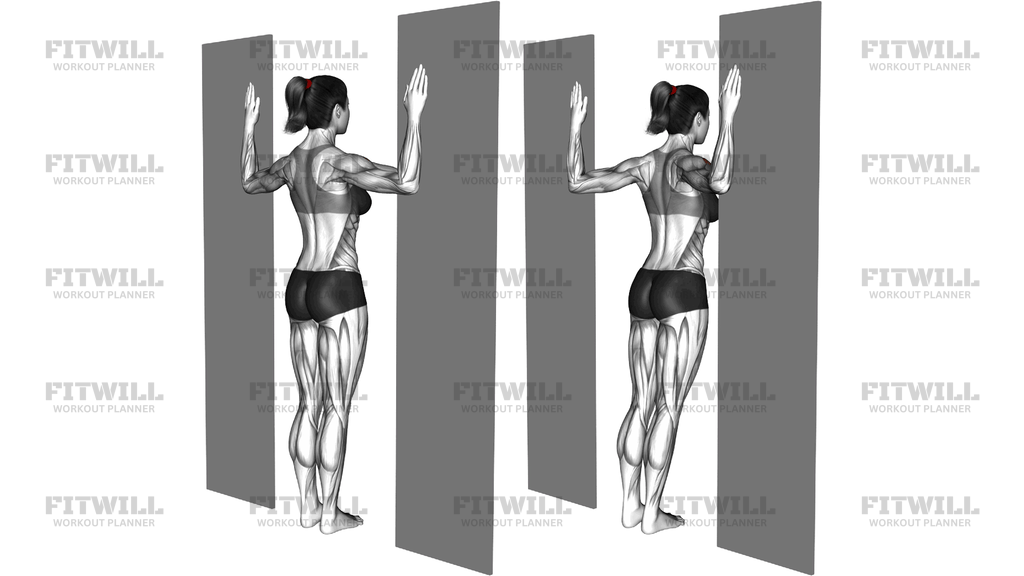
Instructions
- Stand in an open doorway and place both forearms or the inner sides of your upper arms against the doorframe, with your elbows bent to roughly ninety degrees and set at or just below shoulder height.
- Position one foot forward through the doorway and the other foot behind you in a comfortable staggered stance, keeping your feet about hip-width apart for balance.
- Draw your shoulder blades gently down and back so your chest feels tall before you begin the lean.
- Brace your core lightly and keep your ribs stacked over your pelvis so your lower back does not arch as you move.
- Exhale and shift your body weight forward onto your front foot, letting your chest glide through the doorway while your forearms stay pinned to the frame.
- Stop leaning when you feel a mild to moderate stretch across both pecs and the fronts of your shoulders, and hold that position for fifteen to thirty seconds.
- Breathe slowly and steadily during the hold, allowing the chest to relax a little deeper on each exhale if it feels comfortable.
- To release, push gently back through your back foot until the stretch eases off, keeping your forearms on the frame until you are upright.
- Switch which foot is forward and repeat for a second hold, or step away from the doorway and reset entirely between reps.
Tips & Tricks
- Keep your elbows at or slightly below shoulder height first; raising them too high too soon can pinch the front of the shoulder instead of stretching the chest.
- Do not force your head and neck forward as you lean. Many people push through the doorway with the chin instead of the chest, which loads the neck rather than the pecs.
- If your shoulders shrug up toward your ears, consciously press your forearms down into the frame a touch to re-set the shoulder blades.
- Watch for lower back arching, a common compensation when the chest is tight. Tuck your tailbone slightly and keep your abs gently engaged so the stretch stays at the chest.
- Adjust the intensity with your front foot. A shorter step means a lighter stretch; a longer step leans more weight through the doorway, so progress gradually.
- If your doorway is narrow, use only one arm at a time with the other arm hanging relaxed at your side. This also lets you focus on each side separately.
- A towel wrapped around the frame edge can add cushioning if the wood or metal digs into your forearms during longer holds.
- Warm muscles stretch more comfortably, so use this after a workout or a short walk rather than cold first thing in the morning if you feel very tight.
Frequently Asked Questions
Which muscles does the Doorway Chest Stretch target?
It primarily targets the pectoralis major, with the pectoralis minor underneath and the front deltoids also receiving a stretch. The muscles between the shoulder blades work gently to hold your chest open.
Should my elbows be at shoulder height during the Doorway Chest Stretch?
Yes, elbows at or just below shoulder height with about a ninety-degree bend is the standard position. Lower elbows emphasize the mid-chest, while slightly higher forearms shift the focus toward the upper chest.
Is the Doorway Chest Stretch good for beginners?
Yes, it is one of the safest and easiest chest stretches to learn because you control the depth with your front foot. Beginners should start with a short step and a light stretch, then progress over several weeks.
How long should I hold the Doorway Chest Stretch?
Hold for fifteen to thirty seconds per set, resting briefly between holds. For lasting improvements in flexibility, accumulate two to four holds per session and repeat most days of the week.
Why do I feel the Doorway Chest Stretch in my shoulders instead of my chest?
Your elbows are probably set too high or your shoulders are shrugged toward your ears. Lower the elbows slightly, draw the shoulder blades down, and reduce the lean until the sensation returns to the chest.
Can I do the Doorway Chest Stretch every day?
Yes, it is a low-intensity static stretch and most people tolerate daily practice well. Stop or reduce frequency if you notice persistent soreness or pinching at the front of the shoulder.
What can I use instead of a doorway for this stretch?
Any stable vertical surface works, such as a corner wall, squat rack upright, or sturdy pole. The one-arm version against a flat wall is a common substitute that lets you stretch each side individually.
Should I do the Doorway Chest Stretch before or after my workout?
It works well both ways. Use shorter, lighter holds of about fifteen seconds as part of a warm-up, and longer holds of thirty seconds after training or on rest days for flexibility work.
When should I avoid the Doorway Chest Stretch?
Skip it if you have an acute shoulder or chest injury, recent surgery in the area, or if the position causes sharp pain, numbness, or tingling down the arm. Check with a qualified professional before stretching through pain.