Resistance Band Assisted Nordic Hamstring Curl
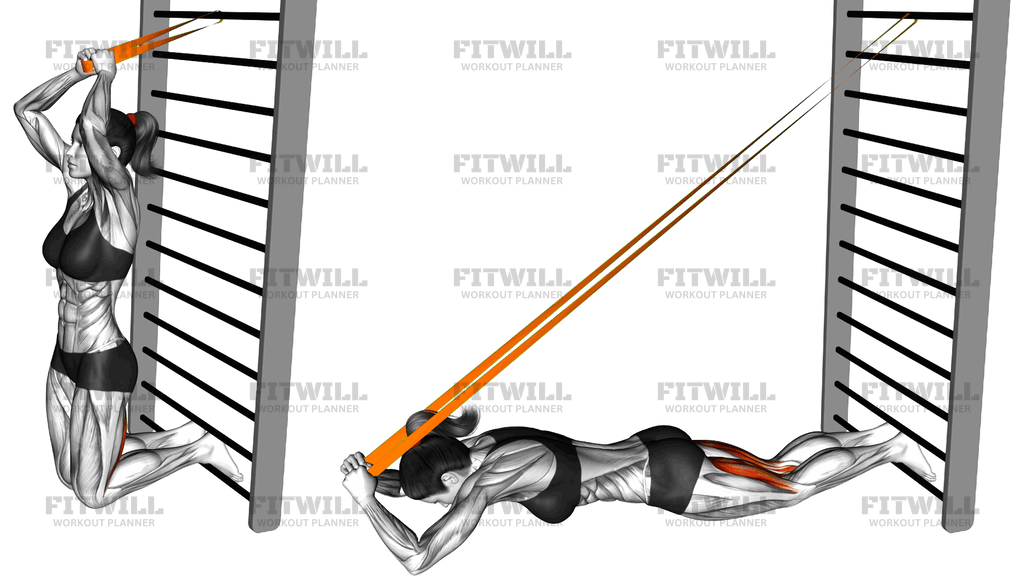
The Resistance Band Assisted Nordic Hamstring Curl takes one of the most demanding bodyweight hamstring exercises and makes it accessible by adding a band for support. You anchor your ankles under a fixed structure, hold a band attached high in front of or above you, and lower your whole body forward from kneeling toward the floor, then use the band's tension to help pull yourself back up. Without assistance, the standard Nordic curl relies almost entirely on the hamstrings to control a heavy eccentric load, which is why so many people fail within the first few inches. The band changes that by sharing the load with your arms and upper body.
This movement primarily trains the hamstrings through a long-length eccentric contraction, which is the portion of the rep where the muscle works hardest as it lengthens under tension. Your glutes, core, and lower back also work hard to keep your hips extended and your body in a straight line as you tip forward. Because the band provides the most help at the bottom of the range, where the movement is hardest, you can actually complete full reps and accumulate quality volume instead of grinding through partial attempts.
The setup is what makes this variation safe and effective. Your ankles need to be firmly anchored so your feet cannot slip out, and the band should be attached to a secure point at or above head height in the direction you are lowering. Holding the band with both hands near your head lets you modulate the assistance: a tighter, shorter band gives more help, while more slack shifts work back onto the hamstrings. If your anchor point, band tension, or ankle position is off, you either lose the assist mid-rep or turn the exercise into a band pull with little hamstring involvement.
To execute it well, keep your hips extended and your body rigid from knees to head as you lower. Most people break at the hips, letting the torso fall forward first, which removes tension from the hamstrings and turns the rep into a hip hinge. Think of your thighs, hips, and torso as one rigid lever tipping toward the floor, and only use your arms on the band to control the speed and catch you near the bottom. The return comes from driving your knees down and pulling with the band until you are upright again.
This exercise suits lifters who cannot yet perform full Nordic curls, athletes rebuilding hamstring strength after a layoff, and anyone using Nordics as a regular accessory for sprinting, running, or leg development. Because the band tension can be adjusted rep by rep, it also works well as a progression tool: reduce the assistance gradually over weeks until your hamstrings handle the movement on their own. Stop the set if you feel cramping in the hamstrings, which is common with this exercise, and avoid letting your hips sag or your lower back round at the bottom.
[ Workout Log & Planner ]
Put your next workout in Fitwill
Keep your plan and training log ready when you are.


Instructions
- Anchor the resistance band to a sturdy overhead or high attachment point in the direction you will be lowering, and check that it is secure before kneeling.
- Kneel on a padded surface facing the anchor with your knees roughly hip-width apart, and hook your feet under a fixed bar, rung, or pad so your ankles stay locked in place with toes pointing back.
- Grip the band with both hands at head height or above your head, elbows bent, and adjust your grip so the band is taut in the upright position.
- Squeeze your glutes, brace your abs, and align your shoulders, hips, and knees in one straight line so your thighs do most of the work and your hips do not collapse forward.
- Lower your entire body forward from the knees in a slow, controlled arc, keeping hips extended and resisting with your hamstrings as your torso travels toward the floor.
- Catch yourself near the bottom with your hands on the band, letting the stretched band absorb load while your chest, shoulders, or arms touch down lightly if needed.
- Pull on the band and press your knees into the floor to drive your body back up to the upright kneeling position, keeping the movement one smooth arc rather than a segmented push and pull.
- Exhale as you pull back up, and inhale briefly at the top before the next lowering phase.
- Complete your reps, release the band carefully, then unhook your ankles one foot at a time while still kneeling to stand up safely.
Tips & Tricks
- Start with a thicker or shorter band than you think you need. Most first attempts fail because the band is too light, and the bottom half of the rep drops fast with no assist.
- If your lower back arches and your belly drops toward the floor at the bottom, your hips have broken extension. Re-set with a harder glute squeeze and a slightly shorter range before going deeper.
- Resist the urge to turn this into a band row. Your arms should steer and support, not do the pulling; the hamstrings and knees should drive the return.
- Cramping in the hamstrings is common in the first few sessions. Work in low-rep sets of 3 to 5 and stop the set at the first sign of a cramp rather than pushing through it.
- Keep your grip on the band at or above head level. Holding it lower turns the rep into a press-up and changes the assistance angle mid-descent.
- A slow lowering phase of 3 to 5 seconds gives you far more hamstring benefit than rushing to the bottom and yanking back up.
- If your ankles slip out from under the anchor, reposition so the pad or bar sits across the lower calf or ankle bone, not the middle of the foot, and check it between sets.
- Progress by reducing band tension over weeks, then by using one hand instead of two, before attempting an unassisted Nordic curl.
Frequently Asked Questions
Which muscles does the Resistance Band Assisted Nordic Hamstring Curl work?
The hamstrings are the primary movers, working eccentrically as you lower forward. Your glutes, core, and lower back stabilize to keep your hips extended and your body rigid throughout the arc.
Is this exercise good for beginners who cannot do a Nordic curl yet?
Yes, that is its main purpose. The band offloads enough tension at the hardest point of the range that you can complete full reps and build the eccentric hamstring strength needed for an unassisted Nordic.
How tight should the resistance band be for the Resistance Band Assisted Nordic Hamstring Curl?
It should be taut while you kneel upright, so tension is already present as you start lowering. If there is slack at the top, the band only catches you near the bottom and the rep gets choppy.
Why do my hips drop or sag at the bottom of the movement?
That usually means your glutes and core have stopped holding extension, so the load shifts to your lower back. Cut the depth slightly, re-brace, and squeeze your glutes harder before your next rep.
Can I do the Resistance Band Assisted Nordic Hamstring Curl without a band?
You can substitute a partner holding your shoulders for a similar assist, or use a low bench or box under your chest to limit the range. Without any help, most people can only manage short partial reps.
How does this differ from a standard Nordic Hamstring Curl?
The band shares the load with your arms and gives the most assistance where the movement is hardest, near the bottom. A standard Nordic leaves the full eccentric load on the hamstrings alone.
How many reps and sets should I do?
Start with 3 to 4 sets of 4 to 6 reps with a controlled 3 to 5 second descent. The eccentric emphasis makes this fatiguing quickly, so quality reps matter more than high volume.
Is it safe for my knees and lower back?
When your ankles are securely anchored, your hips stay extended, and the band is attached to a solid point, the movement is generally well tolerated. Use a pad under your knees, stop if you feel cramping, and avoid rounding your back at the bottom.