Dumbbell Squat To Overhead Press
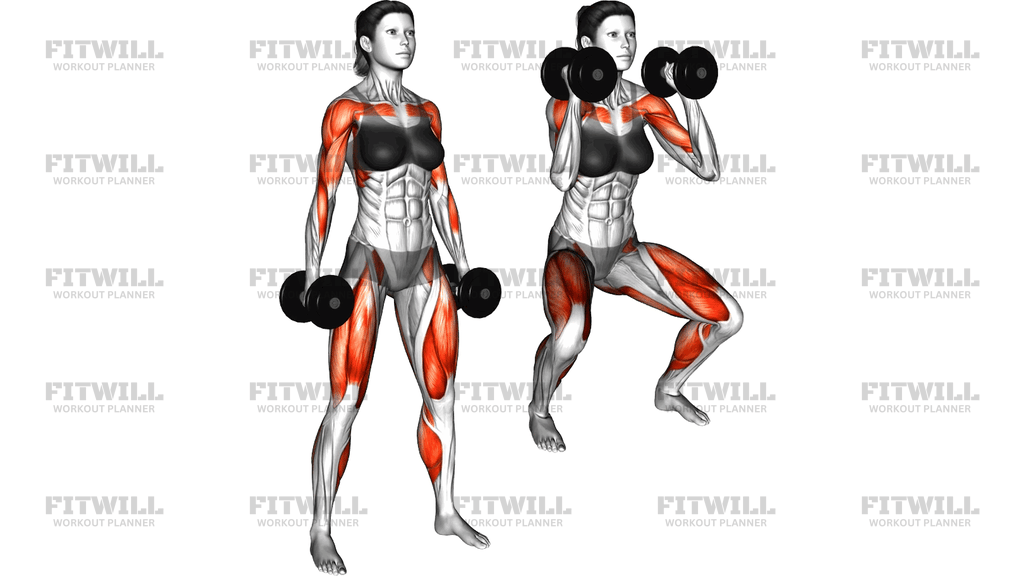
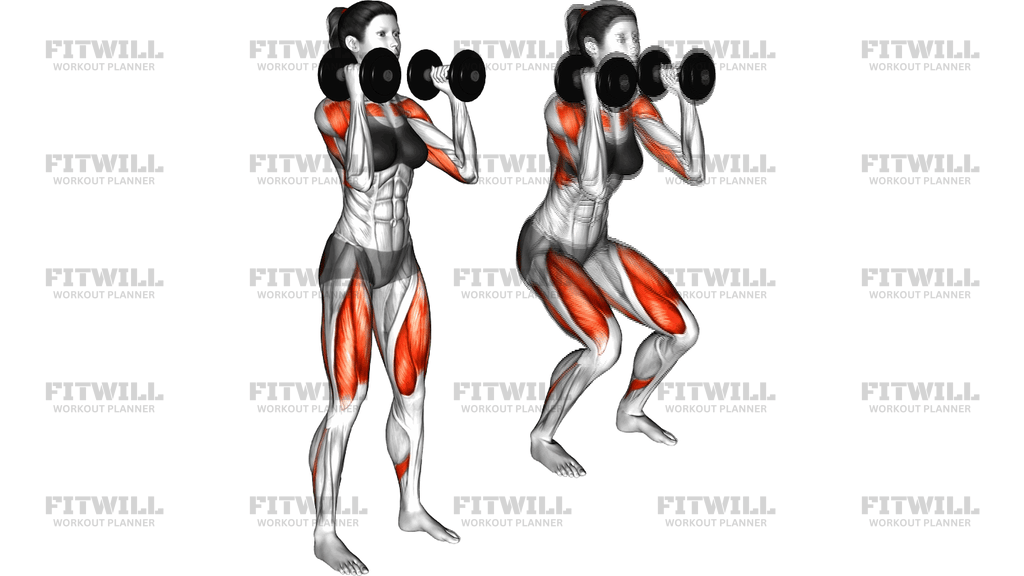
The Dumbbell Squat To Overhead Press is a full-body compound lift that combines two fundamental patterns into one continuous movement: a squat with the dumbbells held at shoulder height, followed by an overhead press as you stand back up. You descend with the weights racked at your shoulders, drive through your legs to rise, and use that upward momentum to help press the dumbbells straight overhead before lowering them back to the shoulders for the next rep.
This exercise earns its place in a program because it links the lower and upper body into one coordinated effort. The squat portion loads the quads, glutes, and hamstrings, while the press challenges the front shoulders and triceps. Your core works the entire time to keep your ribs stacked over your pelvis and stop the weights from pulling you off balance, which is exactly what makes this lift more demanding than doing squats and presses separately.
Because the whole chain has to work together, the setup matters more than it might seem. The dumbbells should rest at your shoulders with elbows tucked roughly under the weights, not flared wide, and your feet should be set about hip-width to shoulder-width apart with toes turned slightly out. If the weights drift forward or your elbows drop during the squat, the press becomes sloppy and your lower back takes on stress it does not need.
Execution is about sequencing, not rushing. Squat down with control until your thighs are at least parallel or as deep as your mobility allows, keep your chest up and heels planted, then stand explosively. As your hips reach full extension, press both dumbbells overhead until your arms are straight and the weights are directly over your shoulders, not out in front of your face. Lower the dumbbells back to the shoulders with control, take a breath, and repeat.
This movement suits lifters who want efficient full-body training, people short on time who need a lot of work done in few exercises, and anyone building conditioning with moderate dumbbells for higher reps. It is common in circuit and metabolic training, but it also works as a strength movement when the dumbbells are heavy enough that the press is a genuine challenge.
The main safety point is honesty about your shoulder and overhead mobility. If you cannot press the dumbbells overhead without arching your lower back or driving your head forward, reduce the weight and work on that position first. Keep the squat and press as two clean phases of one rep rather than a single tangled motion, and stop the set as soon as your squat depth or press path starts to break down.
[ Workout Log & Planner ]
Put your next workout in Fitwill
Keep your plan and training log ready when you are.


Instructions
- Stand with your feet about hip-width to shoulder-width apart, toes turned slightly outward, holding a dumbbell in each hand.
- Clean the dumbbells up to your shoulders so the heads of the weights rest near the front of your shoulders, palms facing inward or slightly forward, with your elbows tucked under the dumbbells rather than flared out to the sides.
- Brace your core as if bracing for a light punch, pull your shoulder blades down and back slightly, and keep your chest lifted with your gaze forward.
- Push your hips back and bend your knees to squat down, keeping the dumbbells at your shoulders, your heels flat, and your knees tracking over your toes.
- Descend until your thighs are at least parallel to the floor or to the deepest position your hips and ankles allow without your heels lifting or your lower back rounding.
- Drive through your whole foot to stand up forcefully, letting the momentum of standing lead directly into the press.
- As your hips reach full extension, press both dumbbells straight overhead until your arms are locked out and the weights sit directly over your shoulders and ears.
- Lower the dumbbells under control back to your shoulders as you prepare for the next rep, resetting your elbows under the weights.
- Exhale forcefully as you stand and press, and inhale at the top or as you lower into the next squat.
- Finish the set by stepping the dumbbells back down to the floor with a hip hinge rather than dropping them from shoulder height.
Tips & Tricks
- The most common mistake is turning this into a squat followed by a separate, slow shoulder press with no connection between the two. Use the drive from your legs; if you never feel any carryover of momentum from standing into the press, you are working two lifts, not one.
- Watch for your elbows dropping during the squat. If the dumbbells slide down your chest and your elbows point at the floor, the weights will pull you forward when you stand. Squeeze the dumbbells against the sides of your shoulders and keep elbows up throughout the descent.
- If your lower back arches visibly when the dumbbells reach overhead, the weight is too heavy or your overhead position is tight. Lower the dumbbells to a load you can press with your ribs stacked over your pelvis, and keep your glutes squeezed at lockout.
- Do not let the dumbbells drift out in front of your face at the top. Finish each press with the weights over your ears and your biceps near your ears, not out in front, so your shoulders rather than your spine support the load.
- Keep your heels and the balls of your feet planted through the whole squat. If you rise onto your toes when standing, the press will start off-balance; sit slightly wider or shallower until you can keep your feet flat.
- Pick a dumbbell weight based on the press, not the squat. Most people can squat far more than they can press overhead, so the dumbbells will feel light on the squat portion. That is normal; the press is the limiting factor in this movement.
- For conditioning work, keep the transitions smooth and continuous between reps. For strength work, pause briefly at the top of each press and reset your brace before descending into the next squat.
- If your wrists bend backward under the dumbbells, grip the handles deeper toward the base of your palm so the weight stacks over your forearm instead of pulling your hand into extension.
Frequently Asked Questions
Which muscles does the Dumbbell Squat To Overhead Press work?
The squat portion primarily targets the quads and glutes with help from the hamstrings, while the press works the front shoulders and triceps. Your core stays active throughout to keep your torso upright and transfer force from your legs to your arms.
Is the Dumbbell Squat To Overhead Press suitable for beginners?
Yes, provided you can already perform a bodyweight squat with good depth and an overhead press without arching your lower back. Start with light dumbbells to learn the timing between standing up and pressing before adding load.
Should I press the dumbbells as I stand up or after I finish standing?
The natural version of this movement lets the drive from your legs flow into the press, so the dumbbells begin rising as your hips extend. If you prefer strict strength work, you can pause at the top of the squat and press from a dead stop.
Why do my elbows keep dropping during the squat?
The dumbbells are likely sitting too far forward on your chest and pulling your elbows down. Reset them so the heads of the weights rest against the front of your shoulders and keep your elbows tucked under the dumbbells for the entire descent.
What should I do if I cannot press the dumbbells straight overhead?
Your overhead shoulder mobility or thoracic extension may be limited. Reduce the weight, work on pressing with your ribs down and head neutral, and consider practicing the press from a seated position before returning to the full squat to press.
How heavy should the dumbbells be for this exercise?
Choose a weight based on your overhead press, since the press is almost always the limiting phase. The dumbbells should feel manageable in the rack position so the squat stays controlled and the press can be completed without leaning back.
Can I use the Dumbbell Squat To Overhead Press for cardio or conditioning?
Yes, with lighter dumbbells and continuous reps it works well in circuits and metabolic training because it uses a large amount of muscle at once. Keep the squat depth and press path clean even when your breathing gets hard.
What can I substitute if I only have one dumbbell?
Hold a single dumbbell at one shoulder or in the goblet position at your chest and squat to a one-arm or single-sided press. This adds an anti-rotation challenge for your core, so brace firmly to keep your torso square.
Is it safe to do this exercise with lower back discomfort?
The main risk is arching your lower back at the top of the press, so keep your ribs stacked over your pelvis and squeeze your glutes at lockout. If any position in the movement provokes discomfort, reduce the load or consult a qualified professional before continuing.
How many reps and sets should I perform?
For strength and muscle, 3 to 4 sets of 6 to 10 reps with a challenging dumbbell weight works well. For conditioning, 2 to 3 rounds of 12 to 15 continuous reps at a lighter load keeps the movement smooth and breathing elevated.