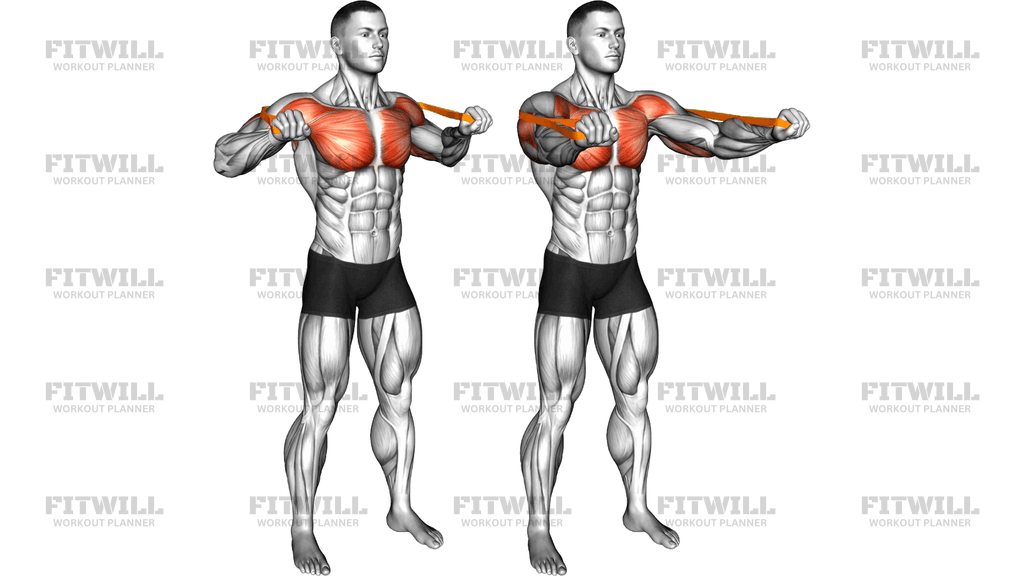
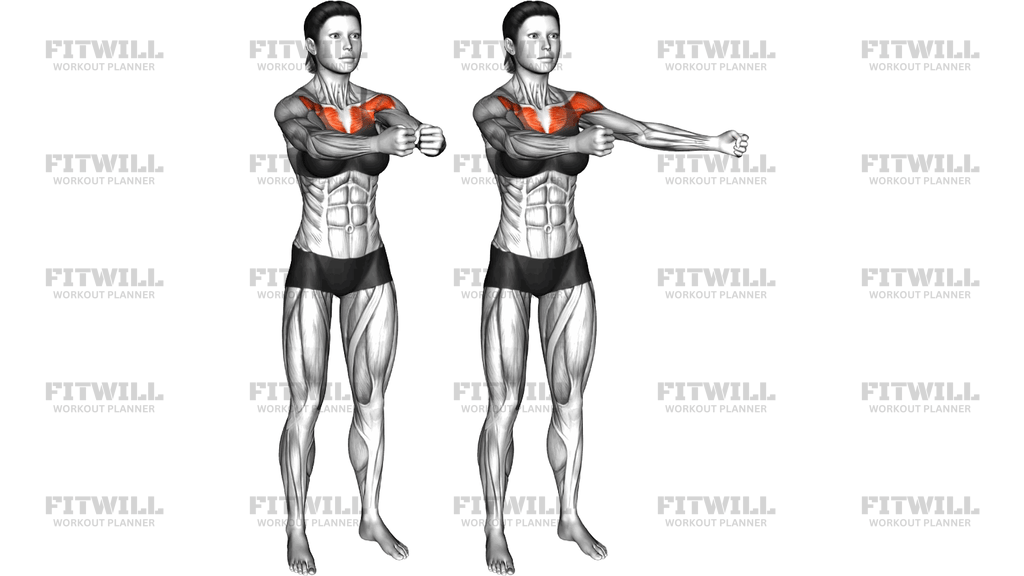
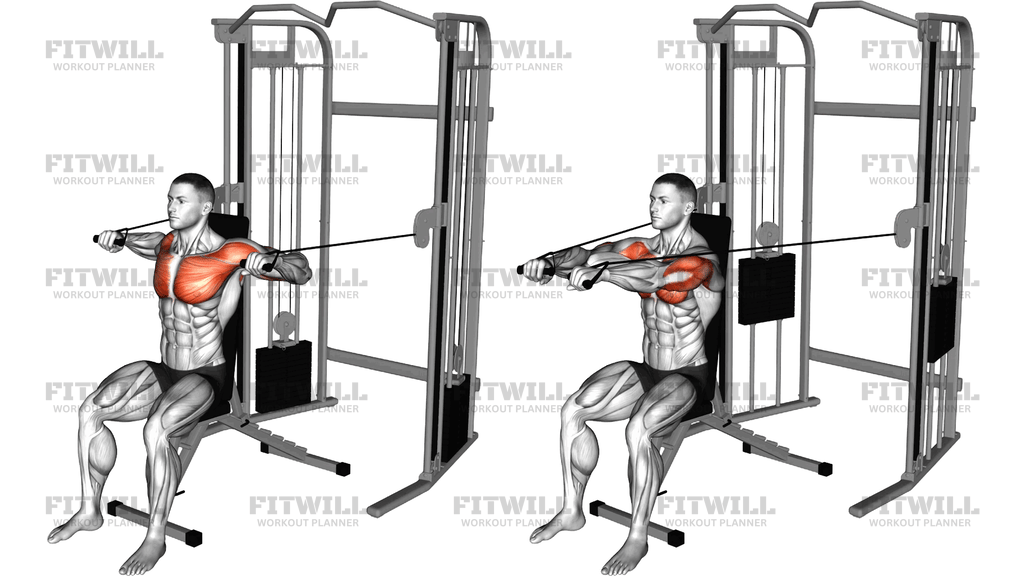
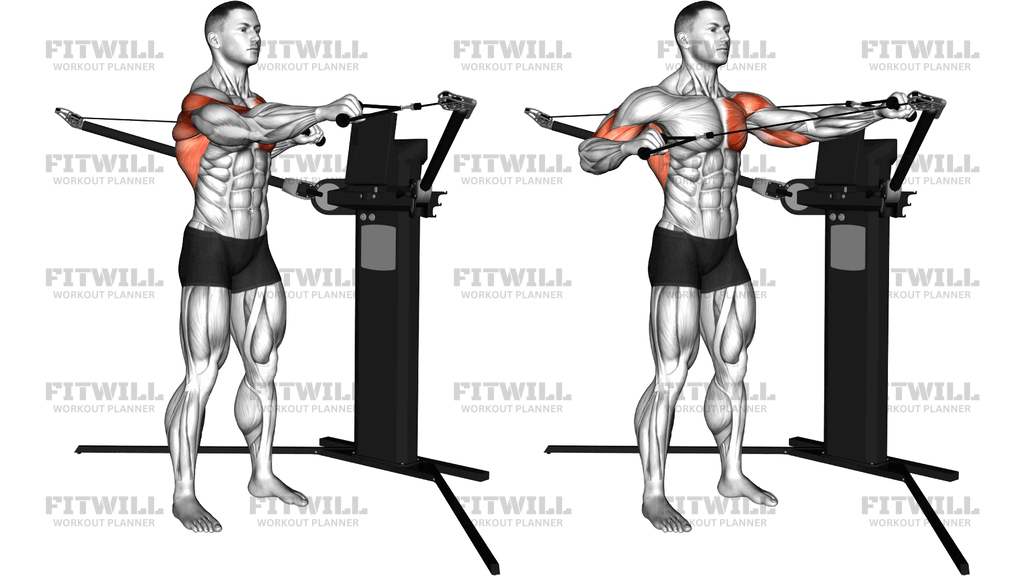
Cable Lying Bench Cross Lateral Raise
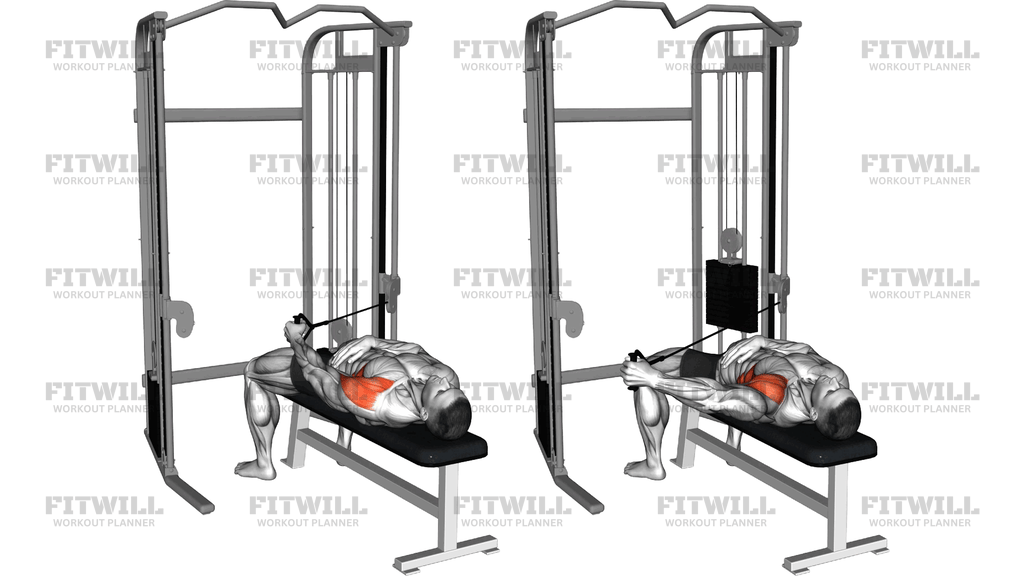
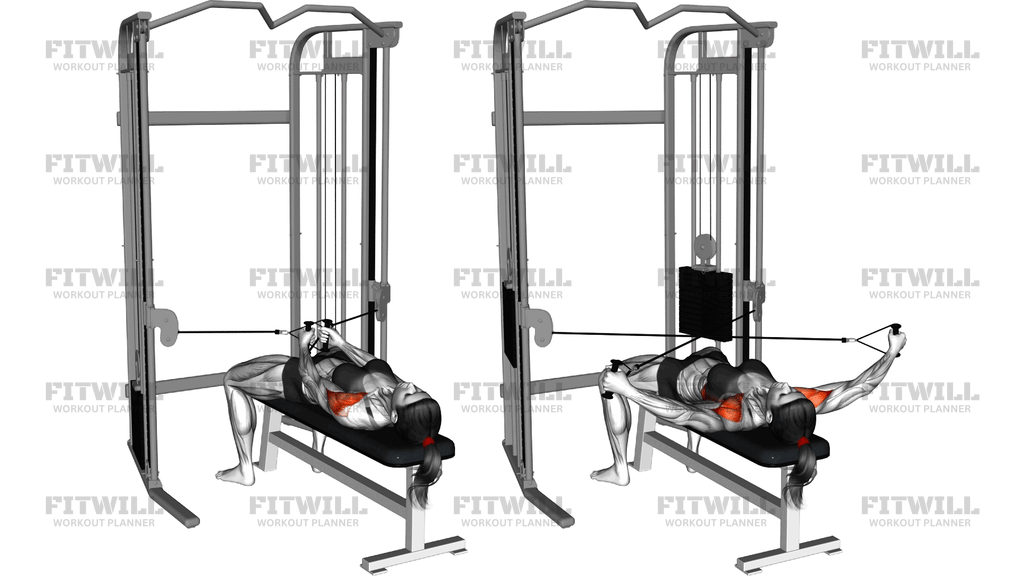
The Cable Lying Bench Cross Lateral Raise is a chest isolation movement performed face-up on a flat bench set between two low pulleys of a cable crossover. You start with each arm extended out to the side, roughly level with your shoulders, holding a handle in each hand so the two cables cross over your torso. From there you sweep both arms up and together in a wide arc until the handles meet above your chest, then lower them back out under control. It is essentially a supine fly pattern, but the crossed low-pulley setup changes the resistance angle compared with a dumbbell fly or a standard cable crossover.
This exercise mainly trains the pectorals, with the middle and lower portions of the chest doing most of the work as the arms travel from a wide, low position up toward the midline. The front delts assist the lift, and the biceps and forearms work statically just to hold the handles and manage the cable tension. Because the cables pull downward and outward from the low pulleys, the chest is loaded throughout the entire arc, including at the bottom where dumbbells tend to lose tension.
The setup is what makes this version valuable. Lying on the bench removes momentum from your torso and stabilizes your shoulder blades against the pad, while the cross-pulley arrangement lets each arm travel slightly across the body at the top, which extends the range of motion past what a dumbbell allows. Getting the bench centered between the pulleys matters: if it is offset, one cable will pull harder and the movement will feel lopsided from the first rep.
This is a useful choice for lifters who want more constant chest tension than dumbbells provide, or who have trouble feeling their chest work in pressing movements. It also suits higher-rep finishers at the end of a chest session, since the cable stack allows small, precise jumps in load and the bench position keeps the movement safe to push close to fatigue. Keep the weight modest, move in a smooth wide arc, and treat it as an isolation exercise rather than a strength lift you chase numbers on.
[ Workout Log & Planner ]
Put your next workout in Fitwill
Keep your plan and training log ready when you are.


Instructions
- Place a flat bench lengthwise between the two low pulleys of a cable crossover, centered so both pulleys are the same distance from your torso.
- Attach a single handle to each low pulley, select a light weight on both stacks, and confirm the selector pins are set equally.
- Lie back on the bench with your head resting on the pad, feet flat on the floor on either side, and grab one handle in each hand with a neutral grip.
- Extend your arms out to the sides at roughly shoulder height with a slight, fixed bend in the elbows, letting the cables cross above your torso; this is your starting position.
- Brace your core, press your shoulder blades into the bench, and keep your ribcage from arching upward before you begin the lift.
- Sweep both arms up and inward in a wide arc until the handles come together above your lower to mid chest, elbows staying slightly bent the whole way.
- Squeeze your chest briefly at the top, allowing each hand to travel toward the opposite shoulder so the arms finish crossing the midline.
- Lower the handles back out to the sides along the same arc, stopping when your upper arms reach shoulder level and you feel a stretch across the chest.
- Exhale as you raise the handles, inhale as you lower them, keeping the breathing steady with each repetition.
- After your final rep, let one stack settle first, then carefully return the second handle before sitting up to avoid the cables snapping back.
Tips & Tricks
- If one side feels heavier than the other, the bench is almost always off-center between the pulleys rather than a real strength imbalance — recheck the setup before adjusting the stacks.
- Do not let the elbows open up to 90 degrees or lock straight; a small fixed bend protects the elbow joint and keeps the tension on the chest instead of the joint capsule.
- A common mistake is pulling the handles in with the biceps like a curl as fatigue sets in. Think about leading with the elbows and drawing them toward each other rather than bending the arms further.
- Stop the descent at shoulder level rather than letting the cables drag your arms below the bench line — the low pulleys keep pulling downward, so going too deep loads the shoulder at its most vulnerable angle.
- Keep your lower back in contact with the bench. If your ribs flare and your hips lift to help the handles up, the weight is too heavy for an isolation movement.
- Because the cables cross, the handles pass close to your face and chest at the top. Keep the arc slightly toward your lower chest so the handles clear your torso comfortably.
- Use lighter loads and higher reps here than you would on a press. Cable tension at the stretched position makes the same weight feel considerably harder than a dumbbell fly.
- Lower the weight under control for a two to three second count. Dropping the arms back down quickly is the easiest way to lose tension and the most common reason people feel this in the shoulders instead of the chest.
Frequently Asked Questions
Which muscles does the Cable Lying Bench Cross Lateral Raise work?
The pectorals are the primary movers, especially as the arms sweep up and across the midline. The front delts assist, while the biceps, forearms, and rotator cuff stabilize and hold the handles.
Why use crossed low pulleys instead of a regular cable crossover for a lying fly?
The cross setup lets each hand travel past the midline toward the opposite shoulder, which extends the range of motion and keeps tension on the chest through the whole arc. Standard low-to-high crossover angles shift the load differently and are harder to keep consistent when lying down.
Is the Cable Lying Bench Cross Lateral Raise suitable for beginners?
Yes, as long as the weight stays light and the bench is centered between the pulleys. Beginners often benefit from practicing the arc with one arm at a time first to learn the path before using both handles.
How does this differ from a dumbbell fly on a flat bench?
Cables maintain constant tension in the stretched position at the bottom, where dumbbells lose resistance, and the crossed cables allow the hands to cross the midline at the top. Most lifters need less absolute weight here than on a dumbbell fly for the same effort.
Why do I feel this more in my shoulders than my chest?
That usually means the elbows are opening and the arms are moving like a lateral raise rather than a fly, or the handles are traveling above mid-chest height. Keep the slight elbow bend fixed and finish each rep with the handles meeting over your lower to mid chest.
How far down should I lower the handles at the bottom?
Stop once your upper arms reach shoulder level and you feel a stretch across the chest. Because the cables pull downward from the low pulleys, dropping deeper pushes the shoulder joint past a comfortable range under load.
Can I do this exercise with one arm at a time?
Yes, and it is a good way to correct side-to-side differences. Just keep your torso braced against the rotation, since a single cable will try to pull you off the bench.
Where should the bench be positioned relative to the pulleys?
Center it between the two low pulleys so both cables pull at the same angle onto your torso. An off-center bench is the most common cause of an uneven pull in this exercise.
What can I substitute if my gym has only one adjustable cable column?
A single-arm cable fly from a low pulley while standing, or a resistance band fly anchored behind you, reproduces a similar arc. You lose the bench support, so brace your core harder to keep your torso still.
Is it safe to do this exercise close to failure?
It is one of the safer chest movements to take near fatigue because the bench supports your torso and cables do not drop on you like a dumbbell can. Just make sure to release one handle at a time at the end of the set so neither cable snaps back.