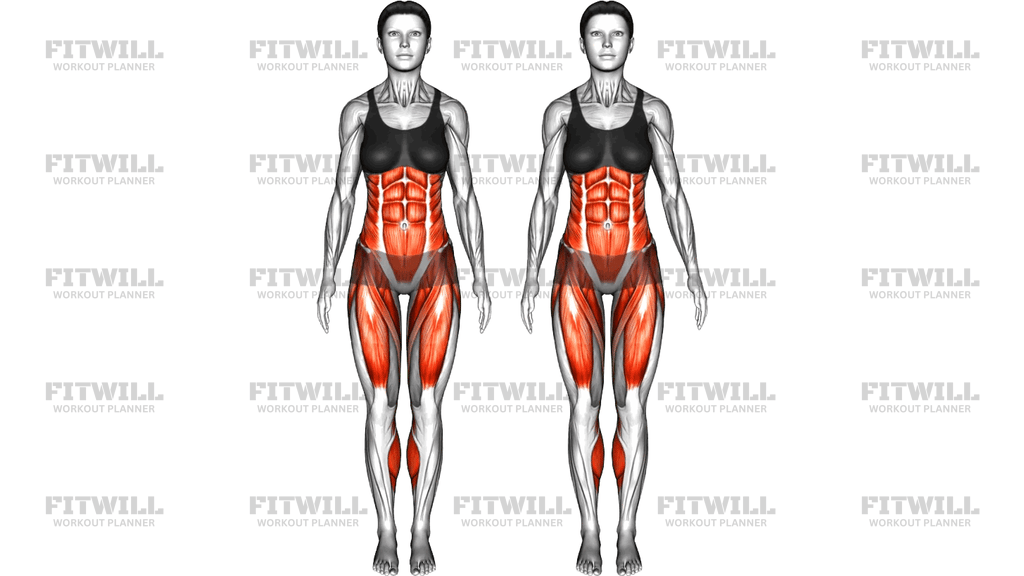
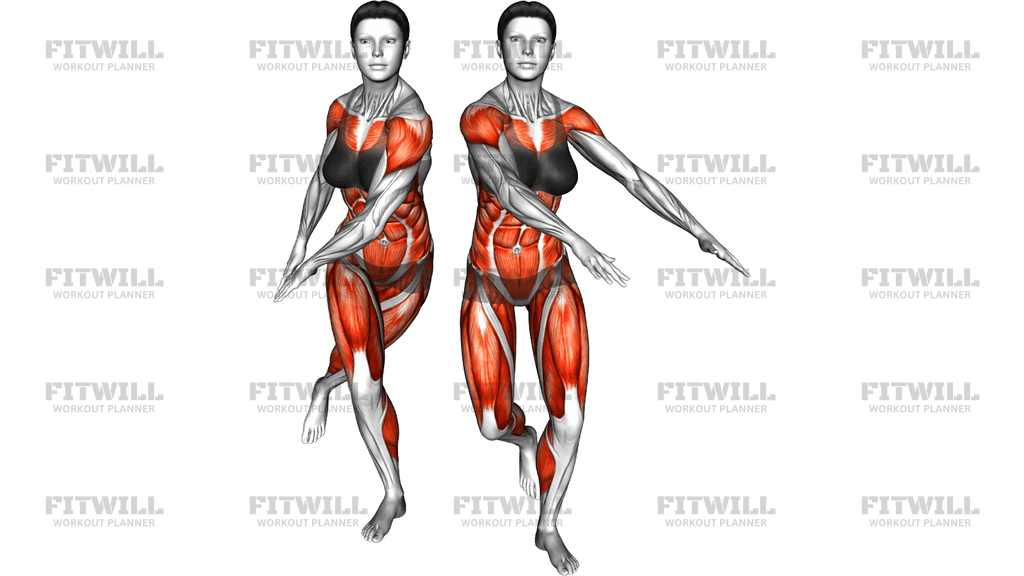
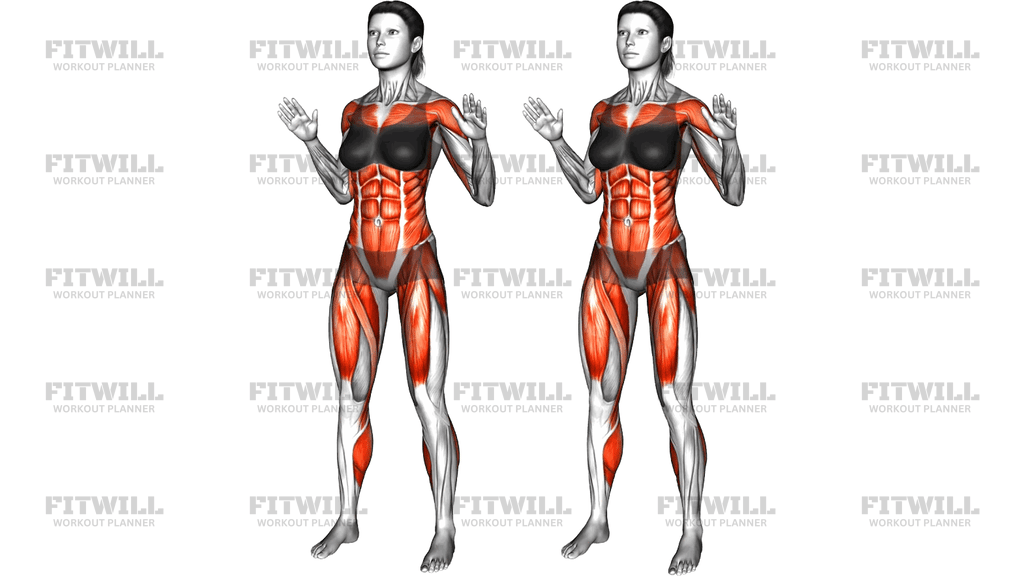
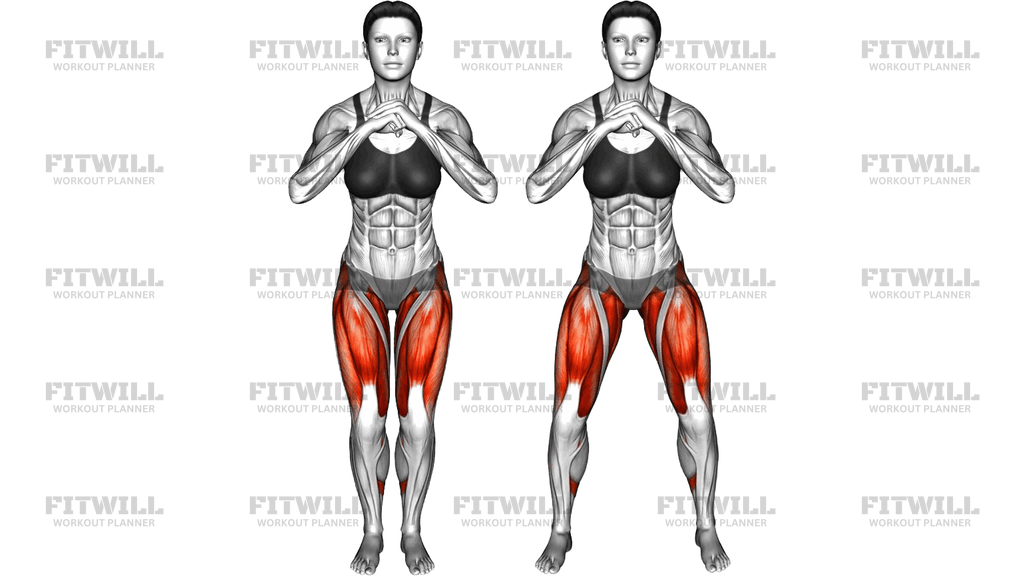
Bodyweight Step Up (Version 2)
The Bodyweight Step Up (Version 2) is a single-leg strength exercise performed by stepping up onto a flat bench or sturdy platform using only one leg to drive your body upward. You stand facing the bench, place one foot fully on top of it, and press through that front leg until you are standing upright on the bench with both feet. From there, you control yourself back down to the floor one leg at a time. With your hands resting on your hips, there is nothing to hold onto, which makes balance and core control a real part of the exercise.
This movement is one of the most practical lower-body exercises you can do. Climbing stairs, hiking uphill, getting out of a low chair, and getting off the floor all rely on the same single-leg pushing pattern the step up trains. The working leg's quadriceps handle most of the drive, the glutes extend the hip as you rise, and the hamstrings and calves stabilize and finish the movement. Because each leg works on its own, a weaker or less coordinated side can no longer hide behind the stronger one the way it can in a two-legged squat.
Setup matters more than most people expect. The bench height determines the difficulty: a lower bench keeps the emphasis on the quads and is easier on the knees, while a higher bench (roughly knee height) demands more hip and glute contribution and better balance. Stand close enough to the bench that your front foot rests fully on the surface, not just the toes, and keep your torso tall with your weight over the working leg rather than trailing back.
To execute it well, shift your weight completely onto the foot on the bench before you push. Exhale as you drive through the whole foot — heel and midfoot — and stand up fully so your hips and knees are open at the top. Avoid pushing off the floor with your back leg; it should only help you keep balance, not contribute force. On the way down, lower yourself slowly and under control, letting the working leg absorb the descent before your back foot touches the floor.
The Bodyweight Step Up (Version 2) fits well into beginner lower-body sessions, warm-ups for heavier leg work, home workouts with minimal equipment, and rehab- or return-to-training programs where loaded squatting is not yet appropriate. It scales easily: adjust bench height, slow the tempo, pause at the top, or later hold a weight to keep progressing without changing the movement itself.
[ Workout Log & Planner ]
Put your next workout in Fitwill
Keep your plan and training log ready when you are.


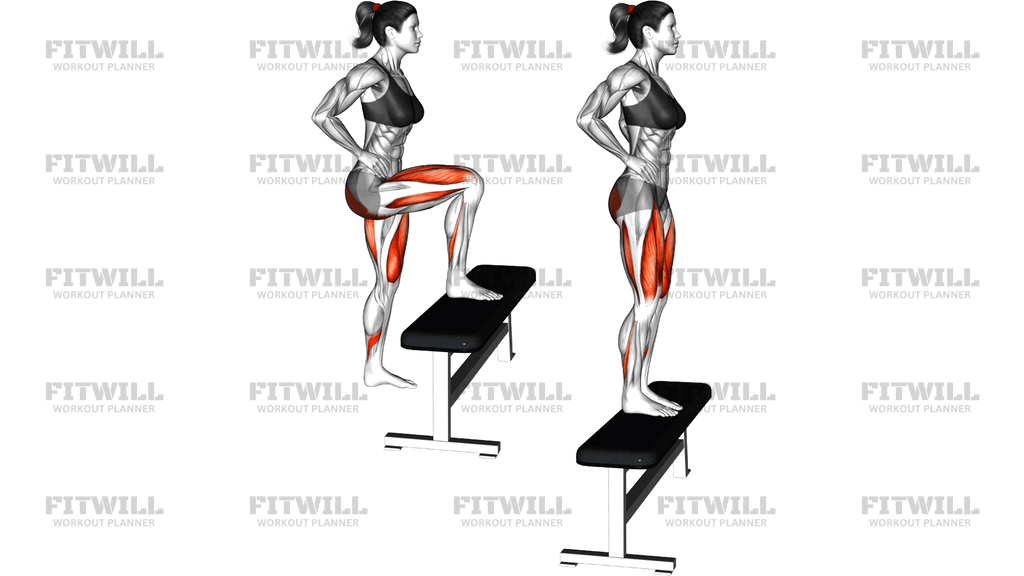
Instructions
- Stand facing a flat bench or sturdy platform set at roughly knee height or slightly lower, about one foot-length away from it.
- Place your right foot fully on top of the bench so your whole foot is in contact with the surface, and put your hands on your hips.
- Stand tall, pull your shoulders back, and brace your abdominal muscles to keep your torso from rounding as you step.
- Shift your body weight completely onto the foot on the bench so the back foot is only touching the floor for balance.
- Exhale and press through your heel and midfoot to straighten the front leg, lifting your body up until you are standing upright on the bench.
- Bring your left foot up and place it beside the right so both feet are together on top of the bench, hips and knees fully extended.
- Shift your weight onto one leg, then lower yourself with control by bending the working knee and hip until your other foot touches the floor.
- Inhale as you descend, keeping your torso upright and your knee tracking in line with your toes rather than caving inward.
- Step the second foot back to the starting stance on the floor, take a breath, and reset before performing the next repetition.
- Complete all repetitions on one leg, then switch to the other side, or alternate legs rep by rep if balance feels more secure that way.
Tips & Tricks
- Choose a bench height that lets you place your whole foot on top; if only your toes reach the surface, the bench is too high and your calf and ankle will take over the push.
- The most common mistake is pushing off the back leg. Lift the toes of your floor-side foot slightly before starting the rep to force the front leg to do the work.
- If your knee dives inward as you rise, think about spreading the floor with your foot and driving the knee out over your little toe.
- Avoid leaning your chest far forward over the thigh — a small forward hinge is fine, but collapsing down reduces glute involvement and strains the front of the knee.
- Stand fully upright at the top with your hips squeezed; half-finishing the rep at the top shortens the glute work considerably.
- Lower yourself in two to three seconds instead of dropping down; the lowering phase is where much of the strength and control benefit comes from.
- If balance is shaky, start with a lower bench or stand near a wall so one fingertip can assist — but keep your hands on your hips as soon as you can.
- Keep your hips level throughout; many people let the hip of the trailing leg drop as they step down, which reduces stability on the working side.
- Place the bench against a wall or on a non-slip surface so it cannot slide away from you mid-rep.
Frequently Asked Questions
Which muscles does the Bodyweight Step Up (Version 2) work the most?
The quadriceps of the working leg do most of the pushing, with strong help from the glutes as you extend the hip at the top. The hamstrings, calves, and core contribute mainly by stabilizing your body through the step.
Is the Bodyweight Step Up (Version 2) good for beginners?
Yes, it is one of the best beginner lower-body exercises because the load is your own bodyweight and the range is easy to adjust. Start with a low bench or step and focus on controlled lowering before adding height or reps.
How high should the bench be for the Bodyweight Step Up (Version 2)?
A surface around knee height or slightly below suits most people. Lower steps emphasize the quads and are gentler on the knees, while knee-height or slightly higher surfaces increase glute involvement and balance demand.
Why should my back leg not push off the floor during the step up?
If the back leg drives, it steals work from the front leg and turns the exercise into a partial two-leg movement. Keep the back foot light on the floor so the working leg gets the intended single-leg stimulus.
Should I step down with the same leg that stepped up first?
Lower with the leg that did not step up first, so the working leg controls the descent, then bring the other foot back to the start. Alternating which leg leads each set keeps both sides developing evenly.
My knee hurts at the front during the Bodyweight Step Up (Version 2) — what should I change?
Check that your whole foot is on the bench, that your knee tracks over your toes instead of caving inward, and that you are not leaning heavily over your thigh. Lowering the bench height and slowing the descent usually resolves discomfort; if it persists, reduce the range or consult a professional.
Can I do the Bodyweight Step Up (Version 2) without a bench?
Yes, any stable, non-slip surface at the right height works — a sturdy low box, a stair, or a solid step platform. Avoid chairs with wheels, lightweight stools, or anything that can shift under your weight.
How many repetitions should I do of the Bodyweight Step Up (Version 2)?
For general strength and control, 8 to 12 repetitions per leg for 2 to 3 sets is a solid starting point. For endurance, go higher with a lower step; to make it harder later, slow the tempo, pause at the top, or hold a dumbbell.
What can I substitute if I cannot balance during the Bodyweight Step Up (Version 2)?
Start with a lower step, stand beside a wall for light fingertip support, or try reverse lunges instead, which train a similar single-leg pattern with a lower balance demand.
Is it better to alternate legs every rep or complete all reps on one side?
Completing all reps on one side before switching makes it easier to feel and correct left-right differences. Alternating legs is fine for conditioning, but keep track of which leg leads so neither side is favored.