Dumbbell 45 Degrees Back Extension
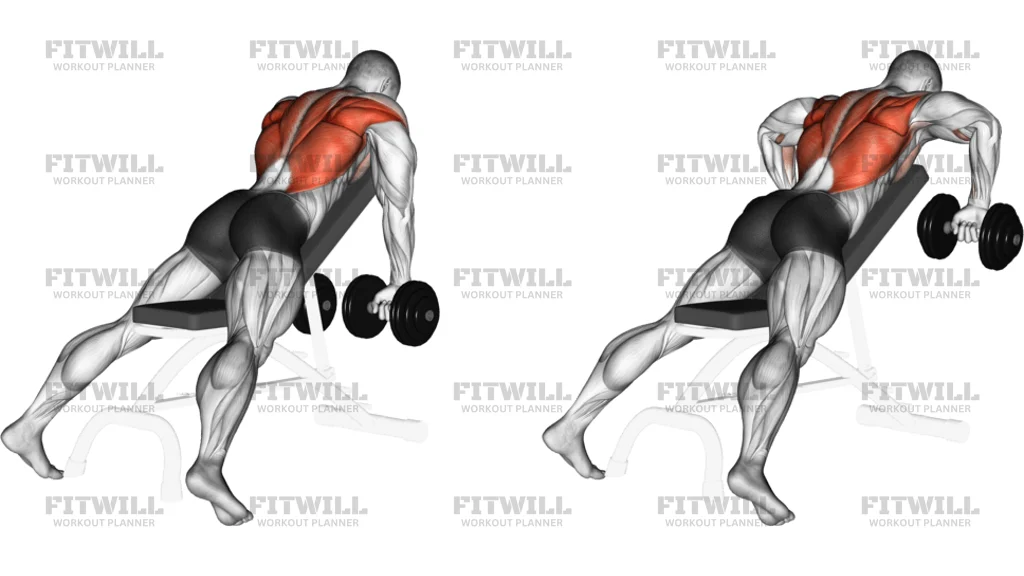
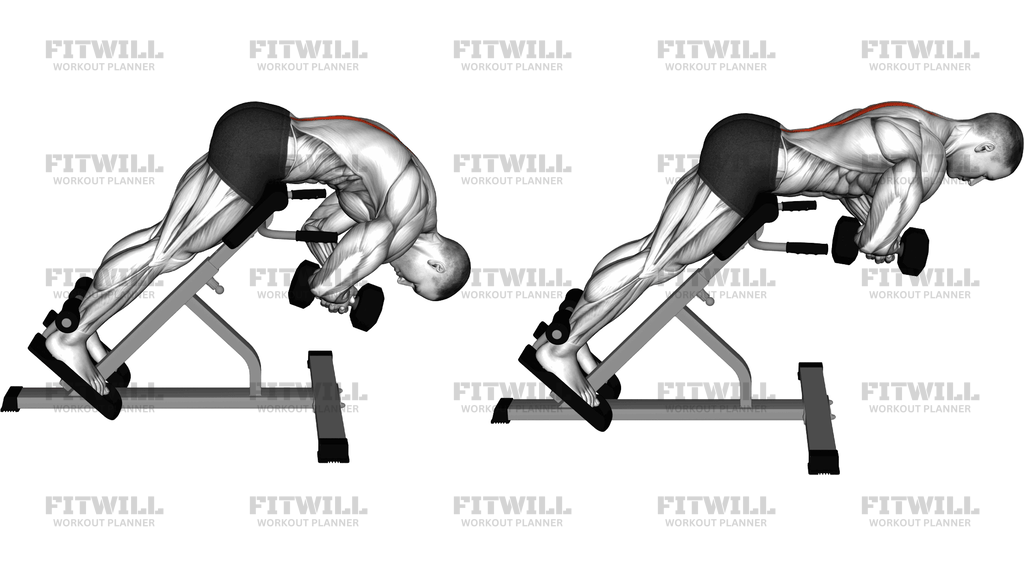
The Dumbbell 45 Degrees Back Extension is a weighted posterior chain exercise performed on an angled hyperextension bench, sometimes called a Roman chair. You anchor your feet on the platform, rest the back of your thighs against the pads, and hold a dumbbell in each hand against your chest or hanging below your shoulders. From a folded-over position, you raise your torso by extending at the hips until your body forms a straight line from head to heels. The 45-degree angle of the bench keeps the range of motion moderate and the loading on the lower back far more manageable than a full horizontal hyperextension.
The main muscles at work are the erector spinae along the lower back, which hold your spine in a neutral position against the pull of the dumbbells. The glutes and hamstrings drive the actual hip extension, while the mid-back and core stabilize the trunk throughout the set. Because the dumbbells add constant resistance, this version builds strength and muscle in the posterior chain faster than the bodyweight variation, but it also demands more control and a stricter setup.
This exercise suits lifters who have already practiced unweighted back extensions with clean technique and want to progress the movement. It is useful for people building lower back resilience for squats and deadlifts, athletes who need stronger hip extension, and anyone whose training lacks direct work for the muscles along the spine. It is commonly placed at the end of a lower body or back day, where 2 to 3 sets of 8 to 15 controlled reps work well.
Setup matters more here than in most accessory lifts. The pad height should sit at the top of your thighs so your hips can hinge freely without the pad blocking the movement, and your feet must be secured under the anchors so nothing shifts as you rise. Holding the dumbbells close to your body shortens the lever arm and keeps the load on the target muscles; letting them drift forward with loose arms turns the set into a shoulder and grip exercise and multiplies the stress on your spine.
Execution should feel like a hinge in reverse, not a sit-up. Fold down slowly, keep your chest tall and spine neutral, then squeeze the glutes to lift your torso until your ears, shoulders, hips, and knees roughly line up. Stop at a straight line rather than craning back past neutral, since the goal is to strengthen the lower back, not to hyperextend it. If you have a history of back issues, check with a qualified professional before adding load, and always start with a weight you could handle for several more reps than prescribed.
[ Workout Log & Planner ]
Put your next workout in Fitwill
Keep your plan and training log ready when you are.


Instructions
- Set the hip pad of the 45-degree bench so the top edge sits just below your hip crease, leaving your hips free to hinge, and secure your feet firmly under the ankle anchors.
- Pick up a dumbbell in each hand, sit onto the bench facing downward, and cross your arms over your chest or hold the dumbbells against your upper chest with elbows tucked.
- Lower your torso over the pad until you are folded roughly 60 to 90 degrees at the hips, letting the dumbbells rest against your chest, and let your head hang in line with your spine.
- Brace your core lightly and squeeze your glutes before initiating the lift so your lower back starts in a neutral position.
- Raise your torso by driving your hips down into the pad, keeping the dumbbells pulled tight to your body and your neck in line with your spine.
- Stop once your ears, shoulders, hips, and knees form a straight line; do not arch past neutral at the top.
- Pause for a beat at the top, then lower your torso under control over 2 to 3 seconds rather than dropping into the fold.
- Exhale as you rise and inhale as you lower, keeping your breathing steady throughout the set.
- On the final rep, either sit up carefully with the dumbbells held to your chest or set them on the floor first before stepping off the bench.
Tips & Tricks
- The most common mistake is using momentum and bouncing out of the bottom; pause for a second in the folded position to kill the bounce and force your glutes to start the lift.
- Do not crane your neck up at the top. Looking at the ceiling extends your upper spine and can leave your neck sore the next day; keep your gaze a foot or two in front of your face.
- If you feel it in your hamstrings more than your lower back, that is not a failure, but you can shift emphasis by holding the dumbbells higher on your chest to lengthen the lever.
- Start with very light dumbbells, even 5 to 10 pounds, because the 45-degree angle makes the load feel heavier on the spine than the same weight does in a row or press.
- Pad position too high locks your hips against the bench and turns the rep into a lower-back-only movement; drop the pad slightly so the hinge comes from your hips.
- Keep the dumbbells pressed against your sternum the whole time. Letting them swing away from your body adds a long lever arm and is the fastest way to overload your lower back.
- If your feet slip out of the anchors mid-set, stop and reset, because a shifting base changes the whole movement path.
- Skip the exaggerated hyperextension at the top. Raising your chest past the line of your body adds stress without adding meaningful muscle work.
- Pair this with heavy hip hinge work like deadlifts earlier in the session only if your lower back tolerance is well developed; otherwise keep it on a separate day.
Frequently Asked Questions
What muscles does the Dumbbell 45 Degrees Back Extension work?
The erector spinae of the lower back work hardest to keep your spine neutral against the dumbbells, while the glutes and hamstrings perform the hip extension. The mid-back and core contribute as stabilizers.
How is the Dumbbell 45 Degrees Back Extension different from a bodyweight back extension?
Holding dumbbells adds direct resistance to the trunk extensors, so the muscles of the lower back, glutes, and hamstrings are challenged across fewer reps. The 45-degree angle stays the same; only the load changes.
Should I hold the dumbbells at my chest or let them hang?
Holding them against your chest with arms crossed is the standard setup because it keeps the weight close to your torso. Letting them hang turns the movement into a front-loaded version that is significantly harder on the lower back.
How high should I rise at the top of the Dumbbell 45 Degrees Back Extension?
Stop when your head, shoulders, hips, and knees form a straight line. Extending past neutral adds compressive stress to the spine without improving muscle development.
What weight should a beginner use for this exercise?
Only add dumbbells after you can perform 15 or more smooth bodyweight reps. Start with very light dumbbells for 8 to 12 reps and progress slowly, since the lower back adapts to loading more gradually than most muscles.
Why do I feel the Dumbbell 45 Degrees Back Extension mostly in my hamstrings?
The hamstrings are a primary hip extensor, so feeling them is normal, especially with the pad set lower on the thighs. If you want more lower back involvement, brace harder and focus on keeping your spine rigid as your hips extend.
Can I substitute another exercise if I do not have a 45-degree bench?
You can perform a stability ball back extension holding a dumbbell, or a dumbbell Romanian deadlift, which trains the same hip extension pattern. Neither matches the exact support position, but both hit the lower back, glutes, and hamstrings.
Is the Dumbbell 45 Degrees Back Extension safe for people with lower back pain?
It can strengthen the muscles that support the spine, but adding load to an irritated back is not advisable. If you have ongoing pain, get clearance from a healthcare professional or coach before using dumbbells in this position.
Where should this exercise go in my workout?
Place it near the end of a lower body or back session, after your main heavy lifts, for 2 to 3 sets of 8 to 15 reps. Doing it first would fatigue the spinal erectors that stabilize your squats and deadlifts.