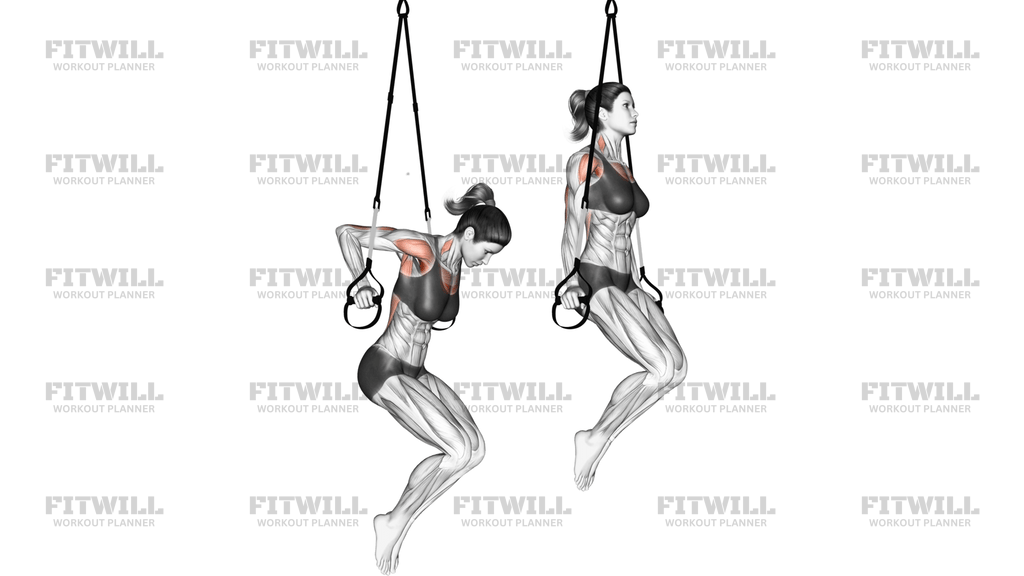
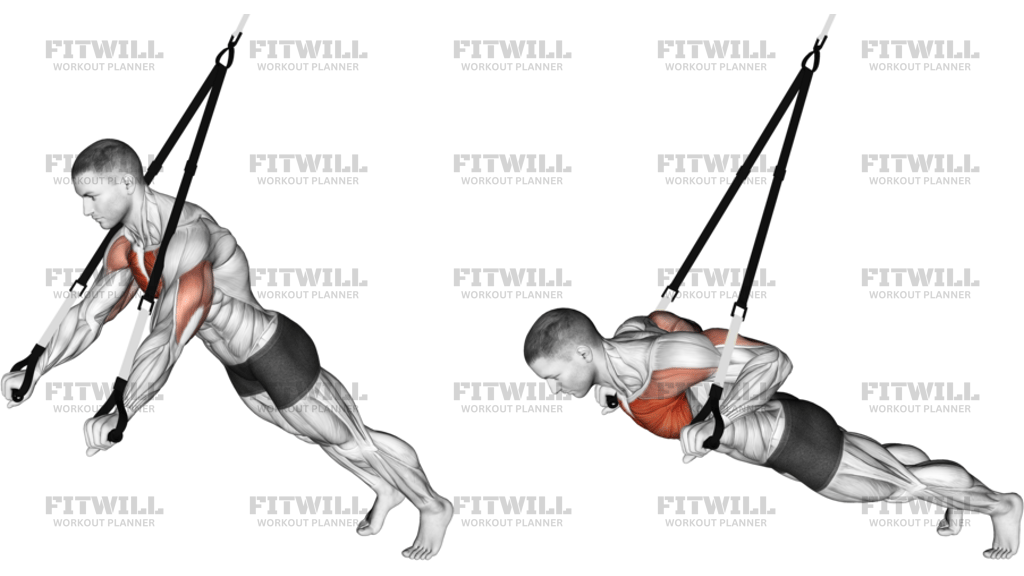
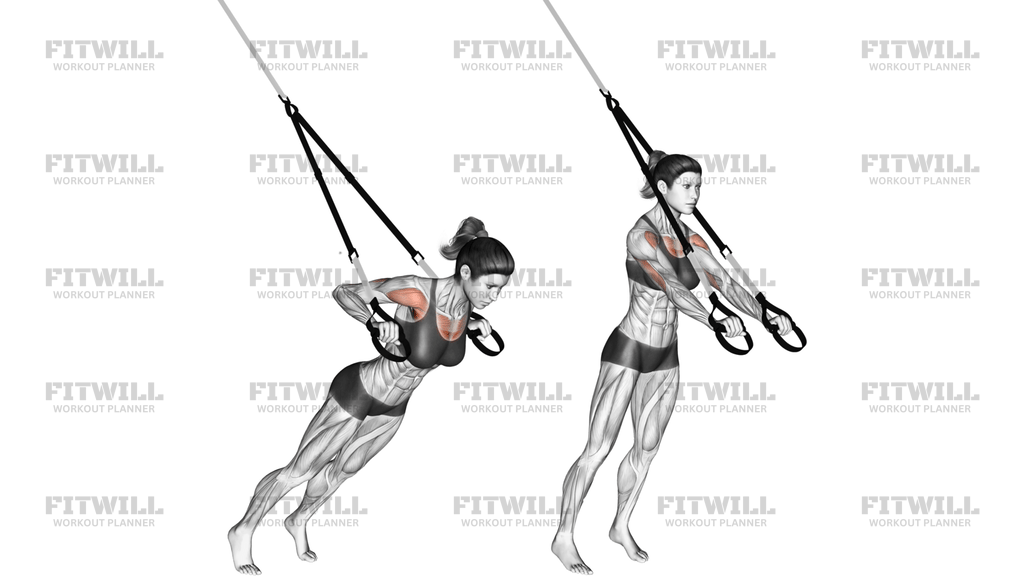
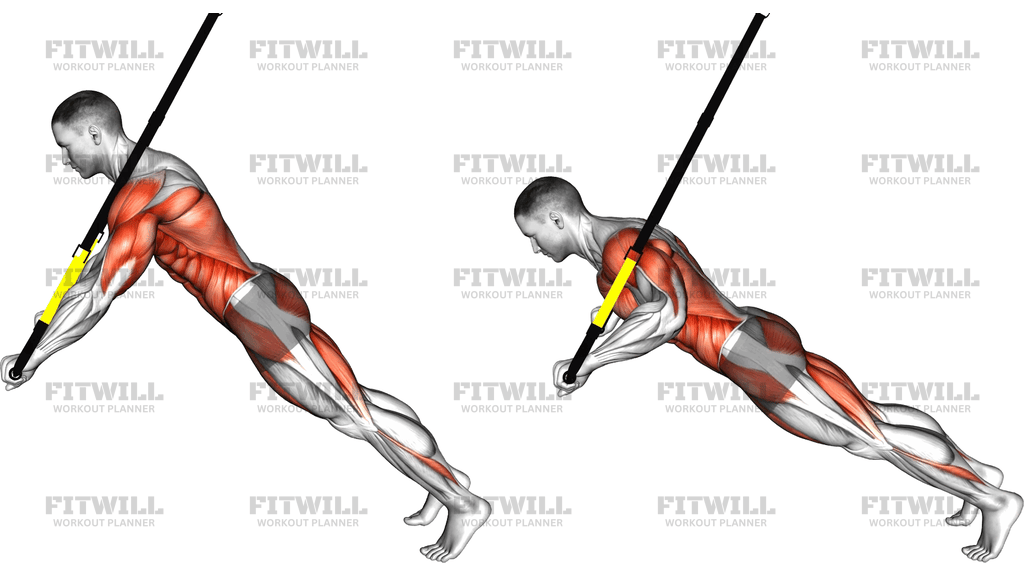
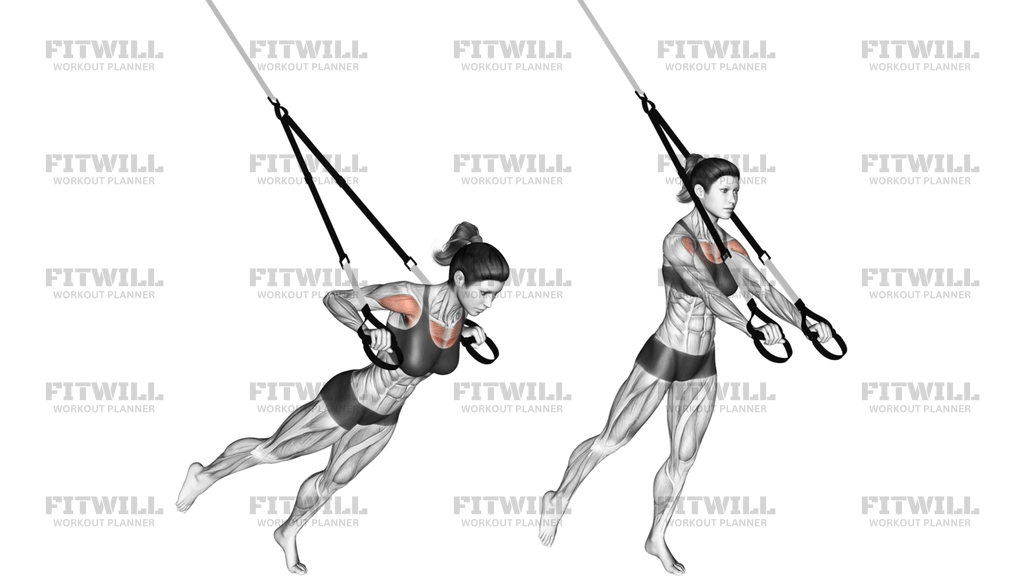
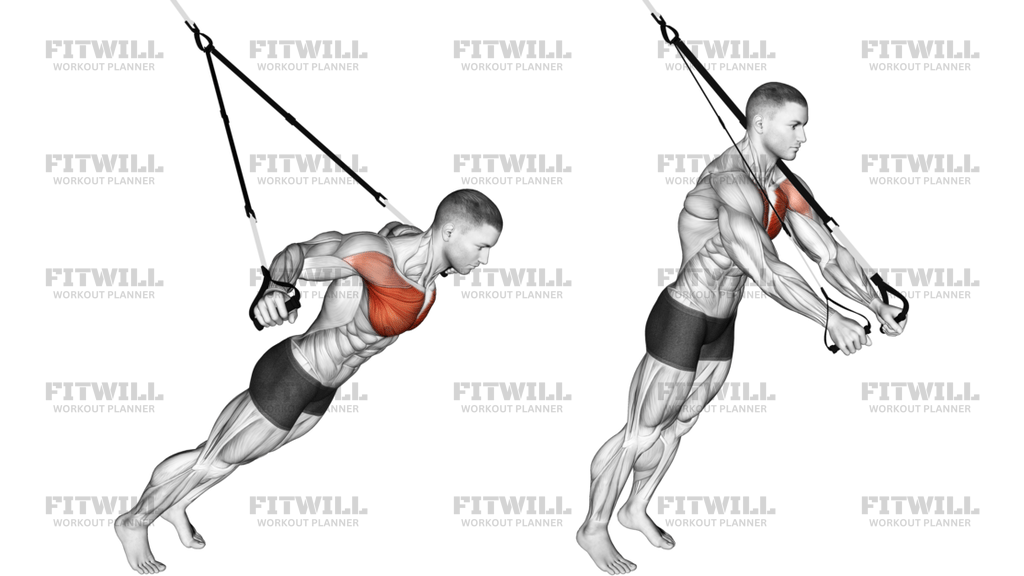
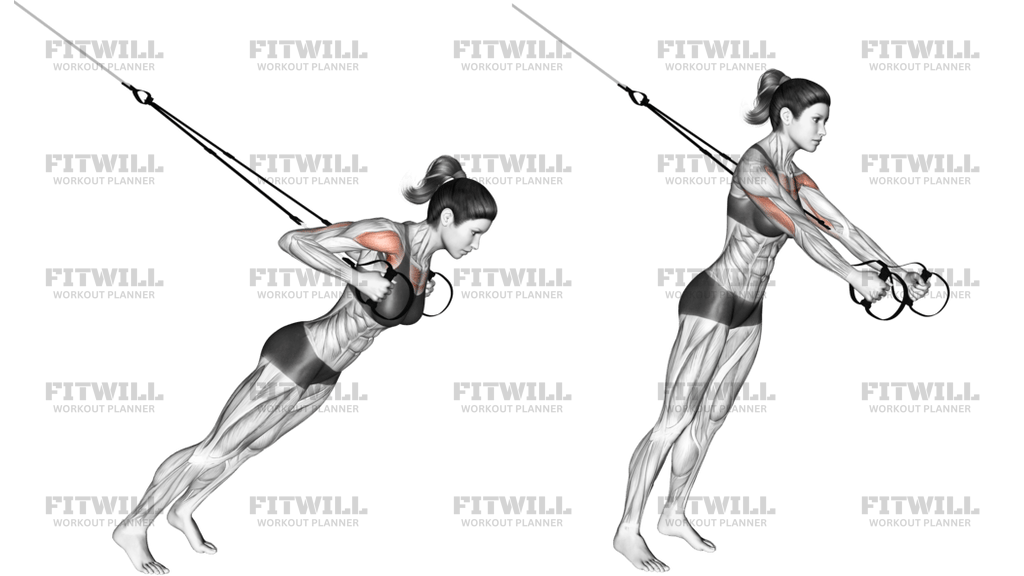
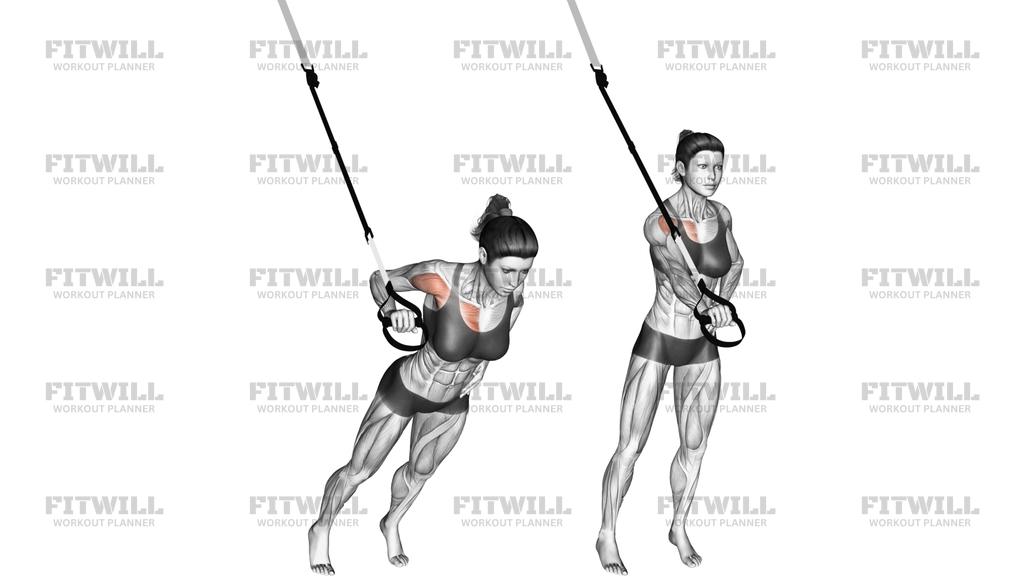
Suspender Push Up With Knee Tuck
The Suspender Push Up With Knee Tuck is a compound bodyweight exercise performed with your feet resting in the cradles of a suspension trainer while your hands stay planted on the floor. From that unstable plank position, you lower into a push-up, press back up, and then pull your knees in toward your chest before extending back to the start. It combines two demanding patterns—an unstable push-up and a suspended knee tuck—into one continuous rep.
This movement earns its place in a workout because it trains pressing strength and trunk control at the same time. The chest, triceps, and front shoulders handle the push-up, while the abs, hip flexors, and deep core drive the tuck and work overtime to keep your spine from sagging or piking between reps. Because your feet are suspended rather than fixed, every phase demands more stabilization than the floor-based versions of the same exercises.
The setup matters more here than in a standard push-up. Strap length, foot position in the cradles, and hand placement all determine whether your body stays in one straight line or breaks at the hips. Suspended feet can drift side to side, and the straps will swing if you rush, so a controlled rhythm is part of the exercise, not just a style choice. A slightly wider hand position and a braced trunk make the whole movement far more repeatable.
To execute it well, think of it as two clean reps stacked together: a push-up where your body moves as one rigid plank, followed by a knee tuck where only your hips flex while your shoulders stay stacked over your wrists. Avoid the temptation to let your hips pop up during the tuck or to sag through the lower back as fatigue builds. Exhaling as you press and again as you tuck helps keep the trunk engaged.
This exercise suits intermediate to advanced trainees who already own a solid floor push-up and a stable suspended plank. It appears frequently in suspension-training circuits, conditioning finishers, and core-focused strength blocks. If the combined version is too demanding, performing the push-up and knee tuck as separate exercises first is a sensible way to build up, and shortening the lever by kneeling is another option.
[ Workout Log & Planner ]
Put your next workout in Fitwill
Keep your plan and training log ready when you are.


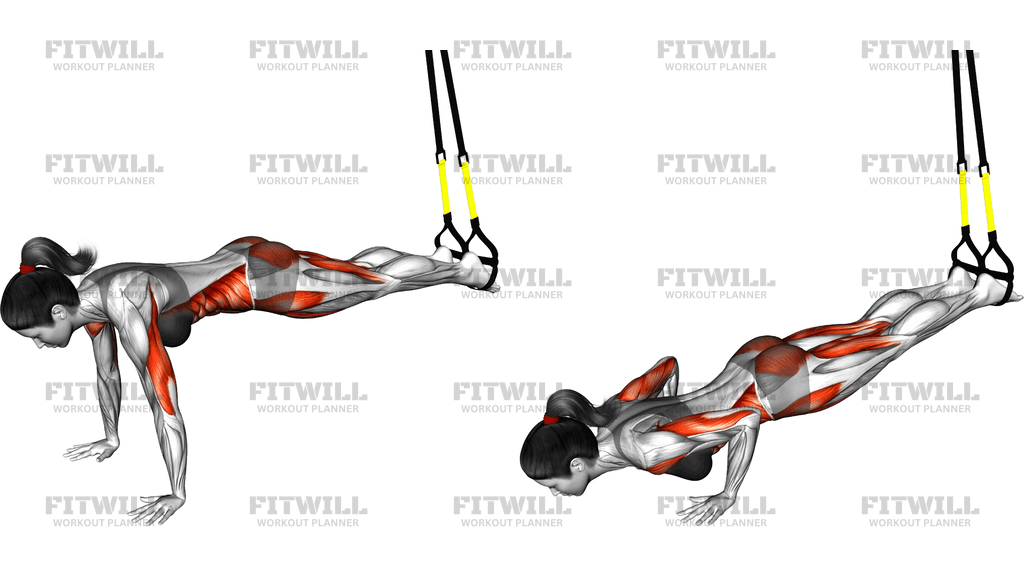
Instructions
- Anchor the suspension trainer securely overhead and adjust the straps so they hang roughly mid-calf to knee height.
- Kneel facing away from the anchor point, place one foot then the other into the cradles so the tops of your feet or toes rest in the straps, and walk your hands out until you are in a high plank with your wrists under your shoulders.
- Set your hands slightly wider than shoulder width, spread your fingers, and grip the floor.
- Squeeze your glutes, brace your abs, and align your head, hips, and heels into one straight line before moving.
- Inhale, then bend your elbows to lower your chest toward the floor, keeping your elbows around 45 degrees from your ribs and your body rigid.
- Exhale and press firmly through your palms to return to the high plank, stopping just short of locking the elbows hard.
- Without pausing, pull both knees in toward your chest by flexing your hips, letting the straps glide forward as your hips rise slightly and your shoulders stay stacked over your wrists.
- Extend your legs back with control until your body is level again, resisting the swing of the straps rather than letting them snap you back.
- Keep breathing steadily—inhale on the lowering phase, exhale on the press and the tuck—and complete all reps before carefully sliding one foot out of its cradle at a time.
- Reset your brace at the top of every rep if you feel your hips dropping or your line breaking.
Tips & Tricks
- Point your toes slightly and press down into the cradles with the tops of your feet; loose, floppy feet let the straps swing and steal stability from every rep.
- The most common fault is the hips shooting upward during the knee tuck. Aim your knees toward your chest, not toward the ceiling, so the hip flexors and lower abs do the work.
- If your lower back arches as you fatigue, end the set rather than pushing through—the suspended position makes sagging hips much riskier than in a floor push-up.
- Shorten the straps if you find your feet touching the floor during the push-up; the cradles should clear the ground throughout the whole range.
- Control the return from the tuck. Letting the straps yank your legs back turns the exercise into a swinging mess and robs the deep core of the eccentric work.
- Keep your neck long by looking at a spot on the floor just ahead of your hands rather than craning up or dropping your head between your arms.
- Spread the straps slightly apart with your feet if they want to bang into each other during the tuck, or tuck one at a time with a slightly staggered foot position.
- Because your hands bear the full load on an unforgiving surface, use a mat or slightly rotated grip if your wrists complain, and shift weight toward the heels of your palms.
- If pressing is your weak link, do the knee tuck first for a few reps, then finish with push-ups separately instead of grinding sloppy combined reps.
Frequently Asked Questions
Which muscles does the Suspender Push Up With Knee Tuck work?
The chest, triceps, and front shoulders drive the push-up portion, while the abs—especially the lower abs—hip flexors, and deep core power the knee tuck and stabilize the plank. Glutes and quads work isometrically to hold the straight-body line.
Is the Suspender Push Up With Knee Tuck suitable for beginners?
It is best treated as an intermediate progression. Beginners should first master a solid floor push-up and a stable suspended plank or suspended knee tuck on its own before combining the two.
How high should I set the suspension straps for the Suspender Push Up With Knee Tuck?
Set the cradles around mid-calf to knee height so your feet hover clearly off the floor in the plank. Lower straps make the exercise easier; higher straps increase the core and stability demand.
Why do my hips rise when I do the knee tuck in the Suspender Push Up With Knee Tuck?
That usually means the knees are driving toward the ceiling instead of toward the chest, or the abs are disengaging under fatigue. Slow the tuck down, exhale sharply, and focus on curling the knees in rather than folding at the hips.
What can I use instead of a suspension trainer for the Suspender Push Up With Knee Tuck?
A stability ball under the shins or feet, or a pair of sliders on a smooth floor, both recreate the unstable-foot plank with a knee tuck. A plain floor push-up plus a mountain climber finish is a simpler substitute.
How do I get out of the straps safely at the end of a set?
Finish at the top of the plank, walk your hands back toward your feet to shift your weight forward, then remove one foot at a time and kneel down. Never step out mid-plank while the straps are loaded.
Should I do the push-up and the knee tuck at the same tempo in the Suspender Push Up With Knee Tuck?
No—treat them as two distinct phases. Lower and press with control, then tuck deliberately and extend back slowly. Rushing the transition is what causes swinging straps and a broken body line.
My wrists ache during the Suspender Push Up With Knee Tuck. What should I change?
Check that your shoulders are stacked over your wrists and that your weight sits toward the heel of your palm rather than the fingertips. An exercise mat under your hands or push-up handles can also reduce wrist extension discomfort.
How many reps of the Suspender Push Up With Knee Tuck should I aim for?
Because it is technically demanding, quality matters more than volume. Three to four sets of 6 to 12 clean reps is a reasonable working range, stopping as soon as your hips start to sag or the straps begin to swing.
Is it safe to do the Suspender Push Up With Knee Tuck every workout?
It places a heavy repeated load on the shoulders and trunk, so two to three sessions per week with at least a day between them is a more sustainable frequency. Rotate it with floor push-ups and standalone core work to manage fatigue.