High Five Plank With Partner
The High Five Plank With Partner is a shared anti-rotation core exercise in which two people hold a plank facing each other and take turns lifting one hand to slap each other's palm mid-air. Because each lift removes one of your four contact points with the floor, your trunk has to resist rotation and extension on its own, which makes the exercise far harder than the friendly high five suggests. It is essentially a dynamic version of the plank shoulder tap, with the added coordination challenge of timing your lift to your partner's.
This movement suits anyone who has already built a basic plank tolerance and wants to progress toward more functional core strength. It is a staple in partner-based circuits, team warm-ups, and bootcamp-style sessions because it demands almost no equipment and builds a natural tempo, since each rep is paced by your partner. It is especially useful for athletes in rotational sports, as the ability to keep the hips square while one arm leaves the floor transfers directly to throwing, swinging, and punching mechanics.
The primary work comes from the deep core and rectus abdominis, which brace the spine, while the obliques work hard to stop your torso from twisting toward the lifted arm. The shoulders and chest stabilize the straight supporting arm, and the glutes and legs hold the plank line from head to heels. The wide stance shown in the movement gives you a broader base so the challenge lands on your trunk rather than your balance.
Setup matters because a poor plank cannot be rescued by a crisp high five. Place your hands under your shoulders, spread your fingers, and face your partner close enough that you can both reach the center point without shifting your weight toward each other. Your body should form one straight line: ears, shoulders, hips, and heels stacked. If your hips sag or pike before the rep even starts, move to your knees or shorten the work interval.
To execute well, brace your midsection as if bracing for a nudge, squeeze your glutes, and lift one arm smoothly forward and up until your palm meets your partner's. The lift should come from the shoulder, not from a shrug, and your supporting elbow should stay stacked under your shoulder rather than drifting back. Touch palms, lower the hand under control, and repeat on the other side.
The most common use case is as a timed or rep-based station in a partner workout, typically 20 to 40 seconds or 10 to 20 alternating contacts per round. A useful safety point: if either partner starts rotating noticeably or their hips drop with each lift, stop the set rather than pushing through, because the exercise loses its purpose and the lower back starts picking up slack once the brace fails.
[ Workout Log & Planner ]
Put your next workout in Fitwill
Keep your plan and training log ready when you are.


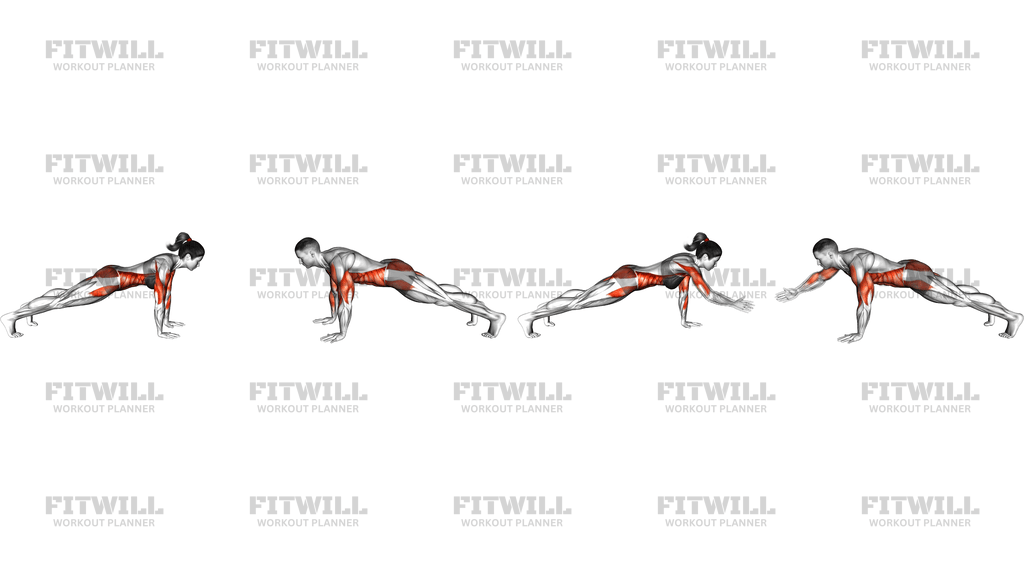
Instructions
- Face your partner and position yourselves roughly an arm's length apart on an exercise mat, leaving room in the middle for your hands to meet.
- Settle into a high plank with your hands under your shoulders, fingers spread, and take a slightly wider than shoulder-width stance with your feet so the base feels stable.
- Align your body in one straight line from head through hips to heels, and make sure both partners are at a similar plank height before starting.
- Brace your abs, squeeze your glutes, and pull your shoulder blades down away from your ears so your supporting arm is locked in.
- Lift one hand off the floor and raise it forward and up toward the center until your palm meets your partner's palm in a high five.
- Keep your hips and shoulders square to the floor the whole time; resist the pull to rotate your chest open toward the lifted arm.
- Lower your hand back to the floor under control, place it under your shoulder again, and briefly recheck that your hips have not sagged or shifted.
- Repeat with the opposite arm, alternating left and right contacts at a pace both partners can match.
- Breathe steadily throughout, exhaling as you lift your arm and inhaling as you return it, rather than holding your breath.
- To finish the set, lower back into a solid two-hand plank first, then step out of it together rather than collapsing mid-rep.
Tips & Tricks
- Widen your feet if you notice your hips rocking side to side with each lift; the wider stance in the plank is your friend here, not a weakness.
- If you rotate every time your hand rises, imagine pressing a coin into the floor with your supporting hand and keep your chest pointing straight down.
- Slow the high five down. Rushing turns it into a shoulder swing, while a two-second lift and two-second lower keeps the obliques under tension.
- Keep the supporting elbow stacked directly under the shoulder. An elbow that drifts behind or beside the shoulder makes the straight-arm position much harder on the joint.
- Match your partner's height and arm length when choosing where to stand; a reach that forces you to lean forward will break your plank line every rep.
- Squeeze your glutes deliberately before each lift. This is the simplest fix for a low back that starts arching once one hand leaves the floor.
- If your wrists complain in the high plank, try holding a dumbbell or hex dumbbell handle with the supporting hand to keep the wrist neutral.
- Agree on a rhythm with your partner before starting. Alternating simultaneously instead of taking turns doubles the instability and is a good progression, not a starting point.
- Stop the set when your form changes, not when time runs out. Two or three crisp sets beat five sloppy ones for this movement.
Frequently Asked Questions
What muscles does the High Five Plank With Partner work?
The abs and deep core do most of the bracing, while the obliques work to prevent your torso from rotating each time a hand lifts. The shoulders, chest, and triceps of the straight supporting arm stabilize the plank position.
Is the High Five Plank With Partner suitable for beginners?
It works for beginners who can already hold a solid high plank for around 30 seconds. If that is not yet the case, build base plank strength first, or perform the same alternating arm lift from a knee plank.
Why do partners stand facing each other instead of side by side?
Facing each other lets both people reach the center point with a forward arm raise, which keeps the lift in the shoulder's comfortable path. It also lets each partner match the other's tempo, which sets the pace of the set.
How far apart should we stand during the High Five Plank With Partner?
Close enough that both of you can touch palms at full arm extension without leaning forward or shifting your hips. If either partner has to crawl or lunge toward the middle, move closer before starting.
My hips twist every time I lift my hand. How do I fix that?
Widen your feet, squeeze your glutes, and focus on pressing hard through the supporting hand. You can also slow the lift down or shorten the height of the raise until your trunk stops rotating.
Can I do this exercise alone if I have no partner?
Yes, the closest solo substitute is the plank shoulder tap, where you tap your opposite shoulder with one hand while holding the same wide-stance plank. A hand raise to a wall or a low target also works if you still want an external target.
Should we high five at the same time or take turns?
Take turns when learning the movement, so one hand is always down and each lift stays controlled. Simultaneous high fives remove two contact points at once and are a genuine step up in difficulty.
How long should a set of the High Five Plank With Partner last?
Twenty to forty seconds or ten to twenty alternating contacts per round works well for most people. Prioritize keeping the hips square over extending the set, and rest enough between rounds to hold a clean plank again.
Is it safe for the wrists and shoulders?
It is generally well tolerated when the supporting hand stays under the shoulder and the elbow stays stacked. If your wrists are sensitive, use a neutral grip on dumbbells or move to a forearm plank variation with alternating hand taps on a low surface.