Cable One-Arm Incline Fly On Exercise Ball
Cable One-Arm Incline Fly On Exercise Ball is a unilateral chest isolation exercise that combines a cable handle with the unstable support of an exercise ball. The ball places the torso in an incline position and forces the ribs, hips, and shoulder girdle to work together, so the fly is not just about moving the arm across the body. It is a useful option when you want upper-chest bias, asymmetrical loading, and extra demand on trunk control without turning the movement into a press.
The main training effect is on the chest, especially the upper fibers of the pectoralis major, with the front shoulder, triceps, and core helping stabilize the position. Because only one arm is working, the torso wants to rotate and the shoulder wants to drift forward. Good reps come from keeping the ball contact, ribs, and pelvis organized while the arm traces a smooth arc from the stretched position to the line of the mid-chest.
Set the ball so the upper back and shoulder blades are supported, plant the feet wide enough to keep the body from sliding, and hold the handle with a soft bend in the elbow. Start with the working arm open slightly out to the side, not cranked behind the body. From there, sweep the hand up and inward in a controlled fly path until the hand finishes in front of the upper chest. Keep the shoulder packed down and avoid turning the rep into a twisting crunch or a pressing motion.
This movement is best used for controlled hypertrophy work, accessory chest volume, or as a coordination drill when you want the chest to do the work while the trunk stays honest. The one-arm setup is especially helpful for spotting side-to-side differences in range, control, and scapular position. It can also be a good choice if a fixed incline bench is unavailable and you still want an incline fly pattern.
The exercise rewards moderate loads, slow eccentrics, and consistent position more than heavy weight. If the ball shifts, the torso arches, or the shoulder rolls forward at the top, the load is too aggressive or the setup is too loose. Keep each rep smooth, finish with the chest, and lower the handle under control so the stretch stays in the chest rather than collapsing into the front of the shoulder.
[ Workout Log & Planner ]
Put your next workout in Fitwill
Keep your plan and training log ready when you are.


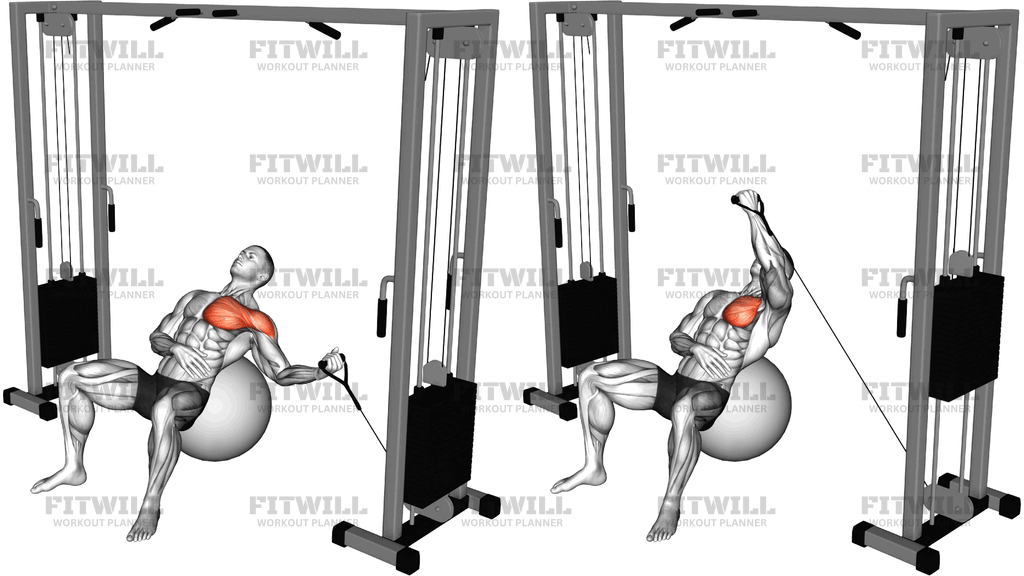
Instructions
- Attach a handle to a low cable, sit on the exercise ball, and walk your feet forward until your upper back and shoulder blades are supported on the ball.
- Plant both feet flat and wide enough to keep the ball steady, then square your hips and ribs toward the ceiling.
- Hold the handle in the working hand with a soft elbow bend and let the arm open slightly out to the side until you feel a chest stretch.
- Set the shoulder down and back without pinching hard, and keep the non-working arm out of the way for balance.
- Brace your midsection so the ball does not roll while you start the rep.
- Sweep the handle in a wide arc up and inward toward the line of your upper chest, keeping the elbow angle almost fixed.
- Squeeze the chest briefly at the top without shrugging, twisting, or turning it into a press.
- Lower the handle back along the same path under control until the chest is stretched again.
- Exhale as you bring the handle together and inhale as you return to the open position.
- Reset your feet and ball position before the next rep if your torso starts to rotate or slide.
Tips & Tricks
- Use a lighter load than you would for a cable fly on a bench, because the exercise ball makes body control the limiter.
- Keep a small bend in the elbow and freeze that angle so the movement stays a fly instead of becoming a one-arm press.
- Let the hand travel in a gentle arc from the side of the chest to the upper chest, not straight up in front of the face.
- Keep the ribs from flaring as the handle comes in; if your low back arches hard, the chest is losing tension.
- Plant the feet far enough apart that the ball does not drift when the cable pulls across the body.
- Stop the descent when you still feel the chest working; do not chase extra range by letting the shoulder roll forward.
- Keep the working shoulder away from the ear at the top so the front deltoid does not take over the finish.
- Use a slower lowering phase than lifting phase to keep tension on the chest through the full arc.
- If the torso keeps twisting toward the cable, shorten the range and reset your pelvis before the next rep.
- Stay smooth enough that you could pause anywhere in the rep without losing balance.
Frequently Asked Questions
What muscle does Cable One-Arm Incline Fly On Exercise Ball target most?
The upper chest is the main target, with the front shoulder and core helping stabilize the one-arm setup.
Why use an exercise ball instead of an incline bench?
The ball adds trunk and hip stability work while still keeping the torso in an incline position for the fly pattern.
How should my arm move during the rep?
Keep a soft elbow and sweep the handle in a wide arc from the side of the chest to the upper chest without turning it into a press.
How do I keep from twisting on the ball?
Widen your feet, brace your midsection, and shorten the range if the cable keeps pulling your ribcage and hips off center.
Should I feel a stretch at the bottom?
Yes, but the stretch should stay in the chest. If the front of the shoulder feels jammed, reduce the range.
Is this a beginner-friendly exercise?
It can be, but only with light resistance and a stable setup. The ball makes balance and cable control more demanding than a standard fly.
What is the biggest form mistake?
Rushing the rep and letting the shoulder roll forward at the top or the torso rotate toward the cable.
Where does this fit in a workout?
It works well as accessory chest volume after presses or as a control-focused finisher when you want a lighter isolation movement.