Cable One-Arm Press On Exercise Ball
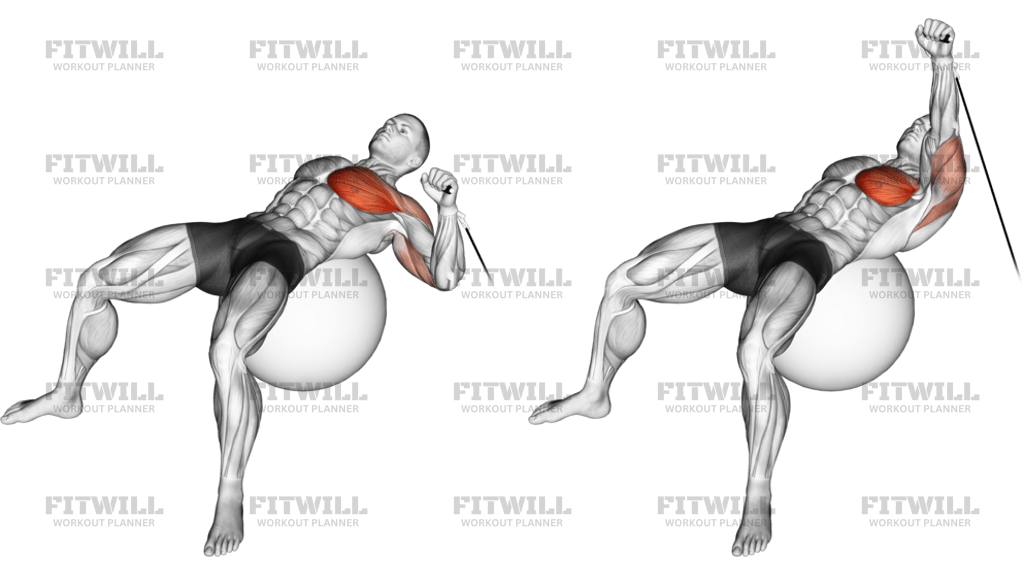
Cable One-Arm Press On Exercise Ball is a single-arm horizontal press performed while lying on a stability ball, so the chest has to produce force while the trunk keeps the torso from rotating or sliding. The unstable support makes the setup more demanding than a flat-bench press, which is why the ball position, foot pressure, and cable angle matter as much as the press itself.
The main target is the chest, with the front of the shoulder and triceps helping to finish the press. The exercise also asks the core and glutes to keep the rib cage and pelvis organized on the ball, so the working side can move cleanly instead of the torso twisting toward the handle. That combination makes it useful when you want pressing strength with an extra stability challenge.
Start by centering your upper back on the exercise ball and planting your feet firmly so your knees stay bent and your hips stay level. The handle should start beside the lower chest or slightly outside it, with the wrist stacked over the forearm and the shoulder not shrugged toward the ear. If the ball is too high under the shoulders or your feet are too narrow, the set will feel unstable before the chest ever does the work.
Each rep should travel in a smooth arc from the side of the chest to a strong finish in front of the shoulder line. Press the handle forward without letting the torso rotate, then lower it slowly until the upper arm is back near the rib cage and the cable still has tension. The exercise works best when the press feels deliberate and the return is controlled, not when the body is bouncing on the ball to cheat the range.
Cable One-Arm Press On Exercise Ball is a good accessory choice for lifters who want more chest work without losing the stability demand around the trunk and shoulder. It can fit in an upper-body session, a core-focused block, or a unilateral balance drill, but it should stay light enough that you can keep the ribs down and the pelvis steady. If the shoulder pinches, the ball rolls, or the torso twists to finish the rep, reduce the load or switch to a more stable press variation.
[ Workout Log & Planner ]
Put your next workout in Fitwill
Keep your plan and training log ready when you are.


Instructions
- Set the cable pulley at about chest height and clip on a single handle.
- Sit on the exercise ball, walk your feet forward, and roll back until your upper back and head are supported.
- Plant both feet flat on the floor with your knees bent and your hips level on the ball.
- Hold the handle in the hand farthest from the stack so the cable starts beside the lower chest.
- Bend that elbow about 90 degrees and set your wrist over the forearm without shrugging the shoulder.
- Brace your ribs down, squeeze your glutes lightly, and keep your torso square to the ceiling.
- Press the handle forward and slightly inward until the arm is almost straight in front of the shoulder line.
- Pause briefly, then lower the handle back with control until the upper arm returns beside the rib cage.
- Breathe out as you press and inhale as you return, then reset your feet and hips before the next rep.
Tips & Tricks
- If the ball slides or wobbles, move your feet wider before you lower the load.
- Keep the working shoulder packed down; a shrug turns the rep into a front-delt press.
- Let the handle travel in a slight arc toward the midline instead of pressing straight out to the side.
- Stop the descent when the upper arm reaches the rib cage; dropping deeper often rolls the shoulder forward.
- Keep the wrist vertical over the forearm so the handle does not fold the hand back.
- Use a lighter load than a flat-bench press because the ball forces your trunk to stay quiet.
- If your hips twist toward the cable, shorten the range and reset your feet between reps.
- A brief pause at the top helps keep the torso from bouncing on the ball.
- If your lower back arches hard to finish the press, lower the weight and re-stack the ribs over the pelvis.
Frequently Asked Questions
What does Cable One-Arm Press On Exercise Ball train most?
It mainly trains the chest, with the front shoulder and triceps helping finish the press. The ball also makes your core and glutes work harder to keep the torso from twisting.
Is Cable One-Arm Press On Exercise Ball beginner-friendly?
Yes, but only with a light load and a very stable setup. If the ball feels shaky, learn the same pressing pattern on a flat bench first.
Where should the cable start in Cable One-Arm Press On Exercise Ball?
The handle should start beside the lower chest or just outside it, with the elbow bent and the wrist stacked over the forearm. That keeps the press path short and the shoulder in a safer position.
What is the biggest mistake on Cable One-Arm Press On Exercise Ball?
Letting the torso rotate toward the handle. If your ribs flare or your hips twist, the chest stops doing the work and the ball becomes a balancing act.
Should I keep my feet wide during Cable One-Arm Press On Exercise Ball?
A slightly wider stance usually helps keep the ball steady and prevents unwanted rolling. If your feet are too close together, the press often turns into a wobble.
Why use an exercise ball instead of a bench?
The ball removes some of the passive support a bench gives you, so you have to stabilize your trunk while pressing. That makes it useful for training chest strength with more anti-rotation demand.
Can I do Cable One-Arm Press On Exercise Ball if my shoulder feels tight?
Only if the press is pain-free and the elbow does not drop too deep behind the torso. Shorten the range or switch to a more stable chest press if the front of the shoulder pinches.
How do I make this exercise harder without just adding weight?
Slow the lowering phase, add a brief pause at the top, or keep the free hand across the chest to resist rotation. Those changes increase stability demand without forcing the shoulder to grind through a heavier press.