Cable Press On Exercise Ball
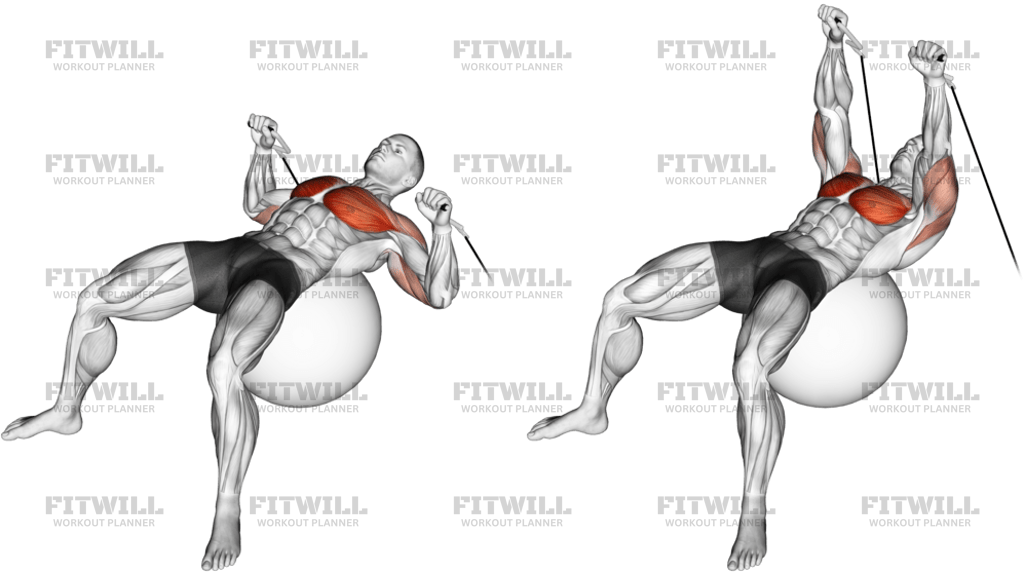
Cable Press On Exercise Ball combines a cable chest press with the instability of an exercise ball, so the set asks your chest to produce force while your trunk and shoulders keep you from drifting or twisting. The ball removes the firm base you would get from a bench, which means the exercise is less about brute load and more about stable pressing mechanics, clean scapular control, and a repeatable bar path.
The main training emphasis is the chest, especially the Pectoralis major, with the anterior deltoids and triceps helping to finish the press. Because your upper back is resting on the ball, your core also has to resist extension and side-to-side wobble. That makes the movement useful when you want pressing work plus a stability challenge, but it also means the setup has to be exact enough that the ball supports your shoulders without sliding your head or lower back out of position.
Set the ball so your upper back and shoulders are supported and your feet are planted wide enough to stay balanced. The handles should start near chest level with the elbows bent and the wrists stacked over the forearms. From there, press the handles up and slightly inward until the arms are nearly straight, then lower them on the same arc with control. If the cables are too heavy, the ball will wobble and the chest will stop doing the work cleanly.
This exercise fits well as accessory chest work, a controlled pressing variation in hypertrophy training, or a bridge between basic pressing patterns and more demanding stability work. It is also a useful option when you want to train pressing without a flat bench, but it is not the best choice for maximal loading. Keep the movement smooth, keep the ribs from flaring, and stop the set if the ball shifts enough that the handles stop traveling evenly.
Fitwill
Log Workouts, Track Progress & Build Strength.
Achieve more with Fitwill: explore over 9600 exercises with images and videos, access built-in and custom workouts, perfect for both gym and home sessions, and see real results.
Start your journey. Download today!




Instructions
- Place the exercise ball under your upper back and shoulders, then plant both feet flat on the floor a little wider than hip width.
- Hold a cable handle in each hand and settle the handles beside your chest with your elbows bent and your wrists stacked over your forearms.
- Let your head rest lightly on the ball and set your shoulder blades in a comfortable back-and-down position before the first rep.
- Brace your abdomen and glutes so your torso stays steady on the ball when the cables start pulling.
- Press both handles upward and slightly inward until your arms are almost straight above the chest.
- Keep your wrists neutral and your chest lifted without arching your lower back or bouncing on the ball.
- Lower the handles back to the starting position along the same path until your elbows are again bent near chest level.
- Pause long enough to regain balance, then repeat for the planned number of reps before carefully sitting up and racking the handles.
Tips & Tricks
- Set the ball so your shoulder blades are supported, not your neck; if your head is hanging back, move the ball lower on your torso.
- Use a wider foot stance than you would on a bench so the ball does not roll when the cables change direction.
- Choose a lighter load than you would for a flat cable press, because the unstable base makes heavy weights harder to control.
- Keep the handles tracking in a smooth arc instead of letting one side drift higher, which is a common sign that the torso is rotating on the ball.
- Do not let your elbows flare sharply out to the sides; a slightly tucked elbow path keeps the shoulders in a stronger pressing position.
- Stop the press just short of hard lockout if your shoulders start shrugging toward your ears.
- Exhale as you press the handles up and inhale as they return to chest level so your ribs do not pop open.
- If the ball slides or the cables yank you off balance, shorten the range and reduce the load before adding more resistance.
Frequently Asked Questions
What muscles does Cable Press On Exercise Ball train most?
The chest is the main mover, with the front shoulders and triceps helping finish each press.
Why use an exercise ball for a cable press?
The ball adds instability, so your core and shoulder control have to stay engaged while the chest does the pressing.
Where should my upper back be on the ball?
Your upper back and shoulders should be supported, with your head resting lightly enough that you can keep a neutral neck.
How wide should my feet be on the floor?
Place your feet wider than hip width so the ball stays steady when the cables pull on each side.
Should the handles start near my chest or above it?
Start with the handles beside the chest and bent elbows, then press them up and slightly inward above the chest.
What is the most common mistake on this exercise?
Using too much load and letting the ball roll or the torso twist instead of pressing in a controlled line.
Is this a good substitute for a bench press?
It is a useful pressing variation, but it is better for controlled accessory work than for heavy max-strength bench work.
Can beginners do Cable Press On Exercise Ball?
Yes, as long as they use light resistance and keep the ball, feet, and cable path stable.