Kettlebell One Legged Deadlift
Kettlebell One Legged Deadlift is a single-leg hip hinge built to train hamstrings, glutes, and balance while the pelvis stays organized and the torso stays long. The exercise asks you to load one leg at a time, so it is less about lifting a maximal weight and more about controlling the hinge, keeping the standing hip stable, and returning to the top without twisting or bouncing.
The setup matters because the free leg, the standing foot, and the kettlebell all work together to keep the rep balanced. In the lowered position shown here, the torso reaches forward, the rear leg extends back, and the kettlebell hangs close to the standing shin. That position lets the hip drive the movement instead of the lower back or the knee taking over.
Perform the repetition by shifting into a clean hinge: keep a soft knee on the standing leg, push the hips back, and let the chest travel forward as the rear leg reaches long behind you. The kettlebell should travel in a straight, quiet path close to the body. At the bottom, the spine should stay long and the pelvis should remain square rather than opening toward the floor.
On the way up, press the standing foot into the floor, squeeze the glute of the working side, and stand by extending the hip rather than yanking the weight with the arm. The rep should feel controlled from the first inch to the last, with the return following the same path as the descent. This makes the movement useful for accessory strength work, posterior-chain development, warmups, and balance-focused training blocks.
Use a load that lets you keep the rear leg long, the kettlebell close, and the torso quiet. If you start rotating, wobbling, or rounding to reach lower, shorten the range and clean up the pattern first. The exercise can be challenging for beginners, but it works very well with light kettlebells and deliberate tempo when the goal is better single-leg control, stronger hips, and more stable deadlift mechanics.
Fitwill
Log Workouts, Track Progress & Build Strength.
Achieve more with Fitwill: explore over 9600 exercises with images and videos, access built-in and custom workouts, perfect for both gym and home sessions, and see real results.
Start your journey. Download today!




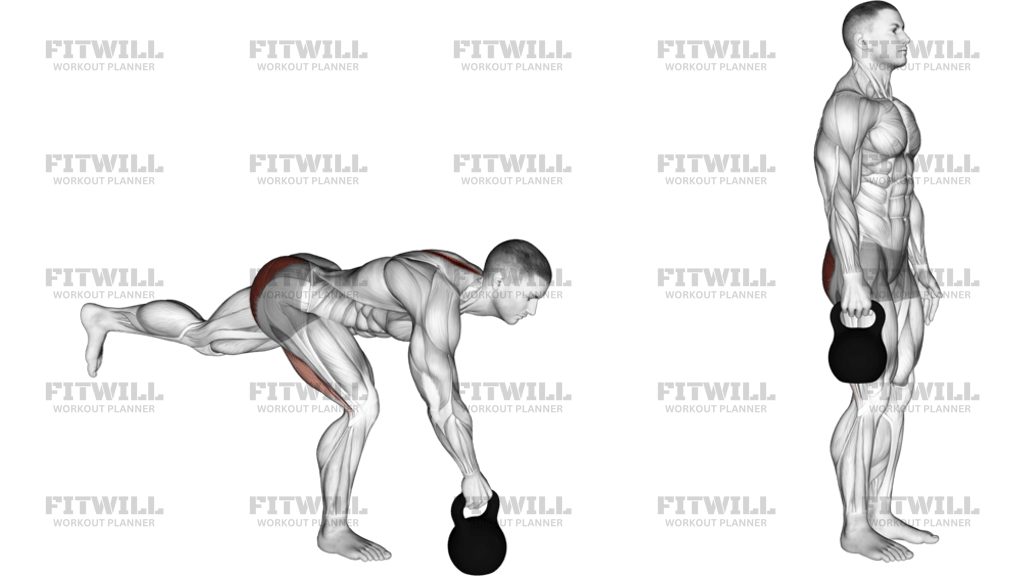
Instructions
- Stand on one leg with the working foot planted firmly and the free leg relaxed behind you.
- Hold the kettlebell in one hand so it hangs by the outside of the standing thigh.
- Keep a soft bend in the standing knee, ribs down, and your neck long before you start the hinge.
- Push the hips straight back and let the torso tip forward as the rear leg reaches long behind you.
- Lower the kettlebell in a straight line close to the standing shin instead of swinging it away from the body.
- Keep the hips square and the back flat while you reach to the depth you can control.
- Drive through the standing foot, squeeze the glute, and extend the hip to come back to standing.
- Finish tall without leaning back, then reset your balance before the next repetition.
Tips & Tricks
- Think about moving the hips back, not dropping the chest down. The hinge should start at the hip crease.
- The free leg should act like a counterbalance, reaching back long rather than lifting high.
- Keep the kettlebell close to the shin on the way down; a drifting bell usually means the hinge is losing tension.
- If the standing knee collapses inward, lighten the load and focus on pressing the foot tripod into the floor.
- Stop the descent when your pelvis starts to open or your lower back wants to round to gain extra range.
- Exhale as you stand back up so the ribs stay stacked over the pelvis through the hardest part of the rep.
- Use a slow lowering phase to make the standing hip do the work instead of letting momentum control the bottom.
- A very light touch of the back foot to the floor between reps can help beginners regain balance without turning it into a kickstand deadlift.
Frequently Asked Questions
What does the kettlebell one legged deadlift train most?
It mainly trains the hamstrings and glutes of the standing leg, with strong balance and hip-stability demands throughout the rep.
Should the kettlebell stay close to my body?
Yes. Let it travel close to the standing shin and outside thigh so the hinge stays controlled and the lower back does not take over.
How bent should my standing knee be?
Keep only a soft bend. The knee should stay unlocked, but the movement should still come from the hip sliding back rather than from squatting down.
How far back should the free leg reach?
Reach it long enough to counterbalance your torso, but not so high that your pelvis rotates open or your low back arches.
What is the most common mistake in this exercise?
Most people either twist the hips open, round to reach lower, or let the kettlebell swing away from the standing leg.
Can beginners use this movement?
Yes, but start with a very light kettlebell and a shorter range of motion until you can hold balance and keep the hinge pattern clean.
Do I need to touch the floor with the free foot?
No. The free leg is mainly there for balance and counterweight, although beginners can lightly tap down between reps if needed.
Where should I feel the effort during the rep?
You should feel the standing hamstring and glute work hardest, with your core and foot helping you stay steady.