Exercise Ball Seated Triceps Stretch
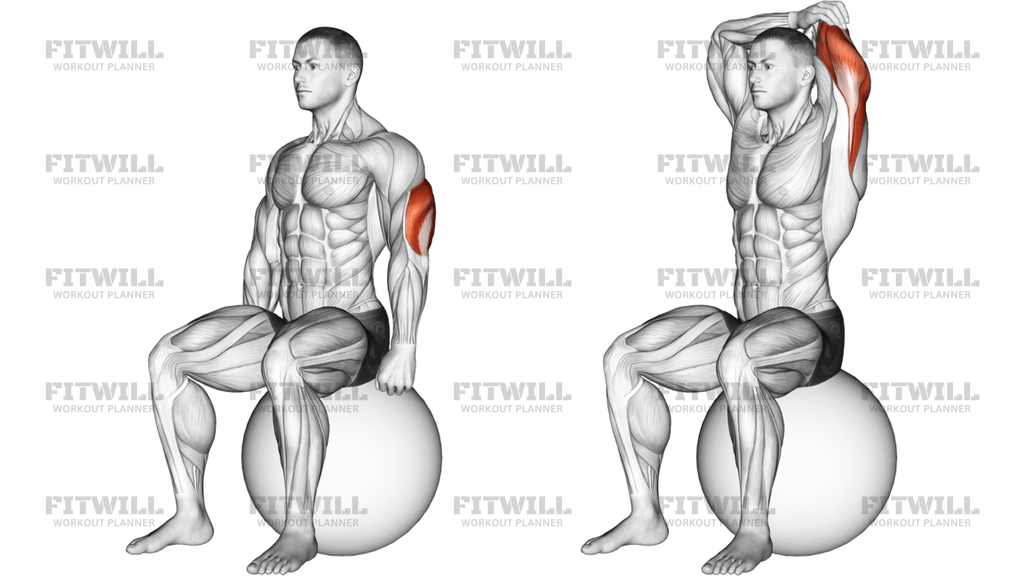
Exercise Ball Seated Triceps Stretch is a seated overhead mobility drill for the back of the upper arm. You sit tall on a stability ball, place one hand behind or on top of the opposite elbow, and let the bent arm travel into an overhead triceps stretch while the torso stays stacked over the hips. The ball adds an unstable base, so the exercise rewards calm posture and controlled breathing more than aggressive range.
The main target is the triceps, especially the long head because the shoulder is flexed overhead and the elbow stays bent. The shoulders, forearms, and core help you keep the rib cage from flaring and the neck from craning. In practical terms, this makes the stretch useful when the back of the arm feels tight from pressing, overhead work, dips, or general upper-body training volume.
Setup matters here because the ball can make the torso drift if you start loose. Sit on the center of the ball with both feet planted firmly, knees roughly hip-width apart, and the spine tall before you raise the arm. Keep the working elbow pointed upward instead of letting it flare wide. If you lean back or twist hard to chase range, the stretch stops being specific to the triceps and starts becoming a compensation pattern.
A clean rep is slow and quiet. Reach the elbow overhead, use the opposite hand to guide the stretch, and stop where you feel a firm but manageable line through the back of the upper arm. Breathe into the rib cage, soften the shoulders away from the ears, and avoid bouncing at the bottom. The goal is not to force the hand lower at all costs; it is to create a repeatable stretch that opens the triceps without irritating the shoulder or elbow.
Use this movement in a warm-up, cool-down, or accessory mobility block when you want to restore overhead arm comfort and reduce stiffness in the triceps after pressing or triceps-dominant work. It can be a good option for beginners because the load is bodyweight only, but the unstable seat still asks for control. If the shoulder feels pinchy, shorten the range and keep the elbow slightly more forward until the position feels smooth and pain-free.
[ Workout Log & Planner ]
Put your next workout in Fitwill
Keep your plan and training log ready when you are.


Instructions
- Sit centered on the stability ball with both feet flat, knees bent, and your torso upright.
- Brace lightly through the abdomen so you stay tall without leaning back on the ball.
- Raise one arm overhead and bend that elbow so the upper arm points upward beside your head.
- Use the opposite hand to hold the working elbow and guide it gently backward.
- Keep the rib cage stacked over the pelvis and avoid flaring the lower back as the arm moves.
- Let the stretch build through the back of the upper arm and stop before the shoulder rolls forward.
- Hold the end position with steady breathing and relaxed neck muscles.
- Release the elbow slowly, bring the arm back overhead, and repeat on the other side.
Tips & Tricks
- Keep the sitting bones centered on the ball so you do not slide forward when the arm goes overhead.
- Aim the working elbow more up than out; a wide elbow usually turns the stretch into a shoulder compensation.
- Use the opposite hand as a gentle guide, not a hard pull.
- Exhale as the elbow settles deeper into the stretch to reduce upper-trap tension.
- If the lower back arches, shorten the range and re-stack the ribs over the pelvis.
- A slight forward head position often means the stretch is too aggressive; keep the chin softly tucked.
- Hold the reach long enough to feel a steady triceps line, but do not bounce or pulse.
- If the shoulder feels pinchy, let the elbow drift a little forward of the head instead of forcing it straight back.
Frequently Asked Questions
What muscle does Exercise Ball Seated Triceps Stretch target most?
The triceps are the main focus, especially the long head because the arm is taken overhead with the elbow bent.
Why sit on a stability ball instead of a bench or chair?
The ball adds a little instability, which encourages better posture and more awareness of the rib cage, hips, and shoulders while you stretch.
How do I know if I am stretching the triceps and not the shoulder?
You should feel the stretch along the back of the upper arm, not a sharp pinch in the front or top of the shoulder. If the shoulder takes over, reduce the range.
Should my elbow point straight up?
Mostly yes, but a small forward angle is fine if it keeps the shoulder comfortable. The goal is a stable overhead line, not a forced vertical position.
Can I do this if my lower back arches when my arm goes overhead?
Yes, but shorten the stretch and keep your ribs down. If you still have to arch to reach the position, the range is too big for that moment.
What is a common mistake with this stretch?
Leaning back on the ball and yanking the elbow down are the biggest issues. Both reduce the triceps stretch and make the shoulder work harder than it should.
When is this stretch most useful?
It fits well after pressing, dip, or overhead sessions, or in a warm-up when the upper arm feels tight before upper-body work.
Do I need to hold the stretch for a long time?
A controlled short hold is usually enough. Focus on breathing and position quality instead of forcing a longer hold with bad posture.