Lever Chest Press Version 4
Lever Chest Press Version 4 is a seated machine pressing exercise that targets the chest with help from the front shoulders and triceps. The back pad fixes your torso in place, so the path of the handles and the position of your elbows matter more than body sway or momentum. That makes it a useful option for building chest strength with a clear, repeatable range of motion.
The machine in the image is set up for a stable seated press: your upper back stays against the pad, your feet stay planted, and the handles travel forward from a stretched position beside the chest to a finished press in front of the upper torso. Because the movement is guided, it is easier to keep tension on the pecs than with a free barbell press, but the shoulders can still take over if the seat height is wrong or the elbows drift too high.
A good setup starts before the first rep. Adjust the seat so the handles line up with mid-chest, then sit tall with the shoulder blades gently set against the pad. Grip the handles firmly, keep wrists straight, and place the elbows slightly below shoulder height. From there, each rep should feel like a controlled push forward rather than a reach. The press ends with the arms almost straight, not locked hard, and the return should be slow enough that the chest stays loaded.
This exercise is commonly used for chest hypertrophy, upper-body push strength, and controlled accessory work after heavier compounds. It also works well for lifters who want a stable press pattern without balancing a barbell or dumbbells. The fixed machine path can be especially helpful when you want to focus on pec tension, match both sides evenly, or train around limited stability.
Even though the machine supports the movement, form still matters. If the seat is too low, the press turns into a shoulder-dominant push. If the seat is too high, the handles may ride above the chest and shorten the pec contribution. Keep the neck relaxed, breathe out as you press, and stop the set if the shoulders roll forward or the handles lose a smooth path. Used well, Lever Chest Press Version 4 is a straightforward chest builder with a predictable, joint-friendly feel.
[ Workout Log & Planner ]
Put your next workout in Fitwill
Keep your plan and training log ready when you are.


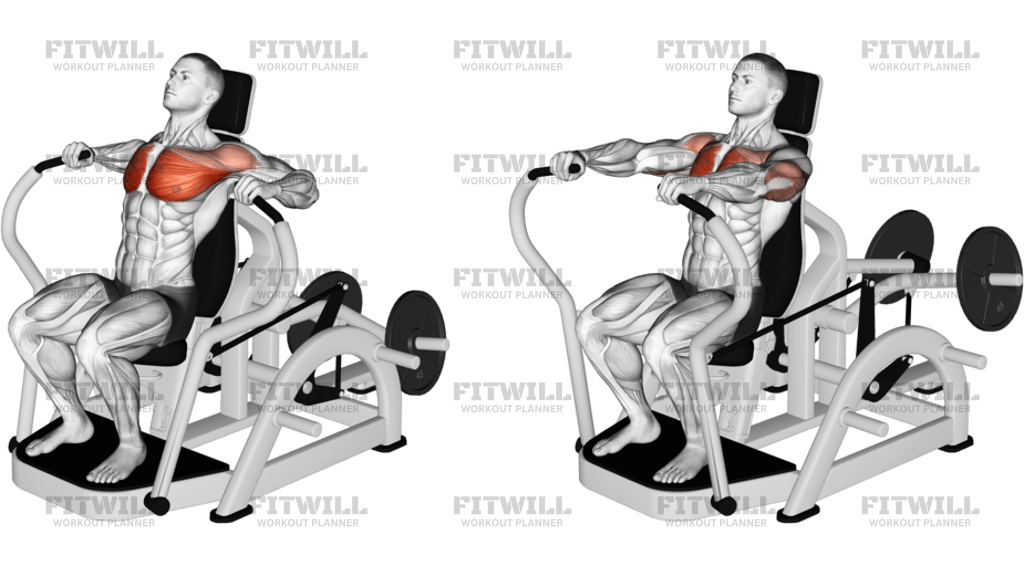
Instructions
- Adjust the seat so the handles line up with mid-chest, then sit back against the pad with your feet flat on the floor.
- Grip the handles with straight wrists and set your shoulder blades lightly into the back pad.
- Start with your elbows slightly below shoulder height and your upper arms open enough to feel a chest stretch without straining the front of the shoulder.
- Brace your torso and press the handles forward in a smooth arc until your arms are nearly straight.
- Keep your chest up and your shoulders from rolling forward as the handles travel away from you.
- Pause briefly at the front without slamming the stack or forcing a hard lockout.
- Lower the handles slowly until you return to the same open starting position and feel the chest lengthen again.
- Exhale as you press and inhale as you control the return.
- Repeat for the planned reps, then let the handles come back under control before releasing your grip.
Tips & Tricks
- Set the seat first; if the handles start too low or too high relative to your chest, the press will shift away from the pecs.
- Keep your wrists stacked over the handles instead of letting them bend back as you press.
- Let the elbows travel slightly out from the ribs, but do not flare them so wide that the shoulders take over.
- Use a controlled lowering phase so the stretch happens in the chest, not as a bounce off the front of the shoulder.
- Stop the press just short of a hard elbow lockout if locking out makes your shoulders shift forward.
- Think about bringing your upper arms together rather than simply pushing the handles away.
- Keep both feet planted and equal pressure through the floor so the torso stays quiet on the pad.
- Choose a load that lets you keep the same handle path on every rep; if the handles drift, the set is too heavy.
Frequently Asked Questions
What muscles does Lever Chest Press Version 4 work most?
The main target is the chest, especially the pectoralis major, with the front shoulders and triceps helping through the press.
Is this machine press beginner-friendly?
Yes. The fixed path and back support make it easier to learn than a free-weight press, as long as the seat height and load are set correctly.
Where should the handles start before each rep?
They should start beside the chest with the upper arms open enough to feel a chest stretch, but not so far back that the shoulders feel pulled forward.
What is the most common mistake on this machine?
Most people set the seat wrong or let the shoulders roll forward, which shifts tension away from the chest and into the front of the shoulder.
Should I fully lock out at the top?
You can finish the press with straight arms, but keep the movement smooth. If a hard lockout shifts your shoulders forward, stop just short of it.
Why does the seat height matter so much?
The seat determines whether the handles line up with mid-chest. If the handles are too high or too low, the press becomes less chest-focused and more shoulder-dominant.
How should I breathe during the set?
Exhale as you press the handles forward and inhale as you bring them back under control.
What should I do if the front of my shoulder feels pinchy?
Shorten the range a little, lower the seat if needed, and keep the elbows a bit closer to the body so the chest does more of the work.