Decline Crunch
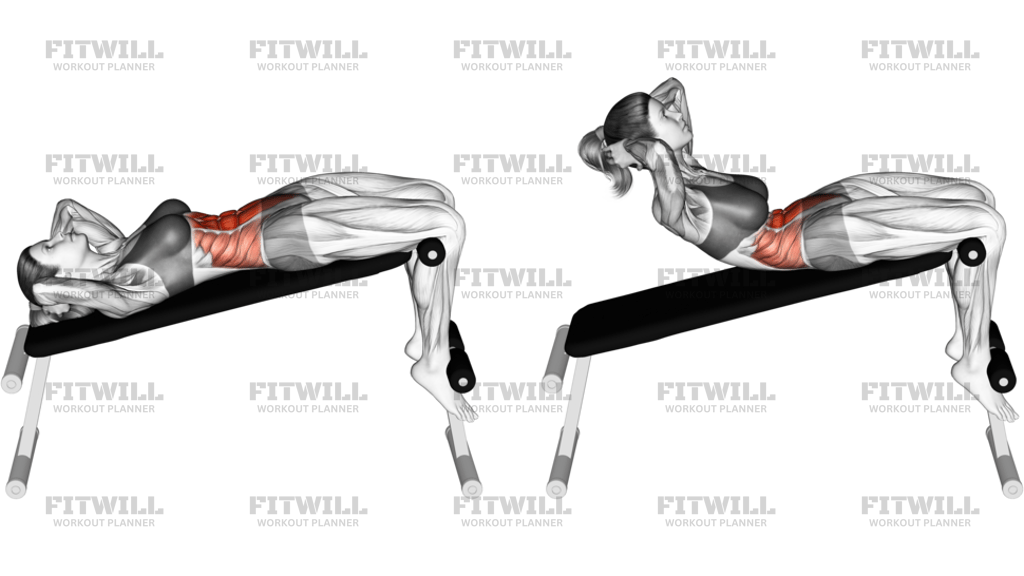
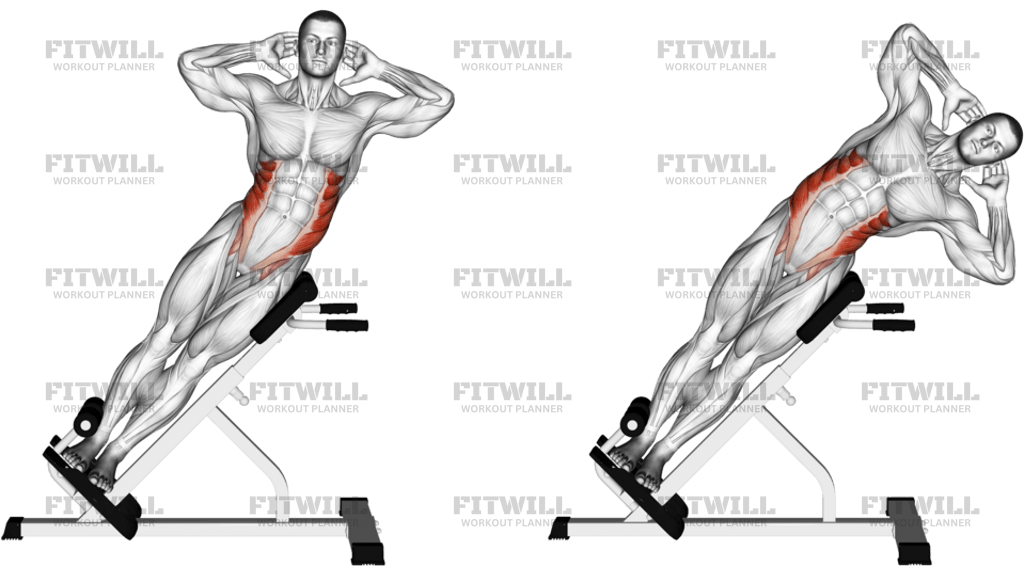
Decline Crunch is a bodyweight abdominal exercise performed on a decline bench with the feet secured under the rollers and the torso angled below the hips. The decline position increases the challenge on the trunk by making it harder to use momentum, so the rep has to come from a controlled spinal curl rather than a fast sit-up. It is most useful when you want direct ab work with a clear setup, a small but deliberate range of motion, and a strong emphasis on tempo and position.
The main target is the rectus abdominis, with the obliques and deeper trunk stabilizers helping keep the ribs and pelvis organized as you curl upward. Because the bench locks in the lower body, the exercise shifts the focus away from leg drive and toward trunk flexion. That makes setup important: if the feet are not secure or the body is too far down the bench, the rep becomes unstable and the neck or hip flexors tend to take over.
A good decline crunch starts with the pelvis and ribs stacked, the lower back lightly supported, and the chin kept off the chest. From there, the shoulders and upper back lift a few inches as the abs shorten, then the torso lowers slowly until the shoulder blades return to the bench. The goal is not to sit all the way up; the goal is to create a clean curl through the midline while keeping the neck relaxed and the movement smooth.
This exercise fits well in core sessions, accessory work, or the end of an upper-body or lower-body workout when you want focused abdominal tension without heavy loading. It is a strong option for people who can already control a basic floor crunch and want more challenge through body angle and longer tension. Keep the reps strict, avoid yanking the head forward, and stop the set once the curl turns into swinging or lumbar arching.
Because the movement is bodyweight and the range is modest, the main progression is better control rather than chasing bigger reps. You can make it easier by reducing the bench angle or shortening the range, and harder by slowing the lowering phase or pausing at the top. If the low back starts to arch or the hip flexors take over, the set is too hard or the bench angle is too aggressive.
[ Workout Log & Planner ]
Put your next workout in Fitwill
Keep your plan and training log ready when you are.


Instructions
- Set a decline bench to a manageable angle and lie back with your head near the high end, your feet locked under the ankle rollers, and your knees bent.
- Place your fingertips lightly beside your temples or behind your ears, keep your elbows slightly open, and tuck your chin so your neck stays long.
- Exhale to brace your midsection, flatten the ribs, and keep your lower back in contact with the bench before you start the curl.
- Lift your shoulders and upper back off the pad by curling your ribs toward your pelvis, not by pulling your head forward.
- Keep the movement short and controlled as you rise, stopping once your abs are fully shortened and your shoulder blades are clearly off the bench.
- Pause briefly at the top without relaxing your feet, ribs, or neck.
- Lower yourself slowly until your shoulder blades return to the bench and your trunk is back under control.
- Reset your breath at the bottom and repeat for the planned number of repetitions without bouncing.
Tips & Tricks
- Start with a shallow decline angle; a steep bench makes the hip flexors and neck work harder than the abs.
- Keep your feet wedged firmly under the rollers so your lower body does not slide as you curl upward.
- Think about bringing your ribs toward your pelvis instead of trying to lift your torso in one big arc.
- Leave your chin slightly tucked; if your chin lifts or the head pulls forward, the neck is doing too much of the work.
- Use a short top pause to make the ab contraction honest instead of bouncing out of the bottom.
- Lower for two to four seconds so the abs stay loaded on the way down.
- If your low back arches off the bench, shorten the range and reduce the bench angle before adding reps.
- Keep your elbows in the same position throughout the set; flaring them wider often turns the rep into a neck-driven crunch.
Frequently Asked Questions
What muscles does Decline Crunch work?
It mainly trains the rectus abdominis, with the obliques and deeper core muscles helping stabilize the torso.
Is this harder than a floor crunch?
Usually yes, because the decline angle makes it easier to use momentum and harder to keep the curl controlled.
Where should my feet go on the bench?
Hook them securely under the ankle rollers with the knees bent so your lower body stays fixed while the torso moves.
Should I pull on my head during the rep?
No. Keep the hands light and let the abs lift the shoulders; pulling the head forward usually shifts stress into the neck.
How high should I crunch up?
Only high enough for the shoulder blades to clear the bench and the abs to fully shorten. This is not a full sit-up.
Is Decline Crunch suitable for beginners?
Yes, if the decline is mild and the range stays small and controlled. A steep bench is usually too aggressive at first.
Why does my hip flexor feel this exercise?
If the bench is too steep or the curl becomes too large, the hip flexors can take over. Shorten the range and focus on rib-to-pelvis flexion.
How do I progress this movement?
Progress by using a steeper decline, slowing the lowering phase, adding a brief pause at the top, or increasing reps without losing control.