Barbell Seated Behind Head Military Press
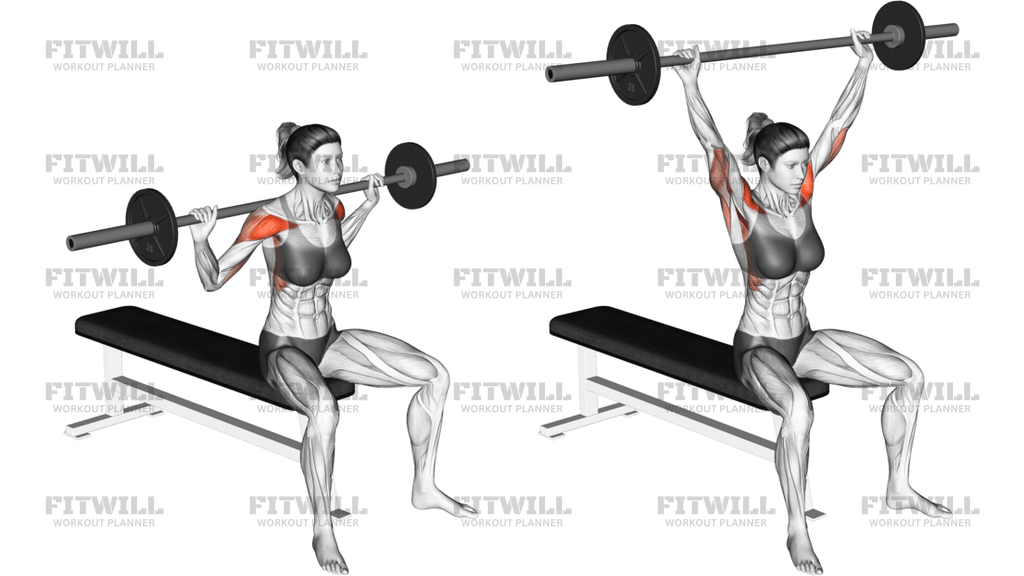
Barbell Seated Behind Head Military Press is a seated overhead press variation that starts with the bar behind the head and finishes with the arms locked out overhead. The image shows a lifter sitting tall on a flat bench with the feet planted and the bar resting just behind the crown of the head, so the exercise is built around a strict vertical press rather than leg drive or a chest-rebound.
This variation is primarily a shoulder builder, with the triceps helping to finish the press and the upper back, rotator cuff, and core keeping the torso steady. Because the bar travels behind the head, the setup matters more than in a standard front military press: the shoulders need enough comfortable range to let the elbows track slightly behind the line of the ears without forcing the neck or lower back into an awkward position. The goal is a controlled press path, not a bigger load at the expense of shoulder position.
A good rep starts before the bar moves. Sit centered on the bench, plant both feet, grip the bar a little wider than shoulder width, and keep the wrists stacked over the forearms. With the bar at the start behind the head, brace the trunk, keep the chest lifted without flaring the ribs, and press the bar straight up and slightly back until it finishes over the midline of the body. At the top, the biceps should come close to the ears and the shoulders should stay active rather than dumped forward.
Lower the bar under control along the same path until it returns behind the head to a depth you can own without pain or shoulder pinching. The descent should be smooth, the neck relaxed, and the torso quiet. If you have to lean back, shrug hard, or swing the elbows to find the top, the load is too heavy or the range is too deep for the day.
Use this exercise when you want strict shoulder pressing strength and you can keep the movement pain-free and repeatable. It is a more demanding option than a front press, so it works best as controlled strength work, accessory shoulder volume, or a technique-focused press variation. If the behind-the-head path feels rough on the shoulders, the safer regression is usually a standard seated or standing overhead press in front of the head.
[ Workout Log & Planner ]
Put your next workout in Fitwill
Keep your plan and training log ready when you are.


Instructions
- Sit centered on a flat bench with both feet flat, the torso tall, and the bar held just behind the head at upper-shoulder level.
- Grip the bar a little wider than shoulder width and stack the wrists over the forearms so the elbows can stay under control.
- Keep the chest lifted, ribs down, and neck long before the first rep starts.
- Take a breath and brace the trunk so the torso stays quiet when the bar leaves the shoulders.
- Press the bar up and slightly back in a straight overhead line until it finishes over the middle of the body.
- At the top, lock out the elbows without over-arching the lower back or shrugging the shoulders forward.
- Lower the bar slowly back behind the head along the same path you used to press it up.
- Stop the descent at a comfortable depth where the shoulders still feel controlled and pain-free.
- Exhale as you press and inhale as you lower, then reset before the next repetition.
Tips & Tricks
- Keep the bar path narrow and efficient: it should clear the head and finish stacked over the shoulders, not drift forward in front of the face.
- Use a range that lets the elbows travel comfortably behind the head; forcing the bar too low is where many lifters feel shoulder pinching.
- Do not turn the rep into a back arch. If your ribs pop up hard or your hips shift on the bench, the load is too heavy.
- A wider grip usually shortens the range and makes the behind-the-head position feel less crowded on the shoulders.
- Keep the chin slightly tucked so the bar can pass without you jutting the head forward to make room.
- The descent should be slower than the press so the shoulders stay organized and the bar does not drop behind you.
- If the upper traps take over and the neck feels cramped, lower the load and finish with the shoulders reaching up instead of shrugging aggressively.
- Plant the feet and keep them still; any leg drive will turn this into a press with body English rather than a strict seated movement.
- Pain in the front of the shoulder or deep inside the joint is a sign to shorten the range or switch to a front press variation.
Frequently Asked Questions
What muscles does Barbell Seated Behind Head Military Press work?
It is mainly a shoulder press, with the triceps helping at lockout and the upper back and core stabilizing the seated position.
Why is the bar started behind the head?
That setup changes the pressing angle and keeps the movement strict, but it also asks for more shoulder mobility than a standard front press.
How wide should my grip be on the bar?
A grip a little wider than shoulder width is usually the best starting point because it leaves room for the head and keeps the elbows in a manageable path.
How low should the bar go behind my head?
Only as low as you can control without shoulder pinch or neck tension; the bottom should feel organized, not forced.
Can I use leg drive on this press?
No. The image shows a strict seated press on a flat bench, so the feet stay planted but the legs should not help move the bar.
What should I do if the behind-the-head position hurts?
Shorten the range or switch to a standard seated overhead press in front of the head; pain in this position is a reason to regress.
Is this harder than a regular military press?
Usually yes, because the behind-the-head path is less forgiving and requires more control at the shoulders and upper back.
What is the biggest form mistake to avoid?
Letting the torso arch and the bar drift around the head instead of pressing it in a clean vertical line.