Resistance Band Foot External Rotation
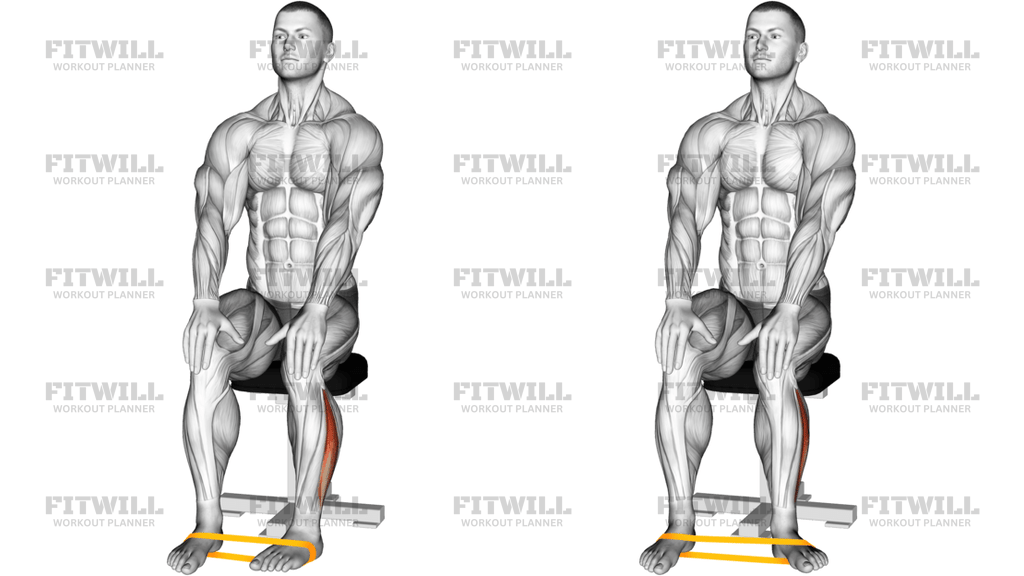
Resistance Band Foot External Rotation is a seated ankle-control exercise that asks you to rotate the foot outward against a light band while keeping the knee, thigh, and torso quiet. In the image, the athlete sits upright on a bench with the band looped around the forefeet, which removes most of the body English and makes the small rotation easier to feel in the outer lower leg and around the ankle.
This movement is useful when you want to train foot and ankle control rather than just move through a repetition quickly. The main work should stay near the outside of the lower leg, the ankle, and the stabilizers that keep the foot tracking cleanly. When the setup is right, the rep looks small, deliberate, and tidy. When the setup is wrong, people usually turn it into a hip twist, a knee turn, or a toe-gripping contest.
The bench position matters because it lets you keep the pelvis stacked and the trunk still while the foot does the work. Sit tall, keep the heel heavy, and let the outward rotation come from the ankle and forefoot instead of from swinging the whole leg. The band should feel like a steady pull that you control through the end range and on the way back, not a snap that yanks the foot around.
Use a light band first. If the resistance is too high, you will usually see the arch collapse, the heel lift, or the knee drift. If the resistance is too low, the exercise becomes a gesture instead of training. The best rep is smooth, controlled, and repeatable, with the return phase just as intentional as the outward turn.
This exercise fits well in a warm-up, accessory block, or lower-leg strength and rehab-style session when you want cleaner ankle mechanics and better foot positioning. Keep every rep pain-free and stop short of any pinching in the ankle, arch cramping, or unnecessary twisting through the knee. The goal is better control of the foot, not a bigger movement at any cost.
[ Workout Log & Planner ]
Put your next workout in Fitwill
Keep your plan and training log ready when you are.


Instructions
- Sit on a flat bench with your feet planted and a light resistance band looped around both forefeet, keeping enough tension that the band stays snug but not so much that it twists your toes.
- Sit tall with your ribs stacked over your pelvis, shoulders relaxed, and both knees pointing forward so the lower leg can move without extra help from the hips.
- Keep the heels heavy and the toes relaxed, then brace lightly so your torso stays still while the ankles do the work.
- Start with both feet in a neutral position and feel the band pull evenly across the forefeet before each rep begins.
- Rotate one foot outward against the band by driving the forefoot and ankle away from center, not by swinging the whole leg.
- Keep the knee quiet and the arch supported as you turn, stopping before the heel lifts or the lower leg starts to twist.
- Hold the end position for a brief pause so you actually own the range instead of bouncing through it.
- Return the foot to neutral slowly under band tension, then repeat for the planned reps or alternate sides as programmed.
- Breathe out as the foot rotates outward and breathe in as you control it back to center.
Tips & Tricks
- Pick a light band first; this is a precision exercise, and heavy resistance usually turns the rep into a hip twist.
- Keep the heel planted or heavy on the floor so the outward rotation comes from the ankle instead of from rolling onto the toes.
- Let the movement stay small and clean; a short, controlled rotation is better than forcing a big range that makes the arch collapse.
- If the knee starts drifting inward or outward, reset the setup before the next rep because the leg is no longer isolating the foot.
- Keep the toes relaxed instead of clawing the floor, or the foot will try to solve the rep with the toes rather than the ankle.
- Pause briefly at the widest outward turn to build control at the end range, where many people lose stability.
- Lower the foot back to center slowly so the return phase trains control instead of letting the band snap the leg back.
- Stay upright on the bench and avoid leaning backward or bracing through the hands, which usually hides bad ankle mechanics.
- Stop if you feel sharp pain in the ankle, arch, or outside of the foot; the target feeling should be work and control, not joint irritation.
Frequently Asked Questions
What does Resistance Band Foot External Rotation train most?
It mainly trains the outer lower leg, ankle control, and the small stabilizers that help the foot track cleanly.
Is the seated bench setup important for this exercise?
Yes. Sitting tall on a bench reduces cheating and makes it easier to isolate the foot instead of turning the whole leg.
Where should the band sit on my foot?
Place it around the forefoot or just across the front of the feet so the band can resist the outward turn without sliding.
Should my knee move while I rotate the foot?
No. Keep the knee pointed mostly forward and let the ankle and forefoot do the work.
How far should I rotate the foot outward?
Only as far as you can go while keeping the heel heavy, the arch stable, and the movement smooth.
Can beginners use Resistance Band Foot External Rotation?
Yes. Start with a very light band and focus on a slow, controlled range before adding more resistance.
What are the most common form errors?
The usual mistakes are twisting from the hip, lifting the heel, gripping with the toes, or letting the band yank the foot back.
When should I use this exercise in a workout?
It works well in a warm-up, lower-leg accessory block, or rehab-style session when you want cleaner ankle mechanics.
How do I make the exercise harder without losing form?
Use a slightly stronger band, add a pause at the end range, or slow the return to neutral while keeping the movement strict.