Strongman Fingals Fingers
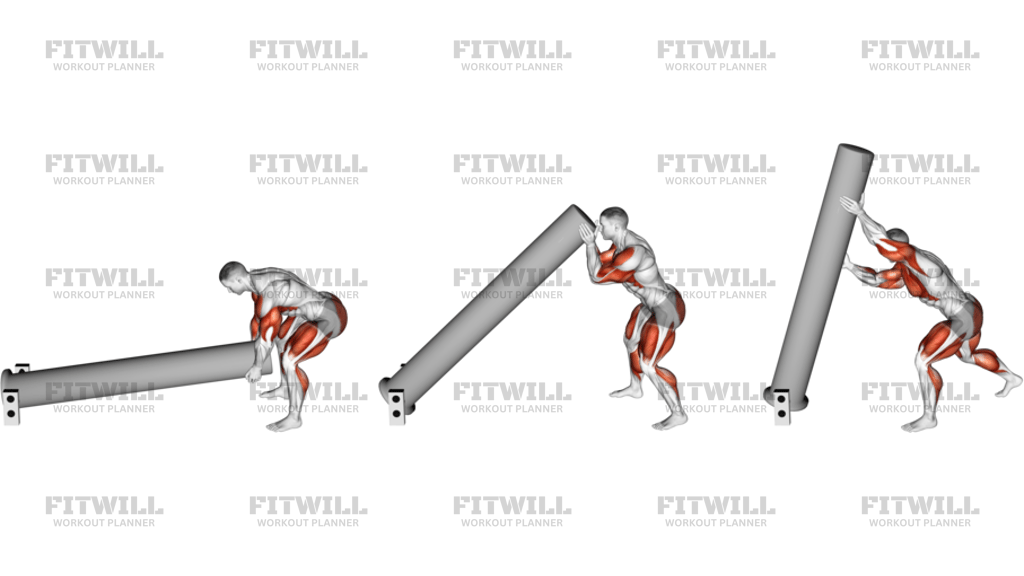
Strongman Fingals Fingers is a strongman event built around a long, hinged pole or log that starts low to the ground and must be driven upward until it passes the vertical. The movement is unusual because you are not just lifting a load, you are controlling a heavy lever as it rotates around a fixed base. That makes the exercise a demanding blend of leg drive, hip extension, shoulder strength, grip, trunk bracing, and timing.
The image shows the key phases clearly: a low crouched start, a transition where the implement rises through chest height, and a final push with the arms extended as the pole comes close to upright. The setup matters because the implement is awkward from the first centimeter. If you start too far away, you lose leverage. If you are too upright too soon, you give away the power that should come from the legs and hips. A close stance, a flat back, and a strong brace keep the load close enough to control.
Fingals Fingers is usually trained as a strongman accessory or event-specific drill, not as a bodybuilding movement. The goal is to produce repeated, confident drives through the sticking point while keeping the torso organized. The shoulders and triceps help finish the press, but the lift starts with the legs and hips. Good repetitions look deliberate: pull or drive the handle in close, stand into the lever, then keep walking the hands and feet through the rotation until the pole is upright.
Because the implement is long and unstable, the easiest mistake is trying to yank it with the arms or letting the body fold forward as the lever gets heavier. That turns the rep into a low-back tug-of-war instead of a coordinated full-body push. Treat every rep like a technical event lift. Reset between efforts, breathe before the drive, and own the transition from the floor to the vertical position.
Use this exercise when you want strongman-specific power, upper-back tension, overhead-ish finishing strength, and high-threshold bracing under awkward loading. Start conservatively, because the lever effect can make the load feel much heavier than the number on the plate suggests. The best result is a clean, repeatable lift that looks smooth from the crouch to the locked-out finish.
[ Workout Log & Planner ]
Put your next workout in Fitwill
Keep your plan and training log ready when you are.


Instructions
- Stand close to the hinged pole with your feet about shoulder-width apart and the base of the implement just in front of you.
- Crouch down with a flat back, chest over the handle end, and both hands set low on the pole or finger.
- Brace hard before the first pull so your torso is locked in before the lever leaves the floor.
- Drive through your legs and hips to start the pole rising, keeping the load close to your body as it comes off the ground.
- As the implement passes knee and thigh height, keep your chest up and continue to stand into the lever instead of rounding forward.
- Walk your hands and feet through the transition as needed, using short controlled steps to keep the pole traveling toward vertical.
- Finish the lift by pressing and extending until the pole is fully upright and under control.
- Lower the implement with the same control, reset your stance, and breathe before the next repetition.
Tips & Tricks
- Keep the load close to your shins and thighs at the start; letting it drift forward makes the lever feel dramatically heavier.
- Think leg drive first and arm push second. If the rep turns into a strict upper-body heave, the lift usually stalls.
- Use a staggered step only if it helps you stay balanced through the transition; do not let your feet chase the implement.
- Keep your ribs stacked over your pelvis as the pole rises so the lower back does not take the whole load.
- Breathe in and brace before the initial pull, then exhale gradually through the hardest part of the drive.
- Choose a load that lets you control the pole through the full arc, not just pop it off the floor.
- If the top half gets sloppy, shorten the set and reset rather than forcing another ugly rep.
- Expect the sticking point around chest height where leverage changes; that is where clean timing matters most.
Frequently Asked Questions
What does Strongman Fingals Fingers actually train?
It trains full-body strongman force with a big emphasis on legs, hips, shoulders, upper back, grip, and trunk bracing.
Is the pole supposed to start close to the floor?
Yes. The low start is part of the event, and staying close to the implement gives you better leverage off the ground.
Where should I feel the hardest part of the lift?
Most lifters feel the sticking point as the lever comes through knee to chest height, when the implement gets harder to rotate.
Do I need to use my arms a lot on Fingals Fingers?
Your arms help finish the lift, but the main drive should come from the legs, hips, and torso, not a long arm-only pull.
Can I treat this like a normal shoulder exercise?
No. It is a strongman event with an awkward lever, so the technique and bracing are more important than a typical shoulder press pattern.
What is the biggest form mistake?
Letting the body fold forward and yanking with the arms usually kills the leverage and overloads the lower back.
Is this beginner-friendly?
Only with a very light implement and a coached setup. The movement is technical and the lever gets unstable quickly.
How do I progress Fingals Fingers safely?
Progress by improving control, adding only small jumps in load, and keeping every rep smooth from the crouch to the vertical finish.