Weighted Muscle Up On Bar
Weighted Muscle Up On Bar is a high-skill bar strength exercise that combines a powerful pull, a fast transition, and a strong top support position while extra load hangs below you. The movement demands much more than arm strength alone. It asks for vertical pulling force, scapular control, trunk stiffness, grip endurance, and enough dip strength to finish the turnover cleanly.
The weighted version makes the transition more demanding because the body has to accelerate a heavier hanging load without losing the close path to the bar. That is why the setup matters so much. A false start, loose torso, or drifting swing can turn the rep into a kip-heavy heave instead of a controlled muscle-up. Done well, Weighted Muscle Up On Bar trains the lats, upper back, chest, triceps, shoulders, forearms, and deep core as one coordinated unit.
The image shows the load hanging between the legs while the athlete stays under the bar, which is the kind of arrangement that rewards a clean hollow body and a deliberate pull. Start from a dead hang with a shoulder-width overhand grip, then keep the ribcage down and the legs quiet as you pull the chest toward the bar. The transition should stay tight to the bar so the elbows can come over quickly instead of flaring out and forcing a long, inefficient turnover.
At the top, the goal is to reach a strong support above the bar with the shoulders stacked over the hands and the elbows fully straightened before lowering. This exercise is usually best placed in a strength block when freshness and coordination are high, not as a burnout movement at the end of a tired session. Use it only if you can already perform strict bodyweight muscle-ups with excellent control, and keep the added load modest enough that the pull and press phases stay crisp. If the bar path, tempo, or finish position starts to break down, the set is over. Because the extra load magnifies small errors, cut the set the moment the transition slows or the swing gets noisy. That keeps the movement useful for strength without turning it into a sloppy max-effort grind.
[ Workout Log & Planner ]
Put your next workout in Fitwill
Keep your plan and training log ready when you are.


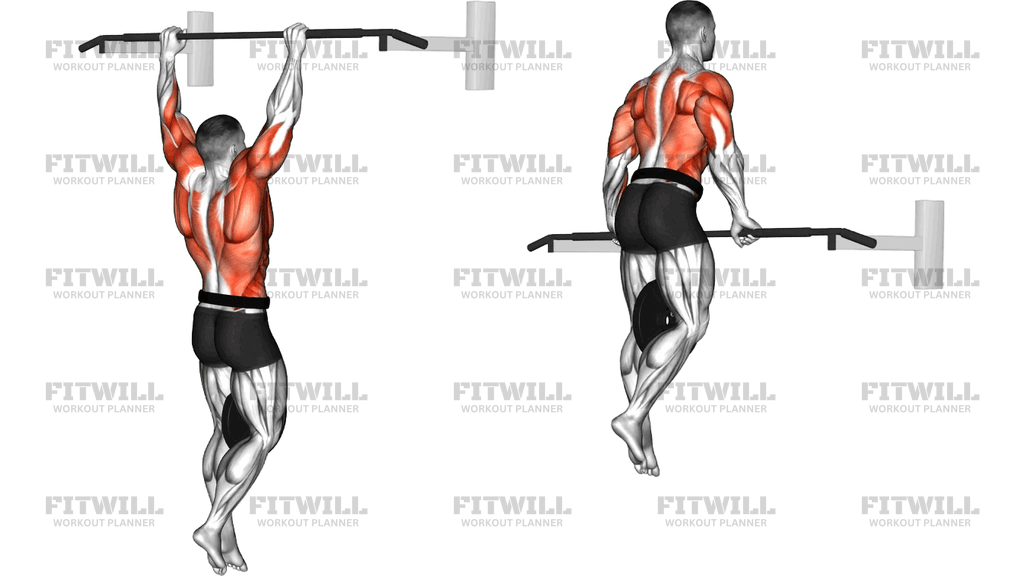
Instructions
- Hang from a straight bar with a shoulder-width overhand grip and let the added weight hang straight below you.
- Set your shoulders, keep your legs quiet, and hold a hollow body so the swing stays minimal before the first pull.
- Brace your midsection, then pull your chest toward the bar while keeping the bar close to your body.
- Drive the elbows down and back as you finish the pull, bringing the bar toward the lower chest or upper sternum.
- Lean the torso over the bar and whip the elbows around as soon as your chest reaches bar height.
- Press down on the bar until your elbows lock and you reach a stable support position above the bar.
- Lower with control back over the bar, then return to a dead hang without dropping out of position.
- Reset your shoulders and breathing before starting the next rep or racking the weight.
Tips & Tricks
- Use only enough extra weight that you can still keep the chest close to the bar during the turnover.
- If your hips swing forward, pause the set and reset the hollow body instead of letting the kip build.
- Think of the pull as bringing the bar to your lower ribs, not just pulling your chin over the bar.
- Keep the wrists over the bar in the transition; drifting too far back makes the press-out harder.
- The rep should finish with straight elbows and shoulders over the hands, not a soft top support.
- Lower under control so the shoulders stay organized and the swing does not grow rep to rep.
- A light hollow hold between reps helps keep the hanging load centered and prevents twisting.
- If you cannot perform a clean bodyweight muscle-up, reduce the load before chasing more height or speed.
Frequently Asked Questions
What muscles does Weighted Muscle Up On Bar work most?
It heavily trains the lats, upper back, triceps, chest, shoulders, and grip, with the core working hard to keep the body tight under the hanging load.
Is Weighted Muscle Up On Bar beginner-friendly?
No. It is an advanced bar skill that usually requires strict bodyweight muscle-ups first, plus enough pulling and dip strength to control the extra load.
Where should the weight hang during Weighted Muscle Up On Bar?
The load should stay centered under you, usually hanging between the feet or from a belt, so it does not swing and pull you off the bar path.
What is the biggest mistake in Weighted Muscle Up On Bar?
Letting the pull drift away from the bar. If the bar gets away from your torso, the turnover becomes slow and the press-out turns into a grind.
Should I use a kip on Weighted Muscle Up On Bar?
A small, controlled swing may happen, but the rep should not rely on a big kip. The more extra load you add, the more important it is to keep the torso tight and the swing small.
How do I know if I am ready for the weighted version?
You should be able to perform clean bodyweight muscle-ups on a bar with a stable top support and a controlled descent before adding resistance.
What should I feel in the top position of Weighted Muscle Up On Bar?
You should feel a strong support through the triceps, shoulders, and upper chest with the elbows locked and the bar under control.
Can I substitute a pull-up or dip instead of Weighted Muscle Up On Bar?
Yes. Weighted pull-ups and straight-bar dips are the closest easier options if you need to build the pull and press portions separately.