Full Planche Push-Up
Full Planche Push-Up is a high-skill bodyweight pressing exercise performed with the torso held almost parallel to the floor and the hands supporting the entire body. In the image, the shoulders are far in front of the wrists, the legs stay straight, and the hips do not sag, which is what makes the movement so demanding. The exercise loads the front delts, chest, triceps, serratus, and deep core at the same time, but the real limiter is usually the ability to hold the body rigid while leaning the shoulders forward.
This is not a normal push-up variation with a wider base or feet on the floor. The challenge comes from keeping the body in a planche line while the arms press under a very forward center of mass. That means the setup matters as much as the rep itself: if the shoulders are not protracted, the ribs flare, or the pelvis drops, the repetition turns into a sloppy hold instead of a controlled strength movement. The best repetitions look almost still from the side because the athlete maintains tension before the descent even begins.
Use this exercise only when you can already support a strong planche lean or a tucked planche push-up pattern. The ideal rep starts from a locked-out top position with the scapulae pushed away from the floor, elbows straight, glutes tight, and toes pointed. From there, bend the elbows just enough to lower the chest in a straight, deliberate path while keeping the body level. Press back to the top without losing the forward shoulder position or breaking the hollow-body line.
Because the range is small and the leverage is severe, quality matters more than depth or repetition count. Short pauses, controlled eccentrics, and clean lockouts are more useful than forcing more reps with bent knees or a collapsed torso. If the shoulders feel overloaded or the lower back starts to arch, the set should end. This movement belongs in advanced strength work, planche practice, or calisthenics-focused programming where the goal is not just pressing power, but total-body control under extreme leverage.
[ Workout Log & Planner ]
Put your next workout in Fitwill
Keep your plan and training log ready when you are.


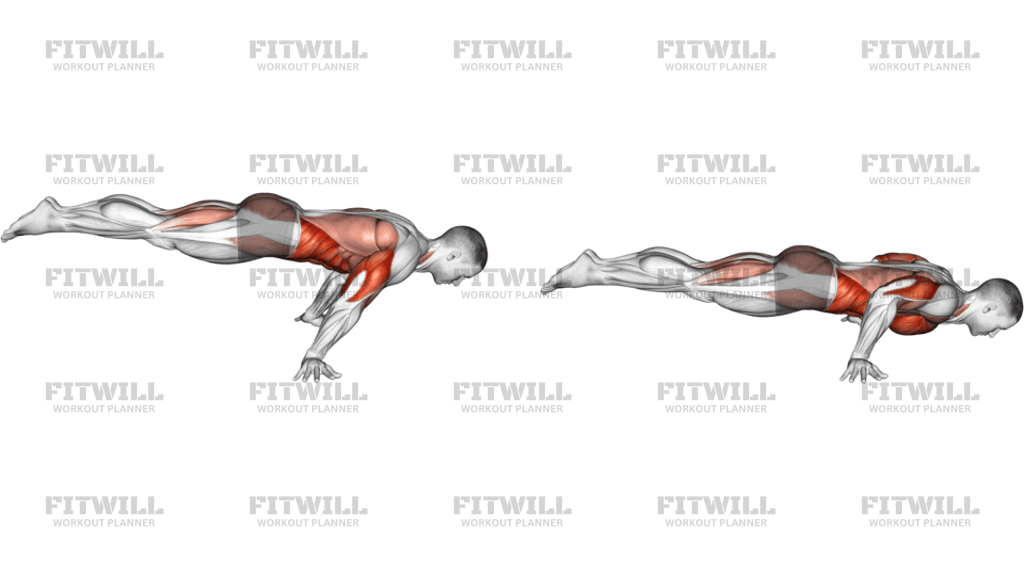
Instructions
- Place both hands on the floor, slightly turned out if that helps your wrists, and lean the shoulders far in front of the wrists.
- Straighten the elbows, lock the legs together, and lift the feet so the body floats in a near-horizontal planche line.
- Protract the shoulder blades, tuck the pelvis slightly, and brace the abs so the ribs stay down.
- Set the neck long and look a few inches ahead of your hands rather than craning upward.
- Inhale to prepare, then bend the elbows just enough to lower the chest in a slow, controlled path.
- Keep the torso level as you descend; do not let the hips pike or the lower back sag.
- Press the floor away to return to full elbow lockout while keeping the shoulders forward and the body rigid.
- Exhale through the press, reset the hollow-body tension at the top, and stop the set when the line or shoulder position breaks.
Tips & Tricks
- Think about pushing the floor away the entire time; planche work is as much about shoulder protraction as it is about elbow extension.
- If your wrists feel strained, turn the hands out slightly and shorten the set instead of forcing more reps.
- A tiny bend in the elbows is enough; chasing a deep chest-to-floor depth usually ruins the body line.
- Keep the glutes squeezed so the legs stay together and the pelvis does not dump forward.
- Do not let the shoulders drift back over the wrists during the rep; the forward lean is the whole point of the exercise.
- Pause the rep if you lose a flat torso, because a broken line turns the drill into a different push-up pattern.
- Use slow eccentrics and low reps because fatigue makes the hips drop long before the muscles are actually done.
- Regress to a tuck or straddle planche push-up if you cannot hold the horizontal position without compensating.
Frequently Asked Questions
What does Full Planche Push-Up train most?
It heavily challenges the front shoulders, chest, triceps, serratus, and core, with the shoulder girdle usually being the main limiter.
Is this the same as a regular push-up?
No. In a full planche push-up the feet are off the floor and the shoulders stay far forward, so the leverage is dramatically harder.
Where should my hands be for the rep?
Place them under the shoulders only after you have leaned well forward; the key is to keep the shoulders in front of the wrists, not stacked over them.
Why does my lower back arch during this exercise?
Usually the core is losing tension or the shoulders are not leaning forward enough. Keep the ribs down, squeeze the glutes, and shorten the set.
Can I use bent knees to make it easier?
Bent knees change the leverage and turn it into a different progression. Use a tuck or straddle version if you need an easier planche pattern.
What is the most common form mistake?
Letting the hips sag or losing shoulder protraction. Both make the movement look like a shaky push-up instead of a controlled planche press.
How should I breathe during the rep?
Take a breath before the descent, hold enough tension to keep the trunk rigid, then exhale as you press back to lockout.
What should I practice before full planche push-ups?
Planche leans, tuck planche holds, and assisted planche push-up negatives are the most useful prerequisites.