Kettlebell Forward Lunge
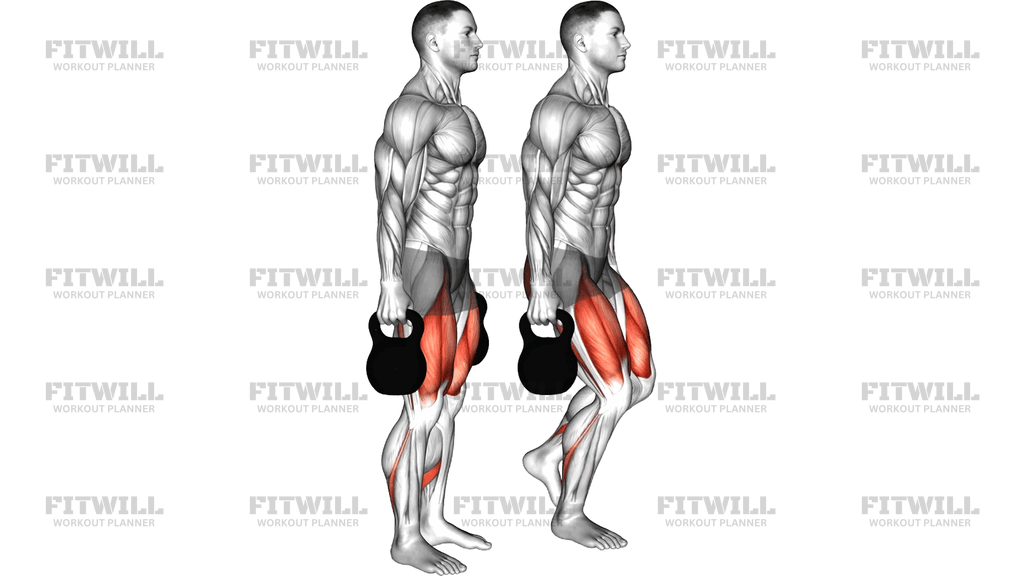
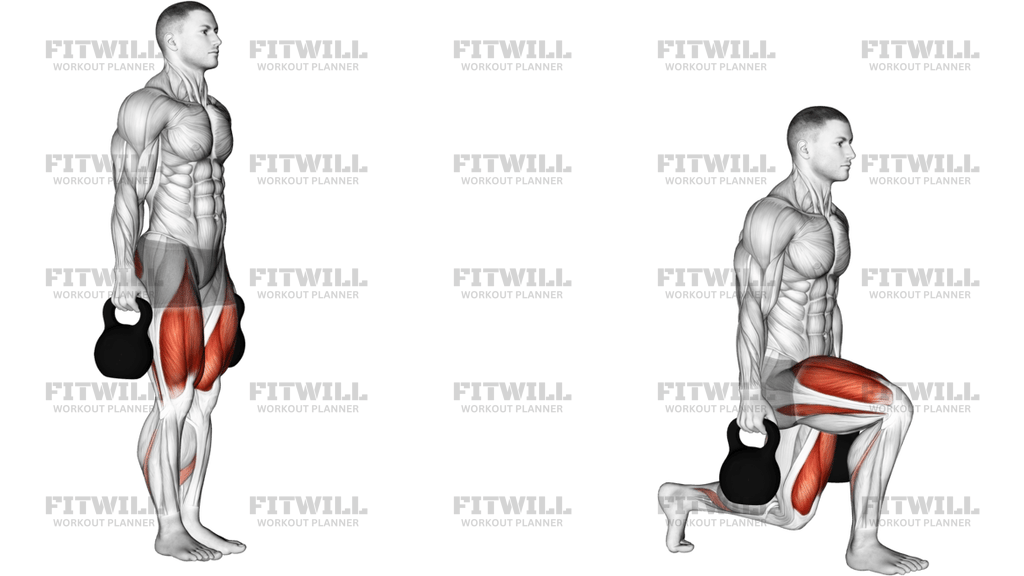
Kettlebell Forward Lunge is a loaded single-leg exercise that builds strength, control, and balance through a forward step and a deep split stance. With the kettlebells held at your sides, the movement challenges the legs and hips to support the body without letting the torso tip, the pelvis twist, or the front knee drift inward. It is a practical lower-body pattern for training how to absorb force, control alignment, and drive back to standing under load.
The main work comes from the front leg as it lowers and stands back up, but the rear leg, hips, and core all help keep the body organized. You should feel the front thigh and glute doing most of the lifting, with the adductors, calves, and trunk working to steady the descent. Because the bells hang at your sides, grip and shoulder stability matter too, especially when the load gets heavier or the set gets longer.
The setup determines whether the rep feels smooth or awkward. Stand tall first, then step forward far enough that you can lower straight down without collapsing into the front knee or being forced to lean excessively. A good lunge keeps pressure through the front foot, the back heel lifted, and the torso controlled rather than rigid. The kettlebells should stay quiet beside your legs instead of swinging as you move.
On each repetition, step forward, lower with control until the back knee approaches the floor, and then drive through the front foot to return to standing. Keep the front knee tracking over the middle toes and let the hips descend between both feet instead of pitching the chest forward. A brief pause near the bottom can improve balance and make it easier to own the position before you come back up.
Kettlebell Forward Lunge fits well in strength sessions, unilateral leg work, or accessory blocks when you want a movement that challenges the legs without needing a machine. It is especially useful if you want to train both sides independently and notice left-right differences in balance or stability. Start with a light load and crisp steps, because once the stride gets sloppy or the torso starts swaying, the exercise stops training the lunge and starts training compensation.
Fitwill
Log Workouts, Track Progress & Build Strength.
Achieve more with Fitwill: explore over 9600 exercises with images and videos, access built-in and custom workouts, perfect for both gym and home sessions, and see real results.
Start your journey. Download today!




Instructions
- Stand tall with a kettlebell in each hand at your sides, feet about hip-width apart, arms straight, and palms facing your thighs.
- Set your ribs over your pelvis, look forward, and plant your whole foot before taking the first step.
- Step one leg forward far enough that you can lower straight down without losing balance or tipping your chest.
- Lower your back knee toward the floor while keeping your front heel planted and your front knee tracking over the middle toes.
- Keep the kettlebells hanging quietly beside your legs as you descend; do not let them swing ahead of your body.
- Pause when your front thigh is close to parallel and your back knee is just above the floor, with your hips square to the front.
- Drive through the front heel and midfoot to stand back up, bringing your hips and shoulders up together.
- Exhale as you press through the floor, then return the front foot to the starting line and reset before the next rep.
- Alternate legs for the prescribed reps or finish one side first if your program calls for it.
Tips & Tricks
- Take a long enough step that your front shin stays fairly vertical at the bottom instead of letting the knee run far past the toes.
- Keep both kettlebells close to your thighs; if they swing, the stride is usually too fast or the load is too heavy.
- Let the torso lean only slightly forward as you descend, but keep the chest open and the head stacked over the ribs.
- Think about lowering straight down between your feet rather than lunging onto a tightrope.
- Keep pressure on the front heel and big toe so the front leg does the work instead of launching off the back foot.
- If your back knee taps the floor hard, shorten the range slightly and own the bottom position before adding load.
- A brief pause in the split stance exposes balance issues and makes each rep more honest.
- Use lighter kettlebells if your grip starts failing before your legs; the hold should not turn into a forearm exercise.
- Stop the set when your hips twist or your front knee caves inward, even if your breathing still feels easy.
Frequently Asked Questions
What muscles does Kettlebell Forward Lunge work most?
It primarily loads the front leg, especially the glutes and quads, while the hips and core help keep you stable.
Should I hold one kettlebell or two in Kettlebell Forward Lunge?
The pictured version uses a kettlebell in each hand at your sides, but some lifters start with one bell or bodyweight before loading both hands.
How far should I step on the forward lunge?
Step far enough that you can lower straight down with the front heel planted and the front shin close to vertical at the bottom.
Why does my front knee collapse inward during Kettlebell Forward Lunge?
That usually means the step is too narrow, the load is too heavy, or the arch is losing tension. Widen the step slightly and press the knee over the middle toes.
Do I need to touch my back knee to the floor?
No. Lower until the back knee is just above the floor or makes a very light tap, then drive back up without bouncing.
Is Kettlebell Forward Lunge good for beginners?
Yes, if they start light and keep the stride controlled. Bodyweight or a single light kettlebell works well until the balance pattern feels solid.
What is the biggest form mistake with the kettlebells at my sides?
Letting the bells swing or drift forward. Keep them hanging straight down so the legs and hips stay in charge of the movement.
Can I use this instead of a split squat?
Yes. Kettlebell Forward Lunge is a more dynamic unilateral leg variation, while a split squat is a better choice if you want to reduce balance demands.