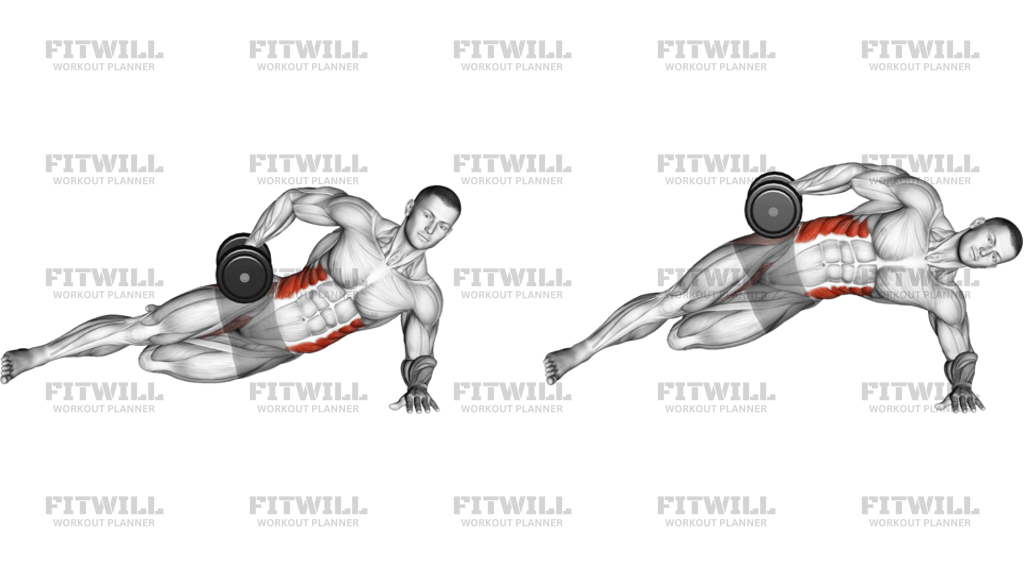
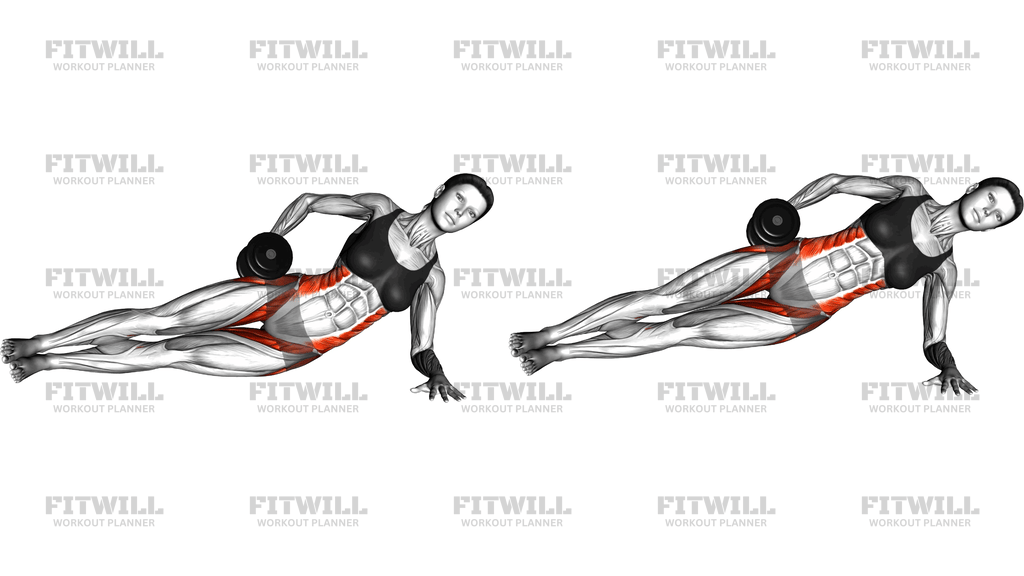
Dumbbell Side Plank With Rear Fly
Dumbbell Side Plank With Rear Fly combines a side plank with an upper-body fly pattern, so it challenges the obliques, shoulder stabilizers, and midline control at the same time. The body stays long and rigid while the top arm moves in a controlled arc with the dumbbell. That mix makes the exercise useful when you want more than a simple core hold: it asks the trunk to resist rotation while the shoulder works through a precise raise and lower.
The side plank position is what makes the movement effective. The supporting hand stays planted under the shoulder, the feet stack or stagger for balance, and the hips have to stay lifted while the dumbbell arm moves. If the torso twists, the ribs flare, or the hips sag, the obliques lose tension and the fly becomes a swing instead of a strength drill. A lighter dumbbell with clean alignment is far more useful here than chasing load.
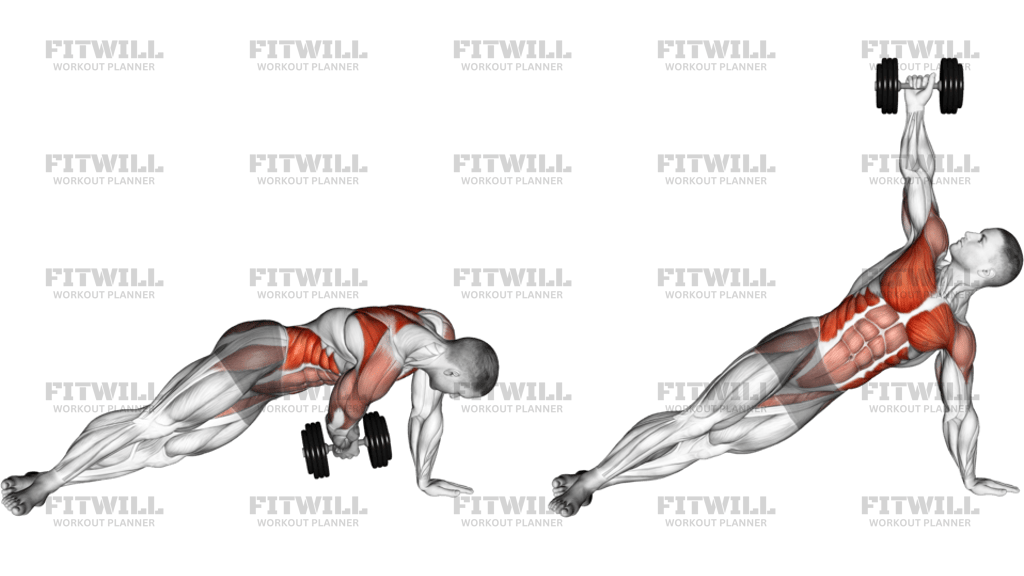
The working arm should travel through a smooth rear-fly arc, not a shrug or a jerk. Start with the dumbbell hanging under the shoulder line, then raise it until the arm is stacked roughly over the shoulder with a soft elbow and a steady torso. Lower it back along the same path without letting the trunk rotate or the supporting shoulder collapse. The goal is to keep the body square and quiet while the top arm moves.
This exercise fits well in accessory work, core training, or a shoulder stability block, especially for people who need anti-rotation strength along with upper-body control. It can also expose weak links quickly, which is useful if one side drops sooner or the shoulder gets unstable under fatigue. Because the position is demanding, it works best when the set stays crisp and the rep speed stays deliberate.
Use Dumbbell Side Plank With Rear Fly when you want controlled tension, not momentum. The set should finish when the hips start to drift, the neck tenses, or the dumbbell path gets sloppy. With a clean side plank, a quiet torso, and a measured fly, the exercise delivers a strong oblique stimulus while also reinforcing shoulder control and whole-body coordination.
[ Workout Log & Planner ]
Put your next workout in Fitwill
Keep your plan and training log ready when you are.


Instructions
- Place one hand on the floor directly under the shoulder and stack your feet in a straight side-plank line, then hold a dumbbell in the top hand with the arm hanging under the shoulder.
- Lift your hips until your head, ribs, pelvis, and legs form one long line, and keep your chest open without rolling forward or backward.
- Set your gaze slightly ahead of you and brace your ribs down so the torso stays steady before the dumbbell moves.
- Keep a soft bend in the working elbow and raise the dumbbell in a wide rear-fly arc until the arm is stacked over the shoulder.
- Pause briefly at the top without shrugging the shoulder or letting the hips twist.
- Lower the dumbbell back along the same arc until the hand hangs beneath the shoulder again.
- Hold the side plank height through the whole repetition and breathe out as the dumbbell rises, then inhale as it lowers.
- Finish the set by lowering your hips carefully and placing the dumbbell down with control before switching sides.
Tips & Tricks
- Choose a dumbbell that lets you keep the side plank square; if the ribs rotate as the arm rises, the weight is too heavy.
- Press the floor away through the support hand so the shoulder stays stacked and does not sink into the ear.
- Keep the top elbow slightly bent and fixed, because straightening it turns the fly into a swing.
- Think about lifting the dumbbell out and slightly back, not shrugging it straight up toward the ceiling.
- If the top hip rolls open, shorten the arc and focus on keeping the belt line facing forward.
- A staggered foot position is often more stable than perfectly stacked feet if balance is the limiting factor.
- Exhale as the dumbbell rises to help keep the ribs from flaring and the trunk from twisting.
- Stop the set when the support shoulder starts to wobble, even if the dumbbell still feels light.
- For a shoulder-friendly variation, keep the arm a little in front of the torso instead of directly out to the side.
Frequently Asked Questions
What muscle does Dumbbell Side Plank With Rear Fly target most?
The obliques are the main focus, with the shoulder and deep core helping keep the body stable while the dumbbell moves.
Can beginners perform this exercise?
Yes, but it is usually best started with a very light dumbbell or a bodyweight side plank first so the trunk position stays clean.
Which hand should stay on the floor in Dumbbell Side Plank With Rear Fly?
The lower hand supports your body on the floor, and the top hand holds the dumbbell and performs the fly arc.
How heavy should the dumbbell be for this movement?
Use a light load that lets you keep the hips lifted and the torso square through every rep. If the body twists before the arm fatigues, the weight is too heavy.
Why do my hips drop during the fly?
Usually the support shoulder or the obliques are losing tension, or the dumbbell is too heavy. Shorten the range and reduce the load until the side plank stays level.
Should the elbow stay straight on the dumbbell arm?
Keep a soft bend in the elbow and hold it there. Locking it out often makes the shoulder feel crowded and encourages swinging.
Is Dumbbell Side Plank With Rear Fly more of a core or shoulder exercise?
It is both, but the side plank makes the obliques and trunk stability the limiting factor for most people. The fly adds extra demand to the shoulder and upper back.
What should I do if my shoulder pinches at the top?
Reduce the range of motion and keep the dumbbell slightly in front of the shoulder line instead of forcing it straight overhead.
Can I make Dumbbell Side Plank With Rear Fly easier?
Yes. Bend the bottom knee for a shorter lever, use a lighter dumbbell, or hold the side plank without moving the arm until the position feels stable.
Where should the dumbbell travel during each rep?
It should follow a smooth arc away from the body and back down along the same path, without any jerking or torso rotation.