Barbell Bent-Over Wide-Grip Row
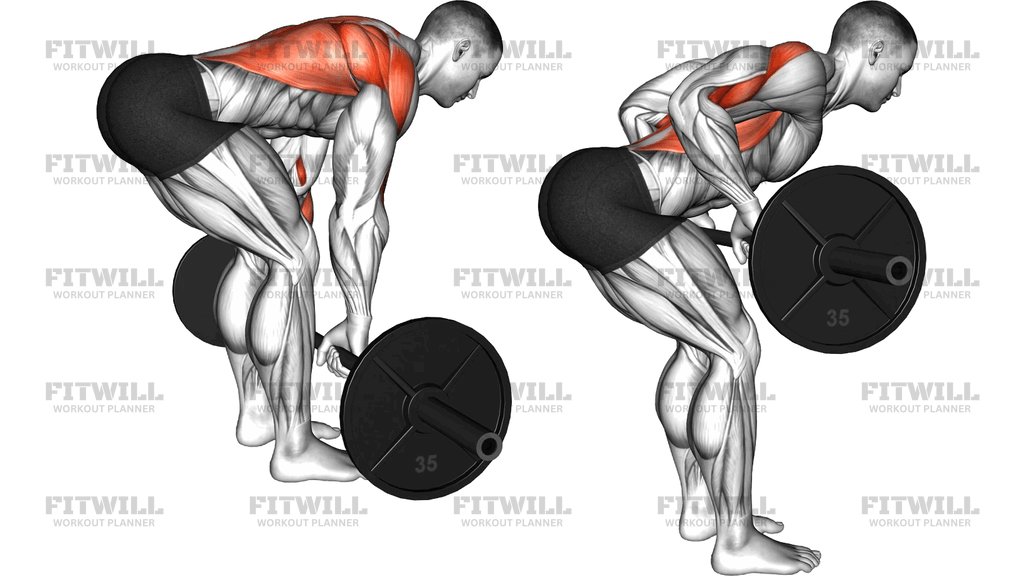
Barbell Bent-Over Wide-Grip Row is a free-weight pulling exercise that starts from a hip hinge and uses a pronated grip wider than shoulder width. The setup in the image matters because the torso angle, hand spacing, and bar path all change how much tension stays on the lats and upper back versus how much the low back has to stabilize. When the hinge is fixed and the bar stays close to the body, this row becomes a clean way to train back thickness, shoulder control, and strong elbow drive.
The main emphasis is on the lats, with the rhomboids, mid traps, rear delts, biceps, and forearm flexors assisting through the pull. A wider grip reduces how much the elbows tuck, so the movement usually feels more upper-back dominant than a narrow row while still loading the lats hard at the start and finish of each rep. That makes the exercise useful for lifters who want a rowing variation that reinforces scapular retraction without turning into a shrug or a body English lift.
The movement should begin with the hips pushed back, knees softly bent, spine long, and chest open while the bar hangs under the shoulders. From there, keep the torso angle steady and row the bar toward the lower ribs or upper abdomen by driving the elbows back and slightly out. The bar should skim close to the thighs and midsection on the way up, then return under control until the arms are straight again. Breathing is simple: brace before the pull, exhale through the effort, and reset at the bottom without standing up between reps.
This row fits well in back-focused strength work, hypertrophy sessions, or as an accessory after a main press or hinge. It rewards strict loading more than heavy cheating, so the best results usually come from a weight you can control with a consistent torso position and a brief squeeze at the top. If the lower back starts to round, the bar drifts away from the body, or the reps become a partial deadlift, the load is too heavy for the intended stimulus.
[ Workout Log & Planner ]
Put your next workout in Fitwill
Keep your plan and training log ready when you are.


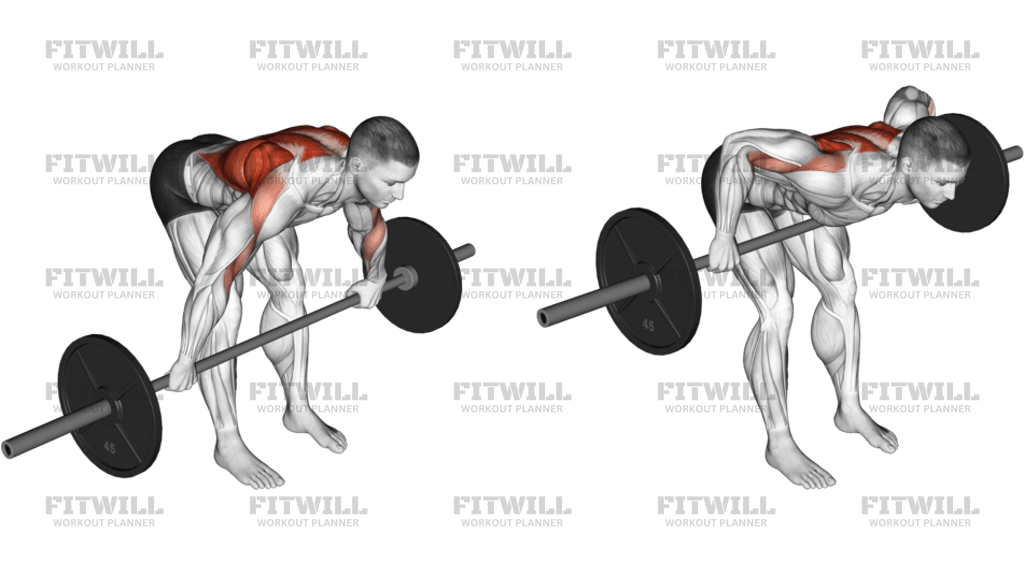
Instructions
- Stand with your feet about hip-width apart and hinge forward until your torso is roughly 30-45 degrees above parallel, keeping a soft bend in the knees.
- Take a wide overhand grip on the bar, with your hands just outside shoulder width, and let the bar hang below your shoulders with your arms straight.
- Set your spine long, draw your chest open, and keep your neck in line with your torso instead of looking up.
- Brace your midsection before the first rep so the torso angle stays fixed while the arms move.
- Pull the bar toward your lower ribs or upper abdomen by driving your elbows back and slightly out to the sides.
- Keep the bar close to your thighs and body as it travels up, and avoid turning the pull into a shrug.
- Squeeze your upper back briefly at the top while the torso stays still and the shoulders do not roll forward.
- Lower the bar in a controlled path until the arms are fully extended and the shoulders are set again.
- Reset your breath at the bottom and repeat for the planned number of repetitions without standing upright between reps.
Tips & Tricks
- A grip that is only slightly wider than shoulder width usually gives enough elbow flare without cutting the range of motion too much.
- If the bar keeps drifting forward, lighten the load and think about dragging it up your thighs on every rep.
- Keep the hinge angle locked in; if the torso keeps rising with each pull, the set has turned into a standing row-plus-deadlift hybrid.
- Let the elbows travel back, not straight up, so the lats and upper back do the work instead of the traps taking over.
- A one- to two-second squeeze at the top helps stop the movement from becoming a momentum row.
- Use straps if grip fatigue ends the set before your back does, especially on higher-rep work.
- Stop the descent before the plates touch your shins or the floor if that would force you to lose your torso position.
- If your low back feels the set more than your lats, shorten the range slightly and reduce the load until the hinge stays stable.
Frequently Asked Questions
What muscles does the Barbell Bent-Over Wide-Grip Row work most?
The lats are the primary target, with the rhomboids, mid traps, rear delts, biceps, and forearm flexors helping during the pull.
Why use a wide overhand grip instead of a narrow grip?
A wider grip usually shifts more work toward the upper back and rear delts while still loading the lats, and it keeps the elbows from tucking too tightly.
How low should the bar travel on each rep?
For this version, aim for the lower ribs or upper abdomen. If the bar is rising toward the chest or neck, the path is too high.
Should my torso stay fixed the whole time?
Yes. The hinge should stay nearly the same from the first rep to the last, with the arms and shoulders doing the moving.
Is this exercise beginner-friendly?
Yes, if the load is light and the hinge is practiced first. New lifters should focus on keeping the back position stable before adding weight.
Why does this row sometimes bother the lower back?
That usually happens when the weight is too heavy or the torso keeps bobbing up and down instead of staying braced in one angle.
Can I use straps with this row?
Yes. Straps are useful if your grip gives out before your back muscles, especially on higher-rep sets.
What is the most common form mistake?
The biggest mistake is turning the row into a body-swinging pull, which moves tension away from the lats and upper back.