Resistance Band High Knee Lunge With Single-Arm Row
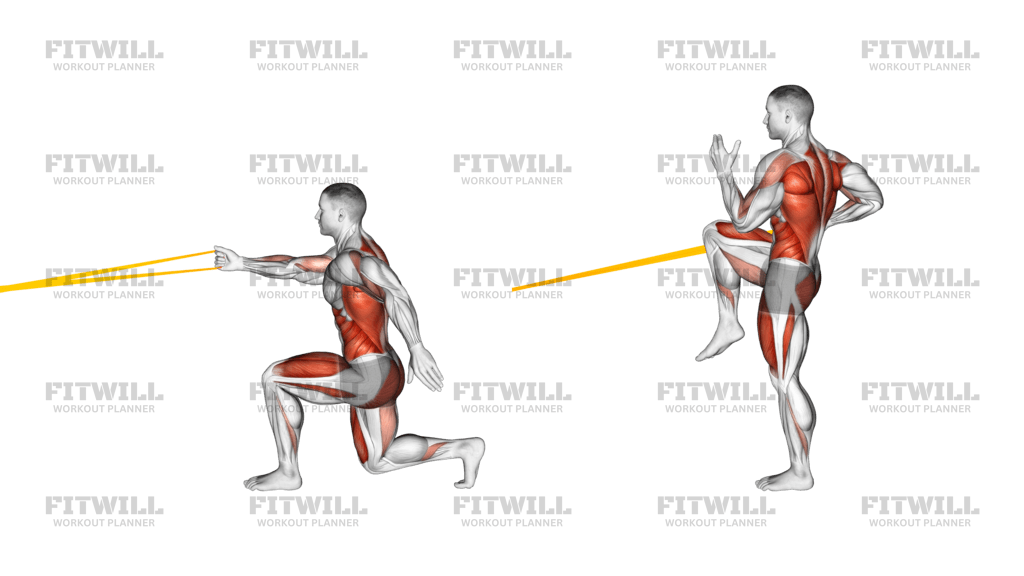
Resistance Band High Knee Lunge With Single-Arm Row combines a split lunge, a knee drive, and a rowing pattern into one coordinated rep. The band is anchored in front of you, and each repetition asks you to control the lower body while you pull the handle back toward your ribs. That makes it useful for training thighs, glutes, lats, core stability, and balance at the same time.
The setup matters because the band tension, stance length, and anchor height determine whether the exercise feels smooth or awkward. Stand far enough from the anchor that the arm starts long but not locked out, then settle into a split stance with your front foot planted and your rear knee lowered toward the floor. From there, you should be able to row without leaning backward or getting yanked out of position by the band.
Each rep should travel from a low lunge to a tall, controlled high-knee finish. As you row, keep your torso square to the anchor, drive the elbow back instead of shrugging the shoulder up, and bring the rear knee forward with the same rhythm. The lower body should rise because you are pressing through the front foot and standing tall, not because you are jumping or twisting through the trunk.
This is a good choice when you want a unilateral drill that links upper-body pulling with lower-body force production. It fits well in athletic warmups, accessory blocks, and conditioning circuits because it challenges coordination without requiring heavy loading. The movement also rewards clean breathing and steady tempo, so it is easy to keep the rep quality high when the resistance is light to moderate.
Use a stable anchor and a band tension you can control for the entire set. If the shoulder feels pinched, the torso starts leaning away from the anchor, or the standing knee caves inward, shorten the stance or reduce resistance. The best reps look smooth, balanced, and repeatable from the first side to the last.
[ Workout Log & Planner ]
Put your next workout in Fitwill
Keep your plan and training log ready when you are.


Instructions
- Clip the band to a solid anchor in front of you at about chest height, then hold the handle in one hand.
- Step back far enough to create steady tension, and face the anchor in a split stance with one foot forward and the other foot behind you.
- Lower into a lunge so the rear knee hovers just above the floor or lightly taps down, while the front foot stays flat and stable.
- Reach the working arm forward so the band is taut, keep your shoulders level, and stack your ribs over your pelvis.
- Brace your trunk, then pull the handle back toward your lower ribs as you press through the front foot.
- At the same time, drive the rear knee forward and up into a high-knee position without leaning back or rotating your hips.
- Squeeze the glute and upper back at the top for a brief pause, with the elbow tucked close and the standing leg tall.
- Return the arm forward under control and lower the lifted knee back to the split lunge with steady tension on the band.
- Complete all reps on one side, reset your stance, and repeat with the opposite arm and leg.
Tips & Tricks
- Choose a band that lets you row smoothly from full reach without jerking the shoulder forward.
- If the band pulls you off balance, step a little closer to the anchor so the starting tension is lighter.
- Keep the front heel rooted when you row; if it lifts, your stance is too short or the resistance is too heavy.
- Think about pulling the elbow to the back pocket rather than shrugging the hand toward the shoulder.
- Keep the hips square to the anchor so the row does not turn into a torso twist.
- Let the rear knee travel straight forward on the drive instead of swinging out to the side.
- Exhale as you row and stand, then inhale as you return to the lunge.
- Stop the set if the front knee caves inward or the trunk starts leaning away from the band.
- Use a controlled lowering phase so the rear knee lands softly instead of dropping fast.
Frequently Asked Questions
What does the Resistance Band High Knee Lunge With Single-Arm Row train?
It trains the legs, glutes, back, and core together while also challenging balance and coordination.
Where should the band be anchored for this exercise?
Anchor the band in front of you around chest height so the row travels straight back toward the ribs.
Should my rear knee touch the floor in the lunge?
It can lightly tap the floor, but it should stay controlled and not collapse or bounce.
What is the main mistake to avoid during the row?
Do not lean back or twist your torso to finish the pull; the elbow should move back while the trunk stays square.
Is this exercise suitable for beginners?
Yes, beginners can do it with a light band and a shorter range until they can keep the lunge and row coordinated.
What should I feel working most during the rep?
You should feel the front leg and glute driving the rise, with the upper back and lats helping finish the row.
Can I use a heavier band to make it harder?
Yes, but only if you can keep the knee drive, torso position, and shoulder path clean from start to finish.
How do I know if my stance is too long or too short?
If you cannot keep the front heel down or the rear knee cannot drive forward cleanly, adjust the stance until both positions feel stable.
Can I program this as a warm-up or a strength drill?
It works well in either place, depending on the band tension and whether you use it for movement prep or controlled accessory work.