Standing Air Bike
Standing Air Bike is a bodyweight core drill that combines a standing knee drive with an opposite-side elbow crunch. It is a simple way to train the abs, obliques, hip flexors, and the small stabilizers that keep your torso upright while one leg moves. Because you stay on your feet the whole time, it also challenges balance and coordination more than a floor crunch.
The setup matters because Standing Air Bike is easy to turn into a rushed swing if you start loose. Stand tall with your feet under your hips, your ribs stacked over your pelvis, and your gaze forward. Keep the shoulders relaxed and the neck long so the movement comes from the trunk and hips instead of from yanking the head or leaning backward.
Each rep should feel like a controlled cross-body crunch. As one knee rises, the opposite elbow comes toward it and the torso rotates just enough to meet the knee without collapsing forward. The standing foot should stay rooted, the lifted leg should come up under control, and the lowering phase should be just as deliberate as the drive upward.
Standing Air Bike works well in warmups, core circuits, athletic conditioning blocks, or as a low-space alternative to floor bicycle crunches. It is useful when you want trunk movement without getting down on a mat, or when you want to teach coordination between the ribcage, pelvis, and hips. The exercise can be sped up for conditioning, but the best version is still smooth enough that you could pause at any point without losing balance.
Keep the range honest and the posture clean. A smaller knee lift with a clear crunch is usually better than a huge knee swing that throws the body off balance. If the neck starts to work harder than the abs, or if the standing side collapses inward, slow the rep down and reduce the range until the core can do the work again.
[ Workout Log & Planner ]
Put your next workout in Fitwill
Keep your plan and training log ready when you are.


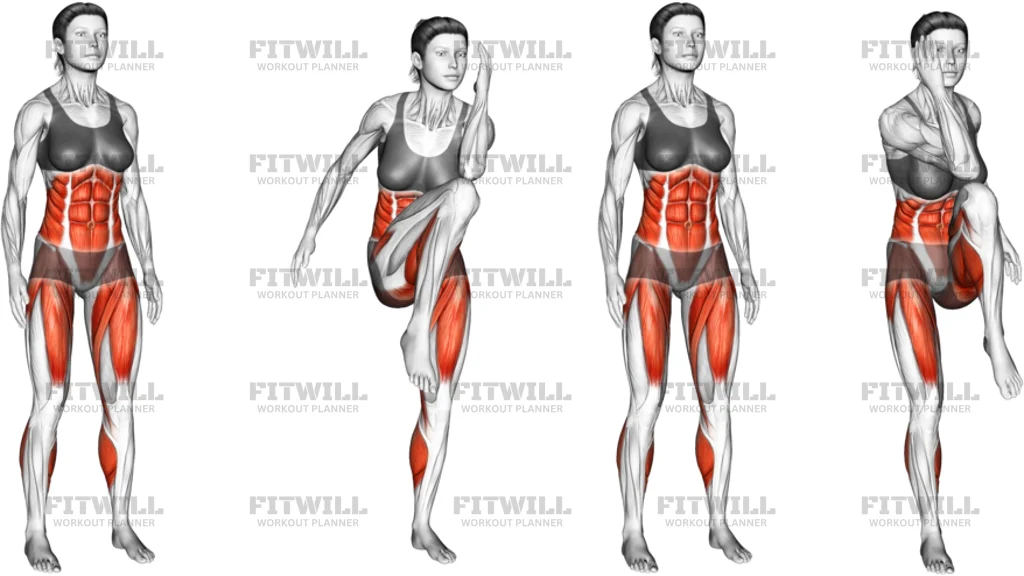
Instructions
- Stand tall with your feet about hip-width apart, shoulders relaxed, and your hands lightly beside your head or at chest height.
- Stack your ribs over your pelvis and brace your midsection so you do not lean back when the knee comes up.
- Shift your weight onto one leg and keep that standing foot planted flat with a soft knee.
- Drive the opposite knee upward toward the opposite elbow while you rotate your torso just enough to meet the knee.
- Crunch through your ribs and waist instead of pulling hard with your arms or neck.
- Lower the knee under control until the foot is close to the floor again, keeping tension in your core.
- Repeat on the same side or alternate sides rep by rep, depending on how the exercise is programmed.
- Exhale as you drive the knee up and inhale as you lower back to the start.
- Finish the set by bringing both feet down under you and standing tall before you walk away or reset.
Tips & Tricks
- Keep the movement crisp but not fast enough to bounce off the standing leg.
- Think elbow toward knee, not elbow slamming into thigh; the gap can stay small without forcing contact.
- If your shoulders creep up, lower the hands slightly so the neck does not take over.
- A tall chest with a slight forward crunch is better than folding at the waist.
- Keep the standing foot glued to the floor and avoid rolling onto the outside edge.
- Use a smaller knee lift if the hip flexors start cramping before the abs do.
- A wall or rack beside you can help if balance limits the quality of the crunch.
- Do not let the lifted knee drift wide; bring it through the center line so the obliques have to work.
- Slow the lowering phase if the rep turns into a leg swing on the way down.
Frequently Asked Questions
What muscles does Standing Air Bike work?
It mainly trains the abs, obliques, and hip flexors, with the standing leg and deeper core muscles helping you stay balanced.
Can beginners perform this exercise?
Yes. Beginners should keep the knee lift small, move slowly, and stand near a wall if balance is an issue.
Should my elbow touch my knee in Standing Air Bike?
No. Bringing them close is enough as long as the torso crunches and the opposite elbow tracks toward the raised knee.
Why do I feel Standing Air Bike more in my hip flexors than my abs?
That usually means the knee is lifting too high or the torso is staying too upright. Shorten the range and make the crunch more deliberate.
Is Standing Air Bike supposed to be a cardio exercise or a core exercise?
It can be either. Slower reps make it more of a core drill, while a quicker pace turns it into a conditioning move.
What should I do if I lose balance during Standing Air Bike?
Slow the tempo, keep the standing knee soft, and use a light touch on a wall or rack until the cross-body pattern feels stable.
Can I do Standing Air Bike without twisting my torso?
You can reduce the twist, but a small opposite-side rotation is what makes the movement work the obliques instead of just the hip flexors.
What is the most common mistake in Standing Air Bike?
The biggest mistake is swinging the knee up with momentum and pulling on the neck instead of controlling the crunch from the torso.