Standing Wheel Rollout
Standing Wheel Rollout is a bodyweight core exercise performed with an ab wheel from a standing hinge. It challenges anti-extension strength, trunk control, and the ability to keep the ribs, pelvis, and shoulders stacked while the wheel moves far away from the feet. Because the line of force gets longer as you roll out, small setup errors quickly turn into low-back arching or shoulder strain, so the start position matters as much as the finish.
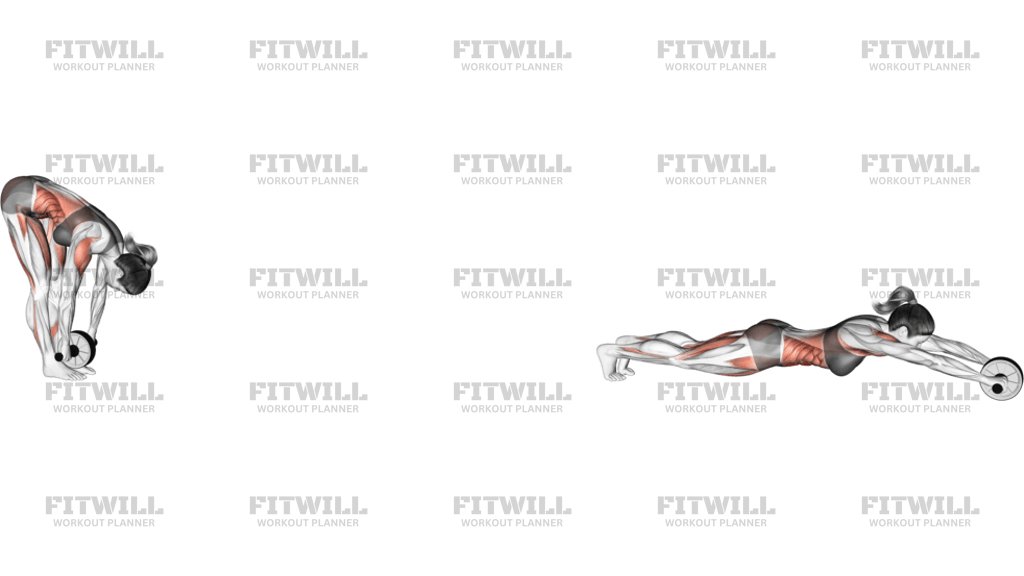
This movement is best understood as a long-lever plank that begins from standing rather than from the knees. In the image, the athlete folds at the hips, places the wheel under the shoulders, and then rolls forward until the body is nearly straight from shoulders to ankles. That extended position demands strong abdominal bracing, active lats, and stable shoulders so the torso does not collapse into the floor. It is a demanding drill, and the useful range is the range you can own without losing spinal position.
Set the feet about hip-width apart, keep the knees softly bent, and grip the wheel firmly with both hands. Hinge down with a neutral spine, then roll the wheel forward in a controlled line while the arms lengthen and the torso travels away from the feet. The goal is not to throw the wheel forward; the goal is to maintain tension through the entire chain while the body reaches its longest safe position. A short pause in the extended position can be useful only if the trunk stays braced and the pelvis does not tip forward.
On the way back, pull the wheel toward the feet by driving the abs, lats, and hip flexors together, not by yanking with the arms alone. Finish by returning to the standing hinge or standing start with control, then reset your breath before the next rep. This exercise fits well in a core block, accessory session, or a strength workout when you want a high-skill anti-extension challenge. It is not a place to chase ego reps; clean mechanics and a safe range of motion matter more than distance rolled.
Fitwill
Log Workouts, Track Progress & Build Strength.
Achieve more with Fitwill: explore over 9600 exercises with images and videos, access built-in and custom workouts, perfect for both gym and home sessions, and see real results.
Start your journey. Download today!




Instructions
- Stand hip-width with the ab wheel on the floor just in front of your toes and both hands gripping the handles.
- Hinge at the hips with a soft bend in the knees, keep your back long, and let your shoulders come over the wheel.
- Brace your abs, squeeze your glutes lightly, and set your ribs down before the first rollout.
- Roll the wheel forward in a straight line while your arms lengthen and your torso moves away from your feet.
- Keep pushing through the handles as far as you can without your low back arching or your hips dropping.
- Pause briefly in the longest position you can hold with a neutral spine and active shoulders.
- Pull the wheel back toward your feet by tightening the abs and lats, then fold back into the standing hinge under control.
- Reset your breath and posture before the next repetition.
Tips & Tricks
- Shorten the rollout distance if your ribs flare or your lower back starts to sag before the return.
- Keep the wheel tracking straight ahead; letting it drift sideways makes the shoulders and trunk fight the rep unevenly.
- Think about pulling the handles toward your hips on the way back so the abs, not the arms, own the return.
- A light exhale as the wheel moves forward helps keep the rib cage from popping up.
- Soft knees are useful, but do not turn the movement into a squat; the hinge should stay visible through the rep.
- Keep your neck in line with your spine instead of looking up at the wheel or tucking hard into the chest.
- If standing rollouts are too aggressive, reduce the range before you reduce quality.
- Stop the set when you lose shoulder position, because a collapsed upper back usually comes before a bad low-back arch.
Frequently Asked Questions
What makes the standing wheel rollout harder than a kneeling rollout?
The standing version uses a much longer lever, so the ab wheel can travel farther away from your base and the trunk has to resist more extension torque.
What should I feel working during this exercise?
You should feel the abs working hardest, with the lats, shoulders, and glutes helping keep the body organized as the wheel rolls out and back.
How far should I roll the wheel forward?
Only roll as far as you can keep your ribs down, your hips from sagging, and your back from arching; the exact distance will vary from person to person.
Can I bend my knees during the rollout?
A small bend is fine and often helpful, but the movement should still look like a controlled hip hinge rather than a deep squat.
Why does my lower back feel this exercise more than my abs?
That usually means the rollout is too long or the brace is fading, so shorten the range and keep the ribs and pelvis stacked before you reach forward.
Should the wheel stay in one line?
Yes, the wheel should travel straight ahead and straight back; side-to-side drift usually points to uneven shoulder pressure or a weak brace.
Is this exercise good for beginners?
Most beginners should start with a kneeling rollout or a partial standing range before attempting the full standing version.
How do I know when to end the set?
End the set when you can no longer control the return, keep the shoulders active, or hold a neutral spine through the farthest part of the rollout.