Kettlebell One-Arm Clean
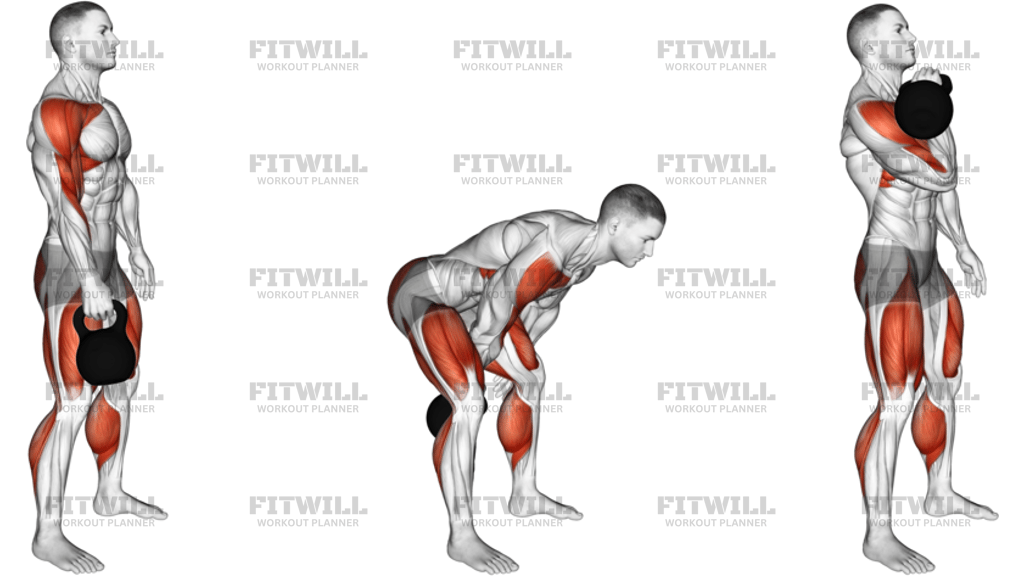
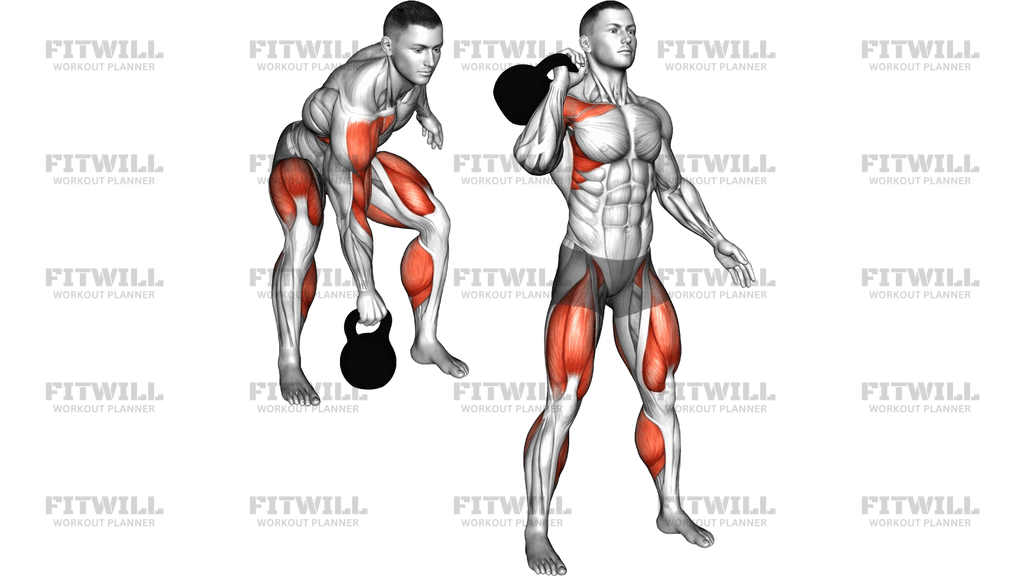
The kettlebell one-arm clean teaches you how to move a bell from a low hinge into a solid front-rack position without letting it swing wide or slam into the forearm. It is a power and coordination exercise more than a pure strength lift, combining hip drive, timing, grip control, and shoulder stability in one compact pattern. The image shows a single-arm clean from a low start into the rack, so the key job is to keep the bell close and let the hips create the lift.
This movement trains the posterior chain, upper back, forearm, and trunk to work together while one side of the body carries the load. The glutes and hamstrings initiate the drive, the core resists rotation, and the shoulder stabilizes the rack position. Because the exercise is unilateral, it also exposes side-to-side differences in control, timing, and bracing that can be hidden in two-handed kettlebell work.
Set up with the feet about hip-width, the bell slightly in front of you, and the torso folded into a strong hinge before the rep begins. From there, the clean should feel like a tight zipper path: the bell floats up close to the body, the elbow folds, and the hand slips around the handle so the bell lands softly in the rack. If the bell loops outward or the wrist gets crushed at the catch, the bell is probably being lifted with the arm instead of being redirected by the hips.
A good rep finishes with the bell resting on the forearm and upper arm near the front of the shoulder, elbow tucked, wrist straight, and ribs controlled. Lower the bell the same way you brought it up, then reset the hinge before the next rep. This makes the clean useful for strength complexes, athletic conditioning, and skill work where crisp repetitions matter more than fatigue. Start light enough to keep the catch quiet and repeatable, then build load only after the path stays tight and the rack stays stable.
Fitwill
Log Workouts, Track Progress & Build Strength.
Achieve more with Fitwill: explore over 9600 exercises with images and videos, access built-in and custom workouts, perfect for both gym and home sessions, and see real results.
Start your journey. Download today!




Instructions
- Stand with the kettlebell on the floor just in front of your midfoot, feet about hip-width apart, and hinge down to grip the handle with one hand.
- Set your free arm slightly out to the side for balance, keep your chest long, and load your hips while your shins stay fairly vertical.
- Brace your trunk before the bell leaves the floor so the rep starts from a stable hinge instead of a loose squat.
- Drive through the floor and extend the hips sharply to send the bell upward in a tight line close to your body.
- As the bell rises past your hips, keep the elbow close and guide the handle so the bell stays near your centerline instead of looping away from you.
- Let the bell roll around the hand into the front rack, finishing with the wrist straight, elbow tucked, and the kettlebell resting softly against the forearm and upper arm.
- Hold the rack long enough to feel balanced, then lower the bell under control by guiding it back down the same close path.
- Reset the hinge between reps, breathe on the drive, and repeat for smooth, quiet clean reps.
Tips & Tricks
- Think hip snap, not arm curl; the bell should feel like it is floating because of the hinge, not because you lift it with the biceps.
- Keep the bell close enough that it nearly brushes your shirt on the way up; a wide arc usually leads to a hard forearm catch.
- If the rack is painful, check that your wrist is neutral and the bell is rotating around the hand rather than crashing over the top.
- Use the free hand as a counterbalance, but do not let the torso twist toward the working side.
- A softer catch usually comes from a stronger hip drive, not a higher pull; finish tall, then let the bell settle.
- Do not squat the clean unless the exercise has been intentionally modified; the hinge should stay clear and loaded in the hips.
- Exhale as the bell snaps upward and inhale briefly in the rack before lowering it again.
- Start with a bell you can keep quiet through several crisp singles before you try longer sets or heavier loading.
Frequently Asked Questions
What does the kettlebell one-arm clean train?
It mainly trains hip drive, trunk control, grip strength, and shoulder stability while teaching you to move the bell into a stable front-rack position.
Is the rack supposed to rest on my forearm?
Yes, the kettlebell should settle softly against the forearm and upper arm in the front rack, with the wrist straight and the elbow close to the body.
Why does the kettlebell bang my wrist?
That usually means the bell is looping too far from the body or the hand is not rotating around the handle soon enough. Keep the path tight and let the hips do more of the work.
Can I learn this exercise as a beginner?
Yes, but it should be practiced with a light bell and slow singles first so you can learn the hinge, timing, and catch before adding speed or load.
What is the difference between a clean and a swing?
A swing finishes with the bell traveling freely, while a clean redirects that same hip-driven momentum into the front rack.
Should I pull with my arm?
No. The arm guides the bell, but the hips create the force. If the rep feels like a curl, the bell is too far from the body or the load is too light for the pattern you are trying to learn.
How many reps should I do?
Most people do better with crisp singles or small sets per side, especially when technique is the priority.
What are the most common mistakes?
The biggest errors are looping the bell away from the body, catching with a bent wrist, twisting the torso, and turning the clean into a squat instead of a hinge.