Leg Front Kick
Leg Front Kick is a standing bodyweight kicking drill that trains hip flexion, quadriceps control, and trunk stability. It looks simple, but the quality of the rep depends on whether you can lift the knee, extend the lower leg, and recover without leaning back or twisting. Done well, it develops balance, coordination, and quick control through the front of the hip and thigh.
The setup matters because the standing leg has to do more work than people expect. Start with feet hip-width, torso tall, and the ribs stacked over the pelvis so the kick comes from the leg instead of the low back. If you let the hips open or the chest drift backward before the leg moves, the kick becomes harder to control and the support side loses stability.
Each rep should feel like a compact sequence: lift the knee, keep the hips square, extend the lower leg forward, then recoil the leg before you place the foot down. That order keeps tension on the front of the hip and thigh while the core and standing leg organize the body. A clean front kick is crisp at the top, but it still comes back under control rather than snapping and dropping.
Leg Front Kick is useful as a warm-up, a coordination drill, a martial-arts style conditioning movement, or a low-equipment lower-body accessory. It can also expose side-to-side balance differences because each leg has to stabilize and kick separately. Keep the kick in a pain-free range, lower the height if your pelvis tips or your back arches, and use a wall support if balance is the main limiter.
Fitwill
Log Workouts, Track Progress & Build Strength.
Achieve more with Fitwill: explore over 9600 exercises with images and videos, access built-in and custom workouts, perfect for both gym and home sessions, and see real results.
Start your journey. Download today!




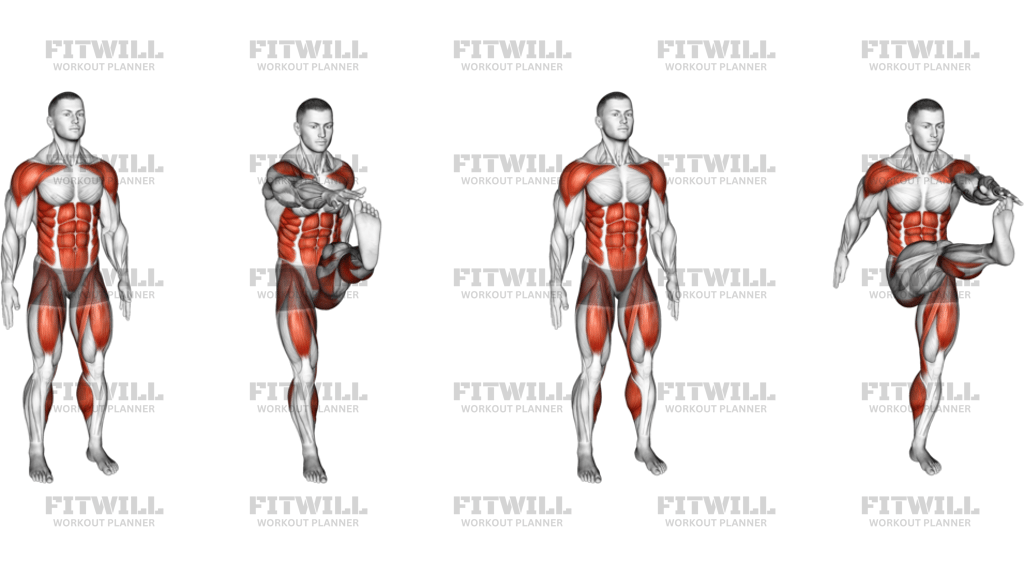
Instructions
- Stand tall with your feet about hip-width apart, knees soft, and your weight centered over the standing leg.
- Raise your hands in front of your chest or slightly out to the sides for balance, then brace your midsection.
- Shift your weight onto one foot and bring the opposite knee up in front of your hip without leaning back.
- Hold the thigh lifted, square the hips forward, and pull the kicking foot back so the toes stay up.
- Extend the lower leg forward in a controlled snap until the foot reaches about waist height or the range you can keep clean.
- Pause briefly at the top with the standing leg stable and the torso upright.
- Recoil the lower leg back under the thigh first, then lower the foot to the floor under control.
- Reset your stance, switch sides, or repeat on the same side for the planned reps.
Tips & Tricks
- Keep the standing knee slightly bent so small balance shifts do not turn into a hop.
- Lift the knee first; kicking from a low swing usually turns the rep into momentum.
- Square both hip points toward the front so the kick stays straight instead of sweeping across the body.
- Pull the toes back so the lower leg stays active and the kick finishes cleanly.
- Stop the kick at the height you can control without leaning your torso backward.
- Return the foot by folding the knee first instead of letting the leg drop.
- Use a wall or rack lightly for balance if the standing foot keeps twisting.
- Exhale as the lower leg extends, then inhale as you bring the foot back down.
Frequently Asked Questions
What muscle does Leg Front Kick target most?
It mainly challenges the hip flexors, quadriceps, and core, while the standing leg and glutes work hard to keep you balanced.
Can beginners perform this exercise?
Yes, as long as you keep the kick low and controlled. Beginners should practice the knee lift and return first before trying a higher snap.
Should I hold onto something while doing Leg Front Kick?
You can use a wall, post, or rack with one hand if balance is limiting the movement. Light support is better than twisting through the torso to stay upright.
How high should I kick?
Kick only as high as you can keep your torso tall and your hips square. Waist height is enough for most people; higher is not better if it makes you lean back.
Should my supporting knee be locked?
No. Keep the standing knee soft so you can stay stable and avoid jarring the joint when the kicking leg returns to the floor.
Do I point my toes or pull them back?
For this version, pull the toes back so the front of the foot stays active and the lower leg lines up cleanly. That helps keep the kick controlled and crisp.
What is the most common mistake?
People usually swing the leg from the hip or arch the low back to make the kick look bigger. The cleaner rep starts with a knee lift, then a straight extension, then a controlled recoil.
Can I do Leg Front Kick slowly?
Yes. Slower reps are useful for balance and control, especially if you pause at the top and bring the leg back under the thigh before lowering it.